
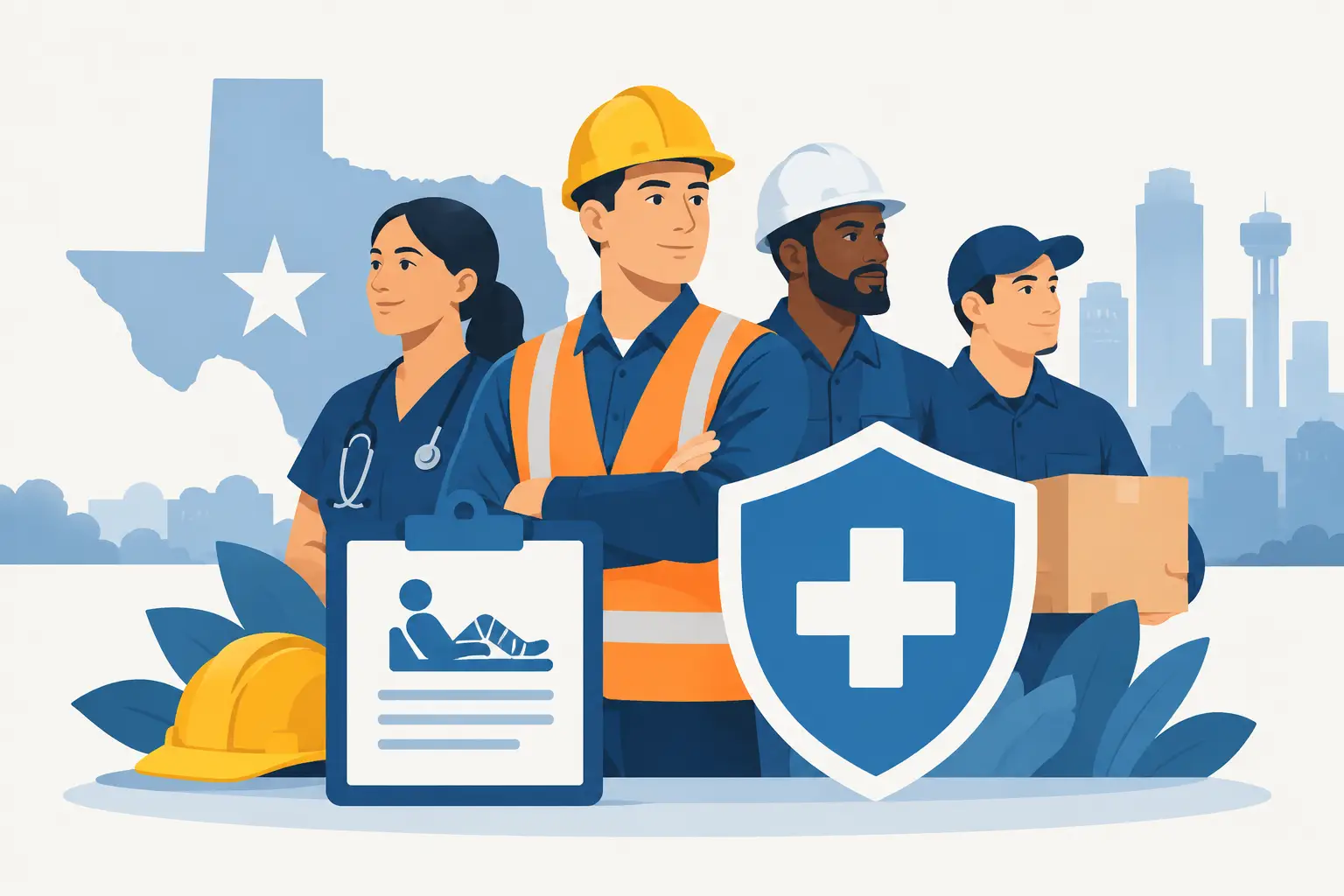
A workplace injury can change a normal business day in a moment. An employee may slip while unloading supplies, strain a shoulder on a jobsite, or be hurt in a vehicle accident while making a delivery. Workers compensation insurance gives Texas employers a practical way to respond with care for the employee and a plan for the business.
For a small business owner, this coverage is not just another line on an insurance checklist. It can help pay for medical care and income benefits after a covered work-related injury or illness, while helping protect the company from the financial uncertainty that can follow an accident. The right policy depends on what your employees do, where they work, and the risks they face each day.
How Workers Compensation Insurance Works
Workers’ compensation is designed to provide defined benefits when an employee is injured or becomes ill because of their job. When a covered claim is accepted, the policy may pay for reasonable medical treatment, a portion of lost wages, rehabilitation services, and certain death benefits. In exchange, workers’ compensation generally limits an employee’s ability to sue an employer for a covered workplace injury.
That structure matters when an accident happens. Instead of trying to sort out medical bills, missed paychecks, and legal questions all at once, the employee and employer have a clear claims process to follow. It does not erase the stress of an injury, but it gives everyone a place to start.
Coverage is typically intended for employees, not independent contractors. The distinction can be complicated, especially in construction, trucking, oilfield support, and other industries that rely on subcontractors or temporary labor. Calling someone a contractor does not always settle the question. A business should review its worker relationships carefully rather than make assumptions based only on a job title or a 1099 form.
Is Workers Compensation Insurance Required in Texas?
Texas is different from many states. Most private employers are not required by state law to carry workers’ compensation insurance. However, choosing not to carry it can create serious financial and legal exposure, and some businesses must have coverage to meet a contract, lease, client requirement, or government project requirement.
Many general contractors require subcontractors to show proof of workers’ compensation before stepping onto a jobsite. Larger customers may ask for it before awarding work. A business without coverage can find itself unable to compete for projects it is otherwise qualified to perform.
Texas employers that choose not to subscribe to workers’ compensation have specific notice and reporting responsibilities. They may also lose certain legal protections that subscribers receive if an employee brings an injury claim. This is one reason many employers view workers’ compensation as a business stability decision, not simply a compliance expense.
The choice deserves a conversation based on your actual operations. A one-person office with limited physical exposure has different concerns than a roofing crew, a landscaping company, a repair shop, or a delivery business with employees driving across West Texas each day.
What a Policy May Cover After an Injury
Every claim is evaluated based on the policy, the facts of the injury, and applicable Texas rules. Still, workers’ compensation coverage commonly addresses several major costs that could otherwise fall on an employer or injured worker.
Medical benefits can help with doctor visits, hospital care, prescriptions, surgery, physical therapy, and other treatment related to a covered injury. Income benefits may help an employee who cannot work or who has lasting impairment after the injury. If a workplace accident is fatal, the policy may provide benefits to eligible family members.
Employers also receive help through the claims process. The insurance carrier investigates the claim, manages eligible benefits, and may provide return-to-work resources. A thoughtful return-to-work plan can be valuable for everyone. An employee may be able to perform modified duties while recovering, and the business may keep an experienced team member engaged rather than losing them completely.
There are limits. Injuries that occur outside the course and scope of employment may not be covered. Intentional self-inflicted injuries, incidents involving certain misconduct, or injuries that happen while an employee is off duty can raise coverage questions. That is why prompt reporting and accurate documentation matter so much.
Who Should Consider Coverage?
Any employer with employees should consider workers’ compensation, but the need is especially clear where physical work, driving, customer locations, tools, machinery, lifting, or hazardous materials are part of the job. In San Angelo and across the surrounding area, that includes many contractors, trades, agricultural operations, restaurants, retail businesses, service companies, and transportation-focused employers.
Office-based businesses should not assume they have no exposure. An employee can be injured in a fall, while traveling for work, or while handling routine tasks. The likelihood may be lower than it is for a construction crew, but a single claim can still be costly and disruptive.
A policy can also send a meaningful message to your team. Employees want to know their employer has a plan if someone gets hurt. Coverage cannot prevent every accident, but it shows that the business is prepared to take care of people when something goes wrong.
What Affects Workers Compensation Insurance Cost?
Premium is not one-size-fits-all. Insurers look closely at payroll, job classifications, the type of work performed, prior claims, and the company’s safety practices. A bookkeeping employee and a welder should not be rated the same way because their day-to-day risks are very different.
Accurate payroll and job classifications are essential. If employees perform more than one type of work, the details matter. Putting every worker in a higher-risk classification can raise the premium unnecessarily. On the other hand, classifying workers too broadly or inaccurately can lead to problems during a premium audit or after a claim.
Claims history also affects cost. A business with frequent injuries may pay more because the carrier sees a greater likelihood of future losses. That does not mean an employer with prior claims cannot find coverage. It does mean the agency should understand the full story, including the changes the business has made to improve safety, training, supervision, or equipment.
The lowest quote is not always the best fit. Consider the carrier’s claims service, workplace safety resources, audit process, payment options, and experience with your industry. A policy that appears inexpensive at the start can become frustrating if the classification, payroll estimate, or service level does not match your business.
Steps That Help Protect Your Team and Your Business
Insurance works best alongside practical safety habits. Clear training, maintained equipment, documented procedures, and regular conversations about hazards can reduce injuries before a claim ever begins. Owners do not need a complicated safety program to start making progress. They need consistent expectations that fit the work being done.
When an injury occurs, respond quickly. Make sure the employee receives appropriate care, report the incident according to your policy requirements, preserve any relevant information, and stay in respectful communication. A delayed report can make a difficult situation harder for both the employee and the business.
It also helps to review coverage before a new contract, new service line, or hiring push. Adding a crew, purchasing vehicles, taking on a larger job, or expanding into more physical work can change your exposure. Insurance should keep pace with the business, not trail behind it.
Choosing Coverage With Local Guidance
Workers compensation insurance has real consequences for your employees, your contracts, and your ability to keep moving after an accident. You deserve clear answers about what a policy covers, what it costs, and whether it meets the requirements of the work you are pursuing.
An independent agency can compare available carrier options and help match coverage to your payroll, job duties, industry, and budget. At San Angelo Insurance, the goal is to listen first and help local employers make a decision they can feel good about. Taking time to review your options before an injury happens is one practical way to care for the people who help build your business.
