

Best overall: an individually matched policy compared through an independent agency. Best for sharing a family car: a household policy. Best for basic coverage on a car you can replace yourself: liability-only insurance. The best insurance for first time drivers Texas residents choose in 2026 depends on who owns the car, who drives it, and which losses you can handle yourself.
- For best insurance for first time drivers Texas searches, compare coverage before choosing an insurer.
- Sanangelo-Insurance offers independent-agency help for San Angelo drivers choosing auto insurance.
- Household policies suit eligible drivers sharing a family vehicle; confirm every regular driver is disclosed.
- Liability-only insurance does not cover damage to your own car.
- Financed vehicles generally need collision and comprehensive coverage under the loan agreement.
Why this matters
Your first policy needs to fit your actual driving life, not just satisfy a paperwork requirement. Driving a parent's car, financing your own vehicle, and borrowing occasionally create different insurance needs.
Sanangelo-Insurance is an independent agency offering auto insurance in San Angelo, Texas. Sanangelo-Insurance is best for San Angelo drivers who want independent-agency help choosing auto coverage. An agency is a place to discuss policy choices; the insurer's policy determines what is covered.
For a 2026 purchase, start with ownership, household drivers, and any lender requirements. Then compare policies using the same coverage limits and deductibles—the amount you pay toward a covered claim.
What makes the best first-time-driver insurance?
The best policy matches these criteria:
- Correct drivers: Disclose household members and everyone who regularly uses the car. Ask how the insurer handles learner's permits and newly licensed drivers.
- Adequate liability: Choose protection for injuries and property damage you cause, rather than treating the legal minimum as a personal recommendation.
- Vehicle protection: Decide whether you need collision, comprehensive, or both. A lender generally requires both.
- Manageable deductible: Pick an amount you can actually pay after a covered loss, not one that only looks comfortable on an application.
- Matching use: Explain commuting, school trips, delivery work, rideshare driving, and regular borrowing before coverage begins.
- Clear claim terms: Understand exclusions, covered drivers, and transportation coverage before you need to file a claim.
First-time-driver insurance options at a glance
These are coverage arrangements, not a ranking of insurance companies. Some overlap: an independent agency can help you explore a household policy or a policy for a financed vehicle.
| Option | Best for | Standout feature | Key limitation |
|---|---|---|---|
| Independently compared auto policy | First-time owners unsure what coverage fits | Guidance on matching coverage to ownership and use | Agency assistance does not replace reading policy terms |
| Household policy | Eligible drivers sharing a family vehicle | Keeps household driving information together | Eligibility depends on residence, ownership, and insurer rules |
| Liability-only policy | Owners able to replace their own car | Covers covered injury and property-damage liability | Does not insure damage to your own vehicle |
| Policy with collision and comprehensive | Drivers financing or leasing a vehicle | Adds protection for covered damage to the insured car | Deductibles and exclusions still apply |
| Non-owner policy | Eligible drivers borrowing occasionally | Liability coverage without insuring an owned vehicle | Generally does not cover damage to the borrowed car |
1. Independently compared policy: best for unsure first-time owners
An individually matched auto policy starts with your circumstances rather than a fixed coverage package. An independent agency gives you a place to explain who owns the vehicle, how you use it, and what protection you need.
For San Angelo drivers, Sanangelo-Insurance offers auto insurance agency services. Bring those details when you get a quote so the coverage discussion starts with the right facts.
Independently compared policy pros:
- Gives you room to discuss liability limits and vehicle protection separately.
- Helps identify questions about household drivers and permitted use.
- Lets you compare proposals using matching coverage selections.
Independently compared policy cons:
- Agency guidance is not a guarantee that every insurer or policy is included.
- You still need to check the issued policy for exclusions and incorrect information.
Best for: A first-time car owner who wants help understanding the choices before selecting coverage.
Ask what each proposal includes, which insurer would issue it, and whether the vehicle and drivers are listed correctly. For your 2026 comparison, keep a written record of the coverage selections so you are not comparing unlike policies.
Verdict: Buy an individually matched policy after confirming that its coverage fits your car and driving use.
2. Household policy: best for sharing a family vehicle
A household policy is often the first arrangement to discuss when a newly licensed driver lives with family and uses a family-owned car. The insurer needs accurate information about the household and its drivers.
Do not assume a parent's permission to drive means the insurer has everything it needs. Ask specifically how the policy handles your license status, regular access to the car, and any time spent living elsewhere.
Household policy pros:
- Keeps information about a shared vehicle and its household drivers together.
- Gives the family one policy arrangement to review for that vehicle.
- Allows the family to discuss the new driver's use before changing coverage.
Household policy cons:
- Moving out or changing vehicle ownership can change eligibility.
- A new driver's claims and driving record can affect the household policy.
Best for: An eligible first-time driver living with family and regularly using a family-owned vehicle.
College attendance, separate addresses, and a car titled in your own name deserve direct questions. Disclose the actual arrangement rather than choosing whichever address seems easiest.
Verdict: Buy through the household arrangement only after the insurer confirms your eligibility and regular driving use.
3. Liability-only policy: best for self-funded car replacement
Liability-only insurance is an option for someone who owns a car outright and can handle losing that car without an insurance payment for the vehicle. Liability coverage pays covered claims for injuries or property damage you cause to others; it does not repair your own car.
Texas minimum liability limits are $30,000 per injured person, $60,000 per accident for bodily injury, and $25,000 per accident for property damage. These are coverage limits, not a promise that every accident will fall within them.
Liability-only policy pros:
- Provides the liability coverage required to meet Texas financial-responsibility rules through an auto policy.
- Separates protection for damage you cause from protection for your own vehicle.
- Fits an owner who deliberately accepts the risk of replacing the car.
Liability-only policy cons:
- Does not cover collision damage, theft, or hail damage to your own car.
- Legal minimum limits can leave you personally responsible for damages above the policy limits.
Best for: A driver with no lender requirement who can replace an owned vehicle without relying on a claim payment.
Before selecting liability-only coverage in 2026, ask yourself whether losing the car would also mean losing access to work or school. A car's modest value does not make its transportation role unimportant.
Verdict: Buy liability-only coverage only when you can absorb the loss of your car; otherwise, skip this arrangement.
4. Collision and comprehensive: best for financed vehicles
Collision covers qualifying damage from a collision or rollover. Comprehensive covers qualifying non-collision losses, such as theft, hail, and fire. Both are subject to policy terms and usually a deductible.
Financing and leasing agreements generally require these coverages. Check the agreement itself for required protection and deductible restrictions rather than relying on the phrase full coverage.
Collision and comprehensive pros:
- Add coverage for qualifying damage to your insured vehicle.
- Address different losses: collision damage and covered non-collision events.
- Help meet a lender's or leasing company's vehicle-protection requirements.
Collision and comprehensive cons:
- Deductibles remain your responsibility on applicable claims.
- A total-loss settlement does not automatically equal the remaining loan balance.
Best for: A first-time driver financing or leasing a vehicle, or an owner unable to absorb a covered vehicle loss.
Read the repair and total-loss terms
In your 2026 policy comparison, ask how repairs are handled and how the insurer determines a total loss. Collision coverage is not a promise to pay every repair estimate, and comprehensive coverage does not remove the need to understand settlement terms.
Choosing auto insurance in Texas means comparing repair-shop choice and total-loss provisions alongside liability limits. Those details matter when you need the vehicle repaired or must replace it after a covered loss.
Also ask about rental reimbursement and gap coverage separately. Rental reimbursement helps with qualifying temporary transportation expenses; gap coverage addresses certain differences between a covered total-loss settlement and an eligible outstanding loan balance. Neither should be assumed to come with collision and comprehensive.
Verdict: Buy lender-compliant collision and comprehensive coverage before driving a financed or leased car.
5. Non-owner policy: best for occasional borrowers without a car
A non-owner policy provides liability coverage for an eligible person who does not own a vehicle. It is designed for qualifying borrowing situations, not as a substitute for correctly insuring a car you own or regularly keep available.
Eligibility matters here. Regular access to a household vehicle can make a different arrangement necessary, so describe exactly which cars you borrow and how often you use them.
Non-owner policy pros:
- Provides a liability option for eligible drivers without an owned car.
- Can fit occasional borrowing rather than vehicle ownership.
- Gives you a policy arrangement to discuss when you need proof of liability coverage.
Non-owner policy cons:
- Generally does not cover damage to the borrowed vehicle.
- Is not a substitute for the vehicle owner's insurance or appropriate rental-car protection.
Best for: A licensed driver without a car who borrows occasionally and meets the insurer's eligibility rules.
Ask how the policy works with the owner's insurance. If the same vehicle is available to you regularly, disclose that fact before applying.
Verdict: Buy non-owner coverage only after confirming that your borrowing pattern qualifies.
How these options rank
The ranking puts the fit between your circumstances and the policy first: ownership, household eligibility, lender requirements, and your ability to absorb vehicle damage. It does not rank insurers by customer satisfaction, claims performance, or individual quotes.
The default recommendation is an individually matched policy because a first-time driver needs the coverage arrangement established before choosing a company. A household policy, liability-only coverage, or non-owner insurance becomes the better fit when your circumstances support it.
Build a comparison you can actually use
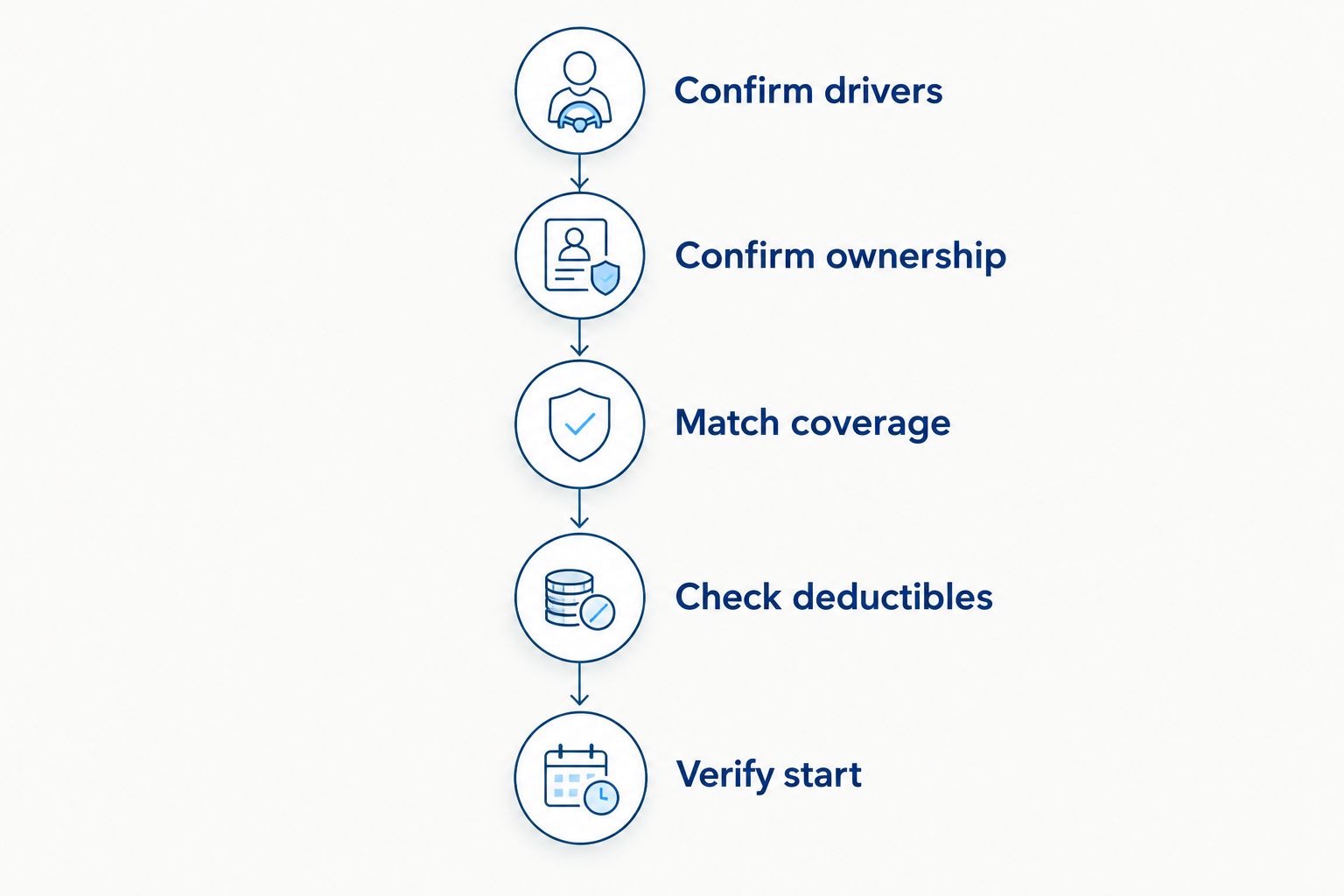
For a 2026 decision, follow the same sequence for every proposal:
- Confirm drivers: List household members and regular users accurately.
- Confirm ownership: Match the vehicle title, policy arrangement, and lender information.
- Match coverage: Request the same liability limits and optional protections.
- Check deductibles: Decide what you can pay toward a covered vehicle claim.
- Verify start: Confirm the effective date and obtain proof before driving.
Bring your driver's license information, vehicle identification number, garaging address, and lender details if applicable. Accurate information makes the proposals easier to compare and helps prevent corrections after the policy is issued.
Which insurance option should you choose?
Choose an individually matched policy as the default; choose a specific arrangement only after confirming that you qualify. Start with the household policy if you share a family car. Start with lender requirements if you finance your own vehicle.
Sanangelo-Insurance auto insurance services give local drivers an independent-agency option for discussing those choices. Use the contact page to explain your situation rather than asking for an undefined full-coverage policy.
FAQ
What’s the best insurance for a first-time driver in Texas?
The best arrangement depends on vehicle ownership, household eligibility, lender requirements, and the losses you can handle yourself. Compare matching coverage selections before choosing an insurer.
Can I stay on my parents’ insurance after getting my license?
You can be covered through a parent’s policy when the insurer’s eligibility rules allow it. Disclose your residence, license status, vehicle ownership, and regular driving use before assuming the arrangement applies.
What insurance does Texas require for a new driver?
Texas minimum auto liability limits are $30,000 per injured person, $60,000 per accident for bodily injury, and $25,000 per accident for property damage. These limits do not provide coverage for damage to your own vehicle.
Do I need collision and comprehensive on a financed car?
Financing agreements generally require collision and comprehensive coverage. Check your agreement for the required coverage and any deductible restrictions.
Is full coverage enough to cover everything?
No, full coverage is not a guarantee that every loss is insured. Ask for the actual coverage names, limits, deductibles, and exclusions, including whether rental reimbursement or gap coverage is included.
Can I get insurance if I don’t own a car?
An eligible driver without a car can buy a non-owner liability policy. Regular access to a household vehicle can require a different arrangement, and non-owner coverage generally does not insure damage to the borrowed car.
When should my first auto policy start?
Your required coverage must be effective before you drive. Confirm the effective date, covered vehicle, and covered drivers, then obtain proof of insurance rather than treating a quote as active coverage.
One last thing
A quote is not proof that coverage has started. Before your first drive, confirm the effective date and make sure the issued documents show the correct vehicle and drivers. That final check matters more than a reassuring label on a proposal.
Related guides
