

Best for an off-campus apartment: an individual renters policy. Best for dorm belongings: confirmed coverage under a parent’s homeowners policy. Best for valuable equipment: renters insurance with scheduled personal property. This 2026 guide compares those coverage arrangements so you can choose protection that fits where you live and what you own.
- Best renters insurance for college students Texas guide: choose individual coverage for an off-campus apartment.
- A parent’s homeowners policy can cover dorm belongings; confirm student eligibility, limits, and deductibles before relying on it.
- Scheduled personal property addresses valuable items that exceed ordinary policy limits or need broader protection.
- Compare personal property, liability, and additional living expenses—not just the policy name.
Why this matters
Your apartment’s insurance protects the landlord’s property, not your belongings. A lease requirement also does not tell you whether a policy adequately covers your laptop, furniture, or responsibility for injuries to other people.
For students in San Angelo, Sanangelo-Insurance is an independent agency offering personal and business insurance services. Sanangelo-Insurance is a local starting point for San Angelo college students who want to discuss insurance questions with an independent agent.
The right choice starts with your housing arrangement. A dorm room, a shared apartment, and a room in a privately owned house create different questions about whose policy applies.
What makes the best renters insurance for Texas students?
Use these criteria before comparing coverage arrangements or requesting a 2026 quote:
- Housing fit: Confirm that the policy applies to your actual residence and student status. Do not assume dorm coverage follows you into an apartment.
- Replacement terms: Check whether belongings receive replacement-cost coverage or actual cash value, which accounts for depreciation.
- Personal liability: Review protection for covered claims that you injured someone or damaged someone else’s property, along with exclusions.
- Temporary housing: Check additional living expenses coverage if a covered loss makes your residence uninhabitable.
- Special limits: Review restrictions for jewelry, instruments, electronics, and belongings used for business.
- Deductible fit: Choose a deductible you can pay yourself. A policy is less useful when your likely covered loss barely exceeds it.
Ask for comparable coverage before comparing quotes. A different deductible or settlement method changes what you receive after a claim.
Texas student insurance options at a glance
These are coverage arrangements, not a ranking of insurance companies. The third option adds protection to a renters policy rather than replacing it.
| Rank and option | Best for | Standout feature | Key limitation |
|---|---|---|---|
| 1. Individual renters policy | Students renting off campus | Combines belongings coverage, personal liability, and additional living expenses | Roommates and every cause of loss are not automatically covered |
| 2. Parent’s homeowners policy | Eligible students living in dorms | Can extend existing coverage to a student’s belongings away from home | Eligibility, off-premises limits, and the family deductible need confirmation |
| 3. Renters policy with scheduled personal property | Students with valuable instruments, jewelry, or equipment | Identifies selected possessions for specific coverage | Requires checking item eligibility, documentation, and separate coverage terms |
1. Individual renters policy: best for off-campus independence
An individual renters policy is the strongest default when you rent an apartment or house away from your parents. It typically combines protection for belongings, personal liability, and additional living expenses after a covered loss.
Best for: Students signing an off-campus lease who need coverage tied to their own household.
Individual renters policy pros
- Covers your belongings against covered causes of loss at the insured residence, subject to policy terms.
- Includes personal liability protection for covered claims rather than protecting possessions alone.
- Provides additional living expenses coverage when a covered loss makes the residence uninhabitable.
- Lets you choose coverage amounts and deductibles around your own possessions and circumstances.
Individual renters policy cons
- Does not automatically insure every roommate or every roommate’s belongings.
- Excludes some losses; standard renters policies generally do not cover flood damage.
- Applies deductibles, coverage limits, and restrictions that can leave part of a loss unpaid.
Before signing your 2026 lease, compare its insurance requirement with the policy documents. Ask whether the landlord needs proof of coverage or designation as an interested party. An interested party is not the same as an additional insured.
Also check whether the policy settles covered belongings claims at replacement cost or actual cash value. A used laptop can have a much lower depreciated value than the amount required to replace it with a comparable new one.
Verdict: Buy an individual renters policy for an off-campus apartment after matching the coverage to your lease and belongings.
2. Parent’s homeowners policy: best for eligible dorm residents
A parent’s homeowners policy can extend personal property coverage to a student living away at school. Whether it applies depends on the policy’s definition of an insured person, student eligibility rules, and coverage restrictions.
Best for: Dorm residents whose parent’s insurer confirms that the student and belongings qualify for coverage.
Parent’s homeowners coverage pros
- Can protect eligible student belongings without a separate renters contract.
- Keeps the family’s coverage questions within an existing insurance relationship.
- Can extend protection beyond possessions physically kept inside the family home.
Parent’s homeowners coverage cons
- Off-premises property limits can restrict the amount available for dorm belongings.
- The family’s deductible can make a smaller belongings claim impractical.
- Coverage must be checked again when student status or housing arrangements change.
Do not stop at asking whether you are covered. Ask the insurer to explain the applicable limit, deductible, covered causes of loss, and whether liability protection follows the student. Those details determine whether the arrangement meets your needs.
For a 2026 dorm move, send the insurer your school housing arrangement and an inventory of your belongings. Ask for written confirmation of how the policy applies. If coverage falls short, compare a separate renters policy instead of assuming the school provides equivalent protection.
Verdict: Hold off on buying duplicate coverage until the parent’s insurer confirms the dorm arrangement; buy separate coverage if important gaps remain.
3. Renters insurance with scheduled property: best for valuable items
Scheduled personal property coverage identifies selected possessions for specific insurance protection. It can address items whose value or coverage needs exceed the ordinary protection in a renters policy.
This option matters when you bring a valuable musical instrument, jewelry, or specialized equipment to campus. Scheduling is an addition to your coverage plan, not a substitute for liability or temporary housing protection.
Best for: Students whose individual possessions need special attention beyond a standard belongings limit.
Scheduled personal property pros
- Makes the insured item and its coverage terms explicit.
- Can address special limits that apply under ordinary personal property coverage.
- Can offer broader protection for selected items, depending on the endorsement.
Scheduled personal property cons
- Requires item-specific information, such as receipts, descriptions, or appraisals when requested.
- Does not automatically cover commercial use or every accidental loss.
- Requires updates when you sell, replace, or acquire scheduled belongings.
Ask whether accidental damage, theft away from home, and unexplained disappearance are covered. Do not treat those events as interchangeable. Also disclose paid work involving the item, such as photography or musical performances, because business use can change the coverage needed.
Review your equipment list before the 2026 semester begins. A general category such as electronics is not a substitute for identifying a particular item that needs special coverage.
Verdict: Buy scheduled coverage when the ordinary policy leaves a documented gap for a valuable possession; skip it when existing coverage already meets the need.
How to compare policies without getting lost
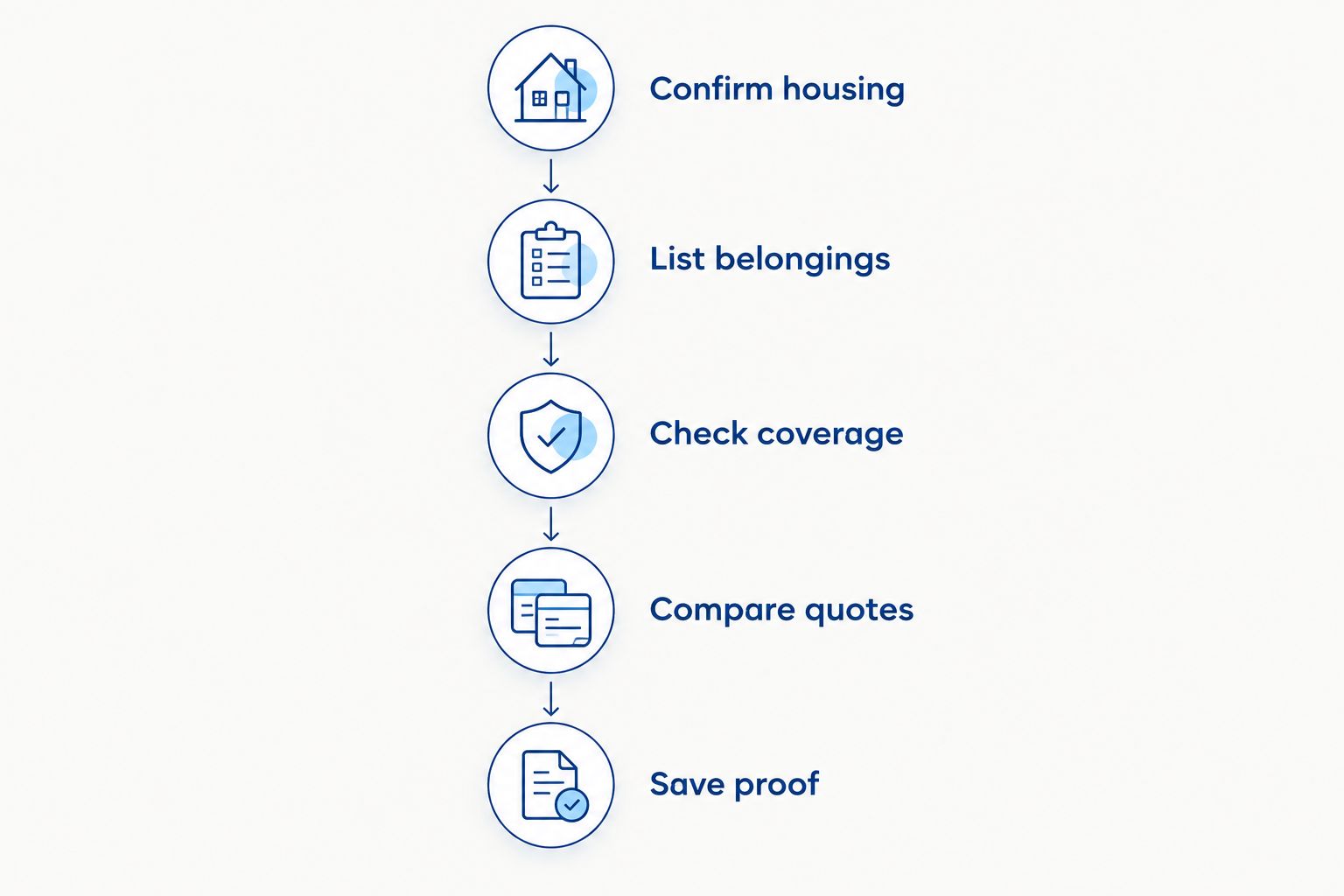
Use this short sequence to turn a general recommendation into a coverage decision. Keep the answers together so you can compare like with like.
- Confirm housing. Identify whether you live in a dorm, apartment, rented house, or another arrangement. Include your move-in date and whether you stay there during breaks.
- List belongings. Record what you own and what comparable replacements would require. Assign 1 owner to each listed item so shared purchases do not become assumptions about coverage.
- Check coverage. Review 3 coverage parts: personal property, personal liability, and additional living expenses. Then check exclusions and special limits.
- Compare quotes. Request 2 quotes using matching limits, deductibles, and replacement terms. Ask about differences before deciding.
- Save proof. Keep the policy, inventory, receipts, and insurer’s claims instructions somewhere accessible outside your residence.
A 2026 inventory should reflect what you actually take to school, not everything you own at your parents’ house. Include borrowed property in your questions, but do not assume your policy treats it like property you own.
Bring these details when you get a quote or discuss your insurance questions. Sanangelo-Insurance offers independent agency services; confirm which student coverage arrangements are available for your situation.
Coverage gaps students should check first
Roommates are separate insurance questions
Sharing rent does not automatically mean sharing insurance. Ask who is named as an insured and whose belongings the policy covers. If you consider a shared policy, ask how claims, belongings, liability, and a roommate’s departure affect everyone named.
Flood is not the same as a burst pipe
Standard renters insurance generally excludes flood damage. Water damage from an accidental plumbing discharge is a different coverage question, subject to policy terms and exclusions. Describe the source of the water when asking about protection rather than using water damage as a catch-all phrase.
A stolen laptop is not every laptop loss
Theft, dropping a laptop, and mechanical failure are different events. A policy covering theft does not automatically cover accidental breakage or equipment failure. Ask about the event you want covered and any applicable deductible.
School breaks can change the situation
Tell the insurer if you move, study elsewhere, store belongings, or leave campus for an extended period. Coverage away from home has conditions. Keep the residence information accurate and ask before assuming protection follows every change.
How the options are ranked
The ranking puts a complete household policy first for off-campus renters, existing family coverage second for eligible dorm residents, and item-specific protection third for a narrower need. The criteria are housing fit, replacement terms, liability, temporary housing, special limits, and deductible fit.
This is not a carrier performance ranking. Choose the arrangement first, then compare actual policy documents and quotes for your circumstances.
Which student insurance option should you choose?
Choose an individual renters policy if you rent off campus and need your own belongings, liability, and additional living expenses coverage. That is the default recommendation for an apartment—not a reason to skip reading the policy.
For a dorm, first confirm whether a parent’s homeowners policy adequately covers you. For valuable equipment, compare the ordinary policy terms with scheduled coverage. Sanangelo-Insurance can be your starting point for discussing those insurance questions locally.
FAQ
What’s the best renters insurance for college students in Texas?
An individual renters policy is the best default for students renting off campus. Dorm residents should first confirm coverage under a parent’s homeowners policy, while students with valuable possessions should check item-specific protection.
Do I need renters insurance if I live in a college dorm?
Check your existing coverage before deciding whether to buy a separate policy. A parent’s homeowners policy can cover eligible students’ dorm belongings, but limits, deductibles, and liability coverage need confirmation.
Does my roommate’s renters insurance cover my stuff?
Your roommate’s renters policy does not automatically cover your belongings. Ask who qualifies as an insured and whether you need your own policy or an explicitly documented shared arrangement.
Is replacement cost better than actual cash value for students?
Replacement-cost coverage generally offers stronger protection against depreciation when replacing covered belongings. Check the policy’s settlement conditions, limits, and deductible before choosing.
Does renters insurance cover my laptop on campus?
A renters policy can cover a laptop away from home for covered causes of loss, subject to its terms. Theft, accidental damage, and mechanical failure are different coverage questions, so ask about each relevant event.
Does renters insurance cover flooding in Texas?
Standard renters insurance generally does not cover flood damage. Ask separately about flood protection for your belongings rather than assuming ordinary water-damage coverage includes it.
What should I bring when asking for a student insurance quote?
Bring your residence details, lease requirements, belongings inventory, and information about existing family coverage. Identify valuable items and business use so the insurance discussion addresses those needs.
One last thing
Photograph the contents of your drawers, not just the room. Clothing, chargers, kitchen supplies, and smaller belongings belong in your inventory too. Store that record somewhere you can reach even if you lose your phone or cannot enter your residence.
Related guides
