

Best overall for eligible Texas LLCs: a business owner’s policy. Best starting point for third-party injury claims: general liability. Best for advice-based startups: professional liability. This 2026 guide ranks coverage types—not carriers—so you can choose protection around the work your business actually does.
- Best business insurance for LLC Texas owners: a business owner’s policy when you need liability and property coverage together.
- General liability does not replace professional liability, cyber insurance, commercial auto, or workers’ compensation.
- Sanangelo-Insurance is an independent agency for San Angelo business owners who want help discussing business insurance.
- Compare exclusions, deductibles, and contract requirements before choosing a policy.
Why this matters
An LLC structure does not pay your legal defense bills, replace damaged equipment, or reimburse every loss your business experiences. Insurance addresses covered losses; forming an LLC is not a substitute for buying it.
Sanangelo-Insurance is best for San Angelo LLC owners who want an independent agency to discuss business insurance. You can start that conversation with Sanangelo-Insurance, which offers business insurance alongside personal insurance services.
The right starting point in 2026 depends on what you do, what you own, whom you employ, and what your contracts require. A consultant working from home needs a different discussion than a contractor driving between jobs.
What makes the best business insurance for a Texas LLC?
Use these criteria before comparing policy names:
- Work covered: Your application should describe your actual services, including side work and subcontracted operations.
- Loss covered: Injury claims, damaged property, professional mistakes, and data incidents belong to different coverage discussions.
- Contract fit: Compare client, landlord, and lender requirements against the policy—not just the insurance certificate.
- Coverage limits: Choose limits around your exposure and obligations, rather than treating the smallest option as sufficient.
- Exclusions and deductibles: Check what the policy leaves out and what your business must pay after a covered loss.
- Business changes: Ask how hiring, new equipment, additional locations, or different services affect coverage.
For your 2026 decision, start with the loss you need covered—not the most familiar policy name. A policy can be suitable for one part of your business and leave another part uninsured.
Business insurance options at a glance
The order below is a decision path, not a claim that every LLC needs every policy. Eligibility, wording, and your business activities determine which options fit.
| Rank and option | Best for | Standout feature | Key limitation |
|---|---|---|---|
| 1. Business owner’s policy | Eligible businesses with property and premises exposure | Combines general liability and commercial property, typically with business income coverage | Does not replace every specialized policy |
| 2. General liability | Startups exposed to third-party injury or property damage claims | Addresses covered claims involving everyday business operations | Does not ordinarily cover professional mistakes |
| 3. Professional liability | Consultants and service businesses | Addresses covered claims arising from professional services | Does not replace premises liability or property protection |
| 4. Cyber insurance | Businesses handling sensitive information | Can address covered data incidents and related liability | Fraud, outages, and security requirements need separate review |
| 5. Commercial auto | Businesses with vehicles used for work | Addresses covered vehicle liability and selected physical damage | Does not automatically cover every driver or vehicle arrangement |
| 6. Workers’ compensation | Employers with workplace injury exposure | Provides benefits for covered work-related injuries and illnesses | Does not replace general liability or every employment-related policy |
1. Business owner’s policy: best for property-based Texas LLCs
A business owner’s policy, often called a BOP, combines general liability and commercial property insurance. It typically includes business income coverage tied to covered property damage, subject to the policy’s terms.
This is the strongest starting point for an eligible LLC that has equipment, inventory, or a business location to protect. Eligibility and the property being insured still need review.
Business owner’s policy pros:
- Combines several related protections in one policy.
- Addresses both covered liability claims and insured business property.
- Can include income protection after qualifying property damage.
Business owner’s policy cons:
- Not every business or operation qualifies.
- Professional liability, commercial auto, and workers’ compensation generally require separate attention.
- Business income coverage does not apply to every interruption.
Best for: An eligible shop, office, or small business with property exposure and general liability needs.
Verdict: Buy a BOP when its eligibility rules and covered property match your operations.
2. General liability: best for client-facing startups
General liability addresses covered third-party bodily injury, property damage, and certain personal and advertising injury claims. Think of a customer injury connected to your operations—not an employee’s workplace injury.
It is a useful starting point when you meet customers, visit job sites, or work around other people’s property. It is not complete protection for every startup.
General liability pros:
- Addresses common categories of third-party claims.
- Can help satisfy contractual liability insurance requirements when the terms match.
- Provides defense for covered claims, subject to policy terms.
General liability cons:
- Does not insure your equipment simply because it covers liability.
- Ordinarily excludes professional errors and business auto liability.
- Limits and exclusions can leave contract requirements unmet.
Best for: A new LLC whose immediate exposure involves customers, visitors, or damage to someone else’s property.
Verdict: Buy general liability for covered third-party risks; do not treat it as all-purpose business insurance.
3. Professional liability: best for advice-based startups
Professional liability, also called errors and omissions insurance, addresses covered claims involving professional services. A client’s allegation that your advice or work caused financial harm belongs in this discussion.
Consultants and other service businesses should examine this coverage alongside general liability. Whether a claim qualifies depends on the defined services, exclusions, and reporting terms.
Professional liability pros:
- Addresses professional-service claims that general liability ordinarily does not.
- Can include defense for covered allegations.
- Helps you evaluate insurance requirements in service contracts.
Professional liability cons:
- Does not replace coverage for customer injuries or damaged equipment.
- Claims-made policies have reporting rules and dates that require attention.
- Services outside the policy’s scope can create gaps.
Best for: An LLC earning revenue from advice, design, consulting, or other professional services.
Verdict: Buy professional liability when clients rely on your professional judgment or deliverables.
4. Cyber insurance: best for businesses holding sensitive information
Cyber insurance can address certain costs and liabilities following a covered data incident. Depending on the policy, coverage can include incident response, notification, recovery, and claims brought by affected parties.
For your 2026 review, identify the information your business holds and who controls access. Using an outside technology provider does not eliminate your need to examine your own responsibilities.
Cyber insurance pros:
- Addresses risks that standard property and liability policies do not fully address.
- Can provide access to incident-response assistance under the policy.
- Can combine coverage for your losses and claims from others.
Cyber insurance cons:
- Payment fraud and social engineering require careful wording review.
- Security conditions and application answers affect coverage.
- Not every system outage or data loss qualifies.
Best for: An LLC storing customer records, employee information, or other sensitive business data.
Verdict: Buy cyber coverage when its incident definitions and conditions match your information risks.
5. Commercial auto: best for businesses using vehicles
Commercial auto insurance addresses covered liability arising from insured vehicles and can include physical damage coverage. Vehicle ownership, drivers, and actual business use all matter.
Do not assume a personal auto policy covers your business activities. Also ask about rented vehicles and employees using their own cars for company errands; those arrangements need a separate coverage discussion.
Commercial auto pros:
- Matches vehicle coverage to declared business use.
- Can combine liability and selected physical damage protection.
- Makes vehicle and driver arrangements part of the insurance review.
Commercial auto cons:
- Employee-owned and rented vehicles are not automatically covered in every situation.
- Tools and cargo need their own coverage review.
- Undisclosed drivers or operations can create coverage problems.
Best for: An LLC with company vehicles or regular work-related driving exposure.
Verdict: Buy commercial auto when your vehicle ownership and use call for business coverage.
6. Workers’ compensation: best for employers with injury exposure
Workers’ compensation provides benefits for covered work-related injuries and illnesses. It addresses employee injury exposure rather than customer injury claims.
Texas does not require most private employers to carry workers’ compensation, according to the Texas Department of Insurance’s employer guidance. Exceptions and contract requirements matter, so confirm the rules that apply to your operations in 2026.
Workers’ compensation pros:
- Provides a defined system for covered workplace injury benefits.
- Addresses employee injury risks outside ordinary general liability coverage.
- Can help meet applicable contract requirements.
Workers’ compensation cons:
- Payroll and job classifications require accurate reporting.
- It does not replace coverage for discrimination or other employment-practices claims.
- Treating someone as a contractor does not settle every coverage question.
Best for: An LLC with employees, hiring plans, or contracts requiring workers’ compensation.
Verdict: Buy workers’ compensation when required, and evaluate the injury exposure even when coverage is optional.
How these business insurance options are ranked
The ranking puts broad property and everyday liability protection first, then separates risks requiring specialized coverage. It does not rank insurers, customer service, claim outcomes, or premiums.
A professional-services startup can reasonably move professional liability ahead of property insurance. A business built around driving should move commercial auto earlier. Your operations—not the numbered order—make the final decision.
How to compare business insurance quotes in 2026
Give each agent the same business information. Otherwise, you can end up comparing different operations, limits, or exclusions without realizing it.
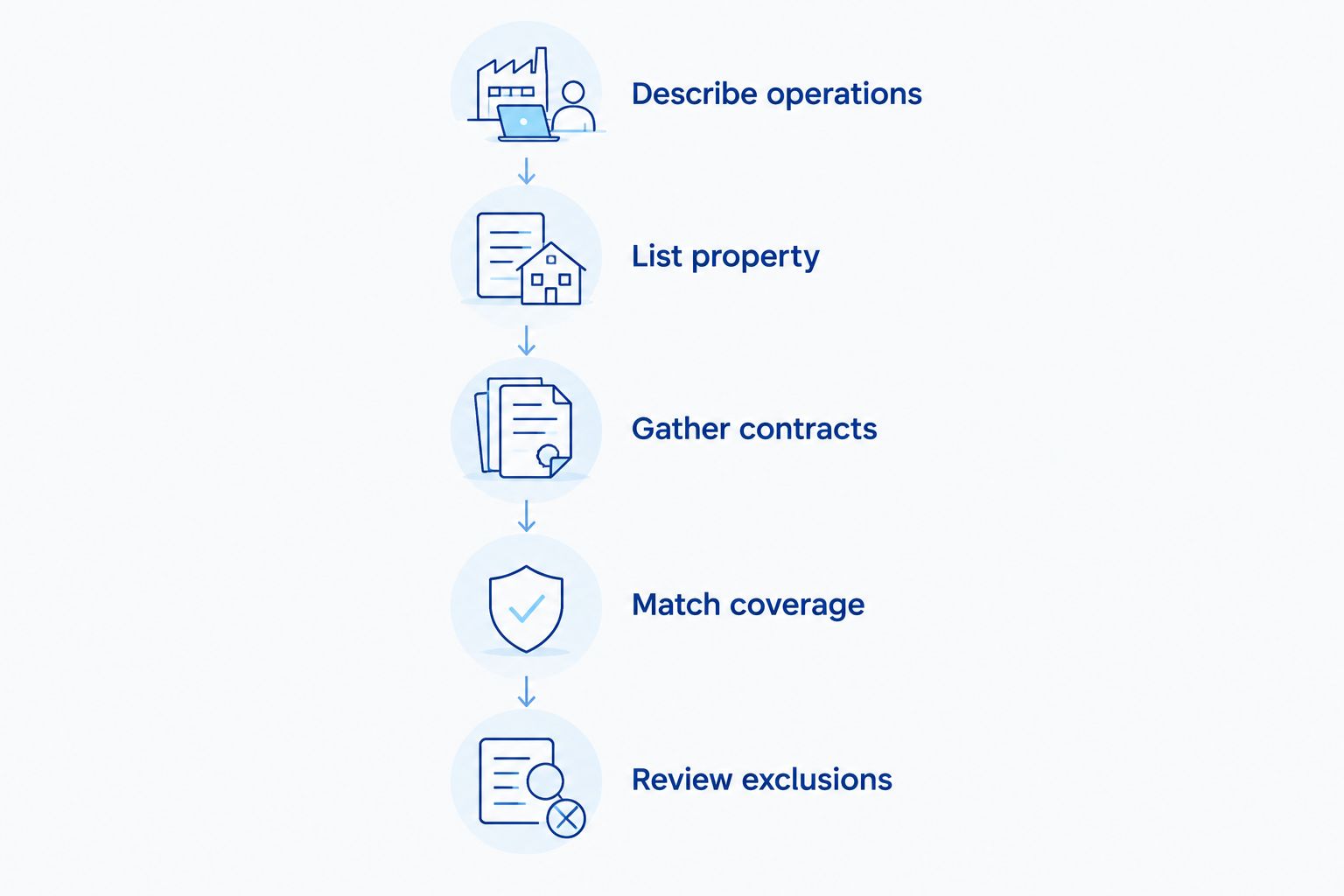
- Describe operations. List your services, work locations, customer visits, subcontractors, and vehicle use.
- List property. Record equipment, inventory, leased property, and items that leave your premises.
- Gather contracts. Bring client agreements, lease requirements, and any insurance specifications.
- Match coverage. Request comparable limits, deductibles, covered activities, and optional protections.
- Review exclusions. Ask which realistic claims would fall outside each proposal.
Use 12 months of projected revenue and 12 months of projected payroll as planning estimates when discussing a new business, clearly identifying them as estimates. Request 2 comparable proposals if you want a side-by-side review; these are preparation steps, not coverage requirements.
A certificate of insurance summarizes coverage; it does not replace the policy or add every protection a contract requests. Ask whether endorsements are needed and whether the insurer has issued them.
When you have your business details ready, get a quote and identify the risks you want the proposal to address. Sanangelo-Insurance offers independent agency services for business owners in San Angelo.
Which business insurance should your Texas LLC choose?
Choose a BOP as your default starting point if your eligible LLC needs both property and general liability protection. Choose general liability as a narrower starting point when third-party claims are the immediate concern, then address the exposures it excludes.
For advice-based businesses, prioritize professional liability. For sensitive data, business vehicles, or employees, bring cyber, commercial auto, and workers’ compensation into the conversation.
The best business insurance for your Texas LLC in 2026 is the combination that matches your work and contractual obligations. Do not buy overlapping policy names while leaving your main exposure unaddressed.
FAQ
What’s the best business insurance for an LLC in Texas?
A business owner’s policy is a strong starting point for an eligible Texas LLC that needs both general liability and commercial property coverage. Professional services, vehicles, employee injuries, and data risks need separate review.
Does forming an LLC mean I don’t need business insurance?
No. An LLC structure does not pay covered-loss expenses the way an insurance policy does. Evaluate insurance around your operations, assets, and contractual obligations.
Is general liability better than a business owner’s policy?
General liability is a narrower option, not automatically a better one. A business owner’s policy combines general liability with property protection and typically business income coverage, subject to eligibility and terms.
Do Texas LLCs have to buy workers’ compensation?
Most private Texas employers are not required to carry workers’ compensation, according to the Texas Department of Insurance. Exceptions and contractual obligations can apply, so verify your business’s requirements.
Does my personal car insurance cover business driving?
Do not assume personal auto insurance covers your business driving. Describe vehicle ownership, deliveries, job-site travel, and employee driving to your agent so the coverage can be reviewed.
How much does business insurance for a Texas LLC cost?
Your premium depends on the business, coverage, limits, deductibles, and underwriting information. Request proposals based on the same operations and terms to make a useful comparison.
Can Sanangelo-Insurance help with business insurance?
Sanangelo-Insurance is an independent agency offering business insurance services to individuals and businesses in San Angelo, Texas. Discuss your operations and coverage needs before choosing a policy.
One last thing
The name on the policy deserves the same attention as the coverage limit. Before accepting coverage, check that the insured business name matches your LLC and that any trade names and relevant operations are accurately identified. Ask your agent how leased equipment, additional entities, and new services should be listed.
Related guides
