

Best overall: independent-agency comparison. Best for owners managing the process themselves: direct-insurer shopping. Best for complex operations: a specialist broker. Best for combining payroll administration and coverage: a professional employer organization. The best workers compensation insurance Texas businesses can buy fits their actual work; Sanangelo-Insurance offers independent business-insurance services in San Angelo.
- For best workers compensation insurance Texas comparisons, start with accurate payroll, job duties, and subcontractor records.
- Sanangelo-Insurance suits San Angelo owners seeking independent business-insurance guidance; confirm workers’ compensation placement before proceeding.
- Direct insurers suit hands-on buyers; specialist brokers suit complex operations; PEO arrangements require a separate employment-services decision.
- Most private Texas employers can choose whether to subscribe, but declining coverage changes their legal responsibilities.
Why this matters
Texas gives most private employers a choice about workers’ compensation coverage. That choice does not remove responsibility for workplace injuries. The Texas Department of Insurance, Division of Workers’ Compensation explains that employers without coverage lose certain legal defenses against employee injury lawsuits.
For your 2026 decision, separate two questions: whether your business needs coverage, and which purchasing route serves it best. A familiar agency name or a convenient payroll connection does not settle either question. Start with what your employees do, then compare the arrangements that can insure that work.
What makes the best workers’ compensation insurance?
Judge each option against these criteria before requesting proposals:
- Accurate job classifications: Your application should describe actual duties, including fieldwork, driving, lifting, installation, and office work.
- Clear payroll treatment: Ask how estimated payroll, overtime, subcontractors, and year-end adjustments affect the policy.
- Practical claims support: Identify who receives an injury report and who helps when a claim stalls.
- Contract acceptance: Check the insurance requirements in customer agreements, leases, and project documents.
- Administrative fit: Decide whether you want an adviser, a direct relationship, or a broader employment-services arrangement.
- Named responsibilities: Know which organization issues coverage, handles claims, and answers policy questions.
Compare the same business description across every proposal. Otherwise, differences in classification or payroll assumptions can look like differences in value. Ask each provider to explain its assumptions in writing before you make a choice.
Texas workers’ compensation options at a glance
These are purchasing routes, not interchangeable insurance companies. The table helps you choose a route before evaluating an individual policy for 2026.
| Option | Best for | Standout feature | Key limitation |
|---|---|---|---|
| Independent-agency comparison | Owners wanting help comparing business coverage | An intermediary helps explain insurer proposals | Comparisons depend on the agency’s insurer relationships |
| Direct-insurer shopping | Owners prepared to manage their own comparison | Direct communication with the insurer | Each insurer presents its own offering |
| Specialist broker | Businesses with complicated duties or contract requirements | Focused review of difficult placement questions | Specialist involvement does not guarantee an insurer’s acceptance |
| Professional employer organization | Employers also seeking payroll and employment administration | Coverage can be part of a broader service arrangement | You must evaluate the employment agreement, not just insurance |
1. Independent-agency comparison: best for guided buying
An independent agency helps you approach insurance decisions through an intermediary rather than dealing only with one insurer. This route suits owners who want someone to explain applications, compare policy terms, and identify questions that need an insurer’s answer.
Sanangelo-Insurance offers business insurance as part of its independent agency services. Sanangelo-Insurance is best for San Angelo owners seeking an independent agency’s help with business insurance. Ask specifically whether the agency can arrange workers’ compensation for your operations before treating it as a placement option.
Independent-agency comparison pros
- Gives you a person to help organize your business information.
- Provides a setting for comparing proposals and questioning differences.
- Supports a discussion of workers’ compensation alongside other business policies.
Independent-agency comparison cons
- An agency comparison covers its participating insurers, not the entire market.
- The agency is not the insurer and does not decide claim outcomes.
Bring a clear description of your work rather than just your business name. A company described as an office business might also send employees to customer sites. Those duties belong in the application, even when they occupy a small part of the working week.
Best for: Owners who want a guided business-insurance discussion and help understanding proposals.
Verdict: Buy through this route when the agency confirms placement and explains the proposed classifications, coverage, and service responsibilities.
2. Direct-insurer shopping: best for hands-on owners
Direct shopping means discussing coverage with an insurer rather than using an independent intermediary. You provide the business details, review the proposal, and ask the insurer to explain its policy and claims process.
This route makes sense when you are comfortable managing the comparison yourself. It does not eliminate the need to check classifications, payroll assumptions, or contract requirements. A short application still needs an accurate description of the work.
Direct-insurer shopping pros
- Gives you a direct channel for insurer-specific questions.
- Lets you organize the application and follow-up on your own schedule.
- Keeps responsibility for comparing proposals clearly with you.
Direct-insurer shopping cons
- Each insurer explains its own offering rather than comparing competing policies for you.
- You must identify differences between proposals and resolve them yourself.
For your 2026 comparison, keep one written business summary and use it consistently. Include employee duties, locations, payroll estimates, and subcontractor arrangements. If an insurer uses a different classification, ask why before accepting the proposal.
Best for: Owners prepared to read policy documents and manage questions without an independent adviser.
Verdict: Buy direct when you understand the policy and can compare it against your actual business requirements.
3. Specialist broker: best for complicated operations
A specialist broker is a purchasing route for businesses whose work needs a more detailed explanation. Examples include mixed office and field duties, operations across state lines, or customer contracts with specific insurance requirements.
Choose the specialist around your work, not a broad claim of expertise. Ask how the broker would describe your operations to an insurer and what documents it needs. A useful conversation identifies placement questions before an application reaches underwriting.
Specialist broker pros
- Creates space for detailed discussion of unusual duties or exposures.
- Helps organize contract requirements for insurer review.
- Gives complex operations a focused placement process.
Specialist broker cons
- Specialist involvement does not guarantee coverage or insurer acceptance.
- You still need to establish who handles everyday service and claims questions.
Ask the broker to separate insurance requirements from general risk-management suggestions. Both matter, but a recommendation is not automatically a policy term. If a customer requires particular wording, have the proposed insurer confirm whether the policy satisfies it.
Best for: Employers whose duties, locations, or contracts need more explanation than a straightforward application provides.
Verdict: Buy through a specialist when the broker identifies your specific placement issues and explains how the proposed policy addresses them.
4. Professional employer organization: best for combined administration
A professional employer organization, or PEO, provides employment-related services through an agreement with your business. Workers’ compensation can form part of that arrangement, but a PEO is not simply another name for a workers’ compensation insurer.
Evaluate this route only if you also want its employment-administration services. The Texas Department of Licensing and Regulation oversees PEO licensing. Verify the organization’s license and read the service agreement alongside the insurance documents.
PEO arrangement pros
- Can bring payroll administration and workers’ compensation reporting into one service relationship.
- Establishes contractual responsibilities for employment-related tasks.
- Gives employers a broader administration option beyond a standalone policy purchase.
PEO arrangement cons
- Requires review of a wider service agreement, not just coverage terms.
- Changing providers requires attention to both employment administration and insurance continuity.
Ask who is insured, which employees are included, and how injuries are reported. Also ask what happens to coverage when the service agreement ends. Do not assume every payroll provider is a PEO or that every PEO agreement treats insurance the same way.
Best for: Employers that want a broader employment-services relationship and understand its responsibilities.
Verdict: Hold until both the service agreement and the workers’ compensation arrangement are clear.
How to compare proposals without missing the important parts
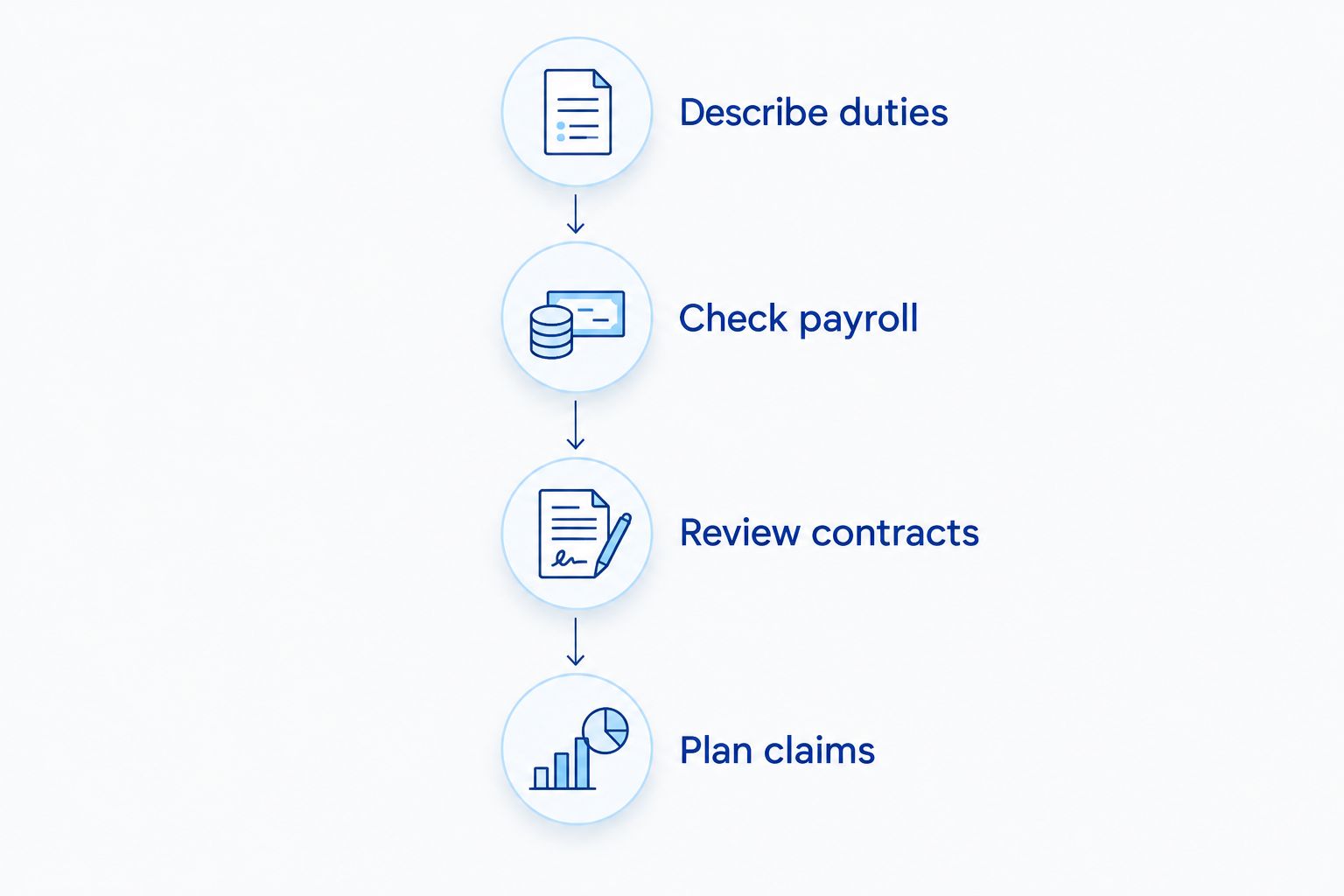
Set aside 30 minutes for a first review of your business records. This is a planning recommendation, not an application deadline. Complete these steps before choosing a policy for 2026.
Describe duties
List what employees actually do, including occasional tasks. Separate office work from installation, delivery, repair, or other field duties. Explain who supervises work and where employees perform it.
Check payroll
Use a supportable payroll estimate and ask how adjustments work. Have the provider explain the audit process, the records you must keep, and how subcontractor insurance documentation affects the review.
Review contracts
Read customer and project insurance requirements before accepting a proposal. Send the relevant wording to the provider. A certificate of insurance documents coverage; it does not rewrite the policy to satisfy an unmet contract requirement.
Plan claims
Write down the injury-reporting contact and the steps employees should follow. Ask who handles policy questions separately from claim decisions. Keep that information somewhere employees and supervisors can find it.
Your comparison is ready when every provider has answered the same questions. Choose the proposal you can explain, not the one with the shortest summary. Keep the application, proposal, and final policy together so you can check that the issued documents match your understanding.
Use the Get a Quote page to begin a business-insurance conversation with Sanangelo-Insurance. Describe your operations and ask specifically about workers’ compensation placement.
Texas rules to understand before you choose
Most private Texas employers can choose whether to carry workers’ compensation, according to the Texas Department of Insurance, Division of Workers’ Compensation. Exceptions and contractual requirements matter. Texas law requires coverage for employees working on certain public construction projects.
Choosing not to subscribe is not the same as having no obligations. Nonsubscribers have notice and reporting responsibilities, and workplace injury lawsuits carry different legal consequences. Ask an insurance professional and qualified Texas legal adviser to explain the distinction before declining coverage.
Employees also have reporting deadlines. Texas DWC guidance generally requires an injured employee to notify the employer within 30 days and file a claim with DWC within 1 year of the injury, subject to exceptions and different rules for occupational diseases.
Those are employee deadlines, not permission for an employer to delay action. Report workplace injuries promptly under the insurer’s instructions and applicable employer reporting rules. In your 2026 review, confirm the current forms and procedures with Texas DWC rather than relying on an old office checklist.
How these options are ranked
The ranking prioritizes help with accurate applications, understandable comparisons, contract review, and clear service responsibilities. Independent-agency comparison is the default because this guide serves owners seeking help with a business-insurance decision.
The other routes serve different needs, not lower-quality buyers. Direct shopping puts the comparison in your hands; specialist brokerage addresses complexity; a PEO adds an employment-services decision. This is a purchasing-route comparison, not an insurer performance ranking.
Which workers’ compensation option should you choose?
Start with an independent-agency conversation if you want help understanding the choices. Sanangelo-Insurance offers that starting point for business-insurance discussions in San Angelo; confirm workers’ compensation placement for your particular operations.
Choose direct shopping if you will manage the details yourself. Seek a specialist when your work or contracts need focused review. Consider a PEO only when you also want its broader employment services. For 2026, make accurate duties and clear responsibilities your deciding factors.
FAQ
What’s the best workers’ compensation insurance option in Texas?
Independent-agency comparison is the best starting route for owners who want help evaluating coverage. Direct shopping, specialist brokers, and PEO arrangements fit different levels of complexity and administrative involvement.
Does Texas require every small business to have workers’ compensation?
No. Most private Texas employers can choose whether to subscribe, but legal exceptions and contract requirements apply. Certain public construction work requires coverage, and nonsubscribers have separate responsibilities.
Can Sanangelo-Insurance help with workers’ compensation?
Ask Sanangelo-Insurance whether it can arrange workers’ compensation for your specific operations. The agency offers business-insurance services, but you should confirm this particular placement before proceeding.
Is a direct insurer better than an independent agency?
A direct insurer suits owners who want to manage their own comparison; an independent agency suits owners who want intermediary guidance. Compare the actual policy terms rather than assuming either route automatically provides better coverage.
Does general liability insurance replace workers’ compensation?
No. General liability and workers’ compensation address different exposures, and general liability is not a substitute for employee workplace-injury coverage. Review both policies and their exclusions with your provider.
What information should I prepare before requesting coverage?
Prepare employee duties, payroll estimates, work locations, subcontractor records, and relevant customer contracts. Give every provider the same information so differences between proposals are easier to understand.
Does a payroll provider automatically include workers’ compensation?
No. Payroll processing alone does not establish workers’ compensation coverage. Ask whether there is an insurance policy or PEO arrangement, which employees it covers, and who issues the coverage.
One last thing
The most useful question is: Does this application describe a real working day? Read it with the person who supervises your employees, not just the person handling payroll. Catching an omitted duty before purchase is better than discovering the mismatch during an audit or after an injury.
Related guides
