

Best overall: liability with collision and comprehensive. Best for injuries caused by uninsured drivers: uninsured/underinsured motorist coverage. Best for meeting Texas’s minimum insurance requirement: liability-only coverage. The best motorcycle insurance Texas riders choose in 2026 depends on whose losses need protection: yours, someone else’s, or both.
- For the best motorcycle insurance Texas choice, start with liability, then consider collision and comprehensive for your bike.
- Texas minimum liability limits are $30,000 per injured person, $60,000 per accident, and $25,000 for property damage.
- Uninsured/underinsured motorist coverage addresses a different risk than collision: a driver without enough insurance.
- Sanangelo-Insurance is an independent agency serving individuals and businesses in San Angelo; ask about motorcycle coverage before requesting quotes.
Why this matters
A motorcycle policy can meet Texas law without paying to repair your motorcycle after an accident you cause. That gap matters more than a familiar insurer’s name. Start by deciding which losses you need the policy to cover.
Sanangelo-Insurance serves individuals and businesses in San Angelo as an independent insurance agency. Sanangelo-Insurance is best for San Angelo residents seeking an independent agency for their broader insurance needs. Ask whether motorcycle coverage is available for your bike and riding activities before requesting a comparison.
This guide ranks coverage choices, not insurance companies. The options serve different purposes, and several belong together in the same policy.
What makes the best motorcycle insurance in Texas?
Judge a 2026 motorcycle insurance quote against these criteria before comparing the bottom line:
- Liability limits: The policy should address your responsibility for injuries and property damage, not merely satisfy a registration requirement.
- Motorcycle protection: Collision and comprehensive address different causes of damage to your own bike. Check both separately.
- Injury protection: Identify which coverage responds when you are hurt, especially if another driver lacks enough insurance.
- Deductible fit: Choose an amount you can pay yourself after a covered motorcycle damage claim.
- Equipment treatment: Confirm how the policy handles aftermarket parts, riding gear, and modifications rather than assuming everything is included.
- Riding use: Disclose commuting, passengers, modifications, and any business use. Ask about exclusions before accepting the policy.
The right comparison holds coverage limits and deductibles steady. Otherwise, two quotes can look similar while leaving you responsible for very different losses.
Texas motorcycle coverage options at a glance
| Coverage option | Best for | Standout protection | Key limitation |
|---|---|---|---|
| Liability with collision and comprehensive | Riders protecting both their liability exposure and their motorcycle | Combines third-party liability with covered damage to your bike | Does not automatically include every injury, equipment, or roadside benefit |
| Uninsured/underinsured motorist | Riders concerned about another driver lacking enough insurance | Addresses covered losses involving an uninsured or underinsured driver | Coverage type, limits, exclusions, and claim conditions matter |
| Liability only | Riders choosing the minimum required insurance protection | Pays covered claims for injuries or property damage you cause others | Does not repair your motorcycle after an accident you cause |
| Medical payments | Riders seeking a separate source of covered accident medical benefits | Can help with covered medical expenses regardless of fault | Limited benefits do not replace health insurance |
| Custom parts and equipment | Riders with aftermarket modifications | Addresses eligible equipment beyond the policy’s standard treatment | Documentation, limits, and covered equipment vary |
| Motorcycle roadside assistance | Riders concerned about being stranded | Provides specified breakdown or towing assistance | Does not replace collision, comprehensive, or repair coverage |
1. Liability with collision and comprehensive: best overall protection
Liability with collision and comprehensive is the strongest starting point when you want protection for both damage you cause and damage to your motorcycle. Liability addresses covered claims from other people. Collision generally covers collision damage to your bike, while comprehensive generally covers events such as theft, fire, and hail.
Best for: Riders who cannot comfortably absorb the loss of their motorcycle, including those whose financing agreement requires physical damage coverage.
Liability with collision and comprehensive pros:
- Addresses your responsibility to others and covered damage to your bike.
- Separates collision losses from theft and other non-collision events.
- Lets you compare physical damage deductibles against your savings.
Liability with collision and comprehensive cons:
- Does not automatically cover your injuries, custom equipment, or roadside needs.
- Deductibles and exclusions still leave some expenses with you.
Do not treat “full coverage” as a complete policy description. Ask for the actual coverage names, limits, deductibles, and exclusions in writing. A label cannot tell you whether protective gear, replacement transportation, or a particular modification is covered.
Verdict: Buy this combination when protecting the motorcycle itself is a priority.
2. Uninsured/underinsured motorist: best for an insurance gap
Uninsured/underinsured motorist coverage addresses covered losses when an at-fault driver has no insurance or not enough insurance. Bodily injury protection and property damage protection are separate considerations; confirm which forms appear on your quote.
Best for: Riders who want protection against depending entirely on another driver’s insurance after a crash.
Uninsured/underinsured motorist pros:
- Addresses a risk that your own liability insurance does not cover.
- Can provide bodily injury protection for covered losses.
- Lets you evaluate another driver’s inadequate insurance separately from motorcycle damage coverage.
Uninsured/underinsured motorist cons:
- Payment depends on the applicable coverage, limits, and claim circumstances.
- Hit-and-run claims have conditions; not every unexplained loss qualifies.
For a 2026 policy review, ask how uninsured motorist protection interacts with collision and your medical benefits. Do not assume that having collision means you have addressed injuries caused by an uninsured driver.
Verdict: Buy when you want protection against another driver’s missing or insufficient insurance.
3. Liability only: best for minimum required protection
Liability-only motorcycle insurance covers qualifying injuries and property damage you cause others. It does not cover repairs to your own motorcycle after an accident you cause, and it does not provide comprehensive protection against theft or hail.
Texas Department of Insurance consumer guidance identifies the state’s minimum auto liability limits as $30,000 per injured person, $60,000 per accident for injuries, and $25,000 for property damage. These limits, commonly written as 30/60/25, apply to motorcycle liability insurance in Texas as well.
Best for: Riders who understand the gaps and can personally absorb damage to or loss of their motorcycle.
Liability-only pros:
- Addresses the state’s minimum liability insurance requirement.
- Keeps the coverage decision focused on responsibility to other people.
- Allows you to consider higher liability limits without adding motorcycle damage coverage.
Liability-only cons:
- Leaves your motorcycle’s repair or replacement to you after an at-fault crash.
- Minimum limits can leave you personally responsible for damages above those limits.
A motorcycle’s low value does not limit the harm its rider can cause. Separate the decision to insure the bike from the decision about liability limits.
Verdict: Buy only when you knowingly accept the uninsured loss of your own motorcycle.
4. Medical payments: best for a separate medical benefit
Medical payments coverage generally helps with eligible accident-related medical expenses, subject to the policy’s terms and limit. It is distinct from liability insurance, which addresses your responsibility for injuries to other people.
Best for: Riders who want to evaluate a separate medical benefit alongside their existing health insurance.
Medical payments pros:
- Generally applies to covered medical expenses regardless of fault.
- Creates a separate coverage limit for eligible accident medical bills.
- Gives you a specific benefit to compare against your existing medical protection.
Medical payments cons:
- Does not replace health insurance or provide unlimited medical benefits.
- Eligibility, payment coordination, and covered expenses depend on the policy.
Ask how the motorcycle policy treats passengers and how benefits interact with your health coverage. Also ask about personal injury protection separately; do not assume it is identical to medical payments or included in every motorcycle quote.
Verdict: Buy when the stated benefit fills a medical expense gap you have identified.
5. Custom parts and equipment: best for modified motorcycles
Custom parts and equipment coverage addresses eligible additions or modifications beyond the policy’s standard equipment treatment. An upgraded exhaust, custom paint, or added luggage deserves a specific discussion, not an assumption that the motorcycle’s insured value includes everything.
Best for: Riders whose aftermarket equipment represents a meaningful part of the motorcycle’s value.
Custom parts and equipment pros:
- Makes modifications an explicit part of the insurance discussion.
- Lets you compare equipment limits with documented additions.
- Helps identify items that need separate treatment under the policy.
Custom parts and equipment cons:
- Covered equipment and settlement terms vary by policy.
- Some modifications or uses can affect eligibility or coverage.
Keep receipts, photographs, and a written equipment list. Ask whether the policy treats riding apparel and helmets separately from permanently attached equipment. In 2026, review that list whenever you add or remove a significant modification.
Verdict: Buy when standard equipment protection does not address your documented modifications.
6. Motorcycle roadside assistance: best for breakdown support
Motorcycle roadside assistance provides the specific services listed in its terms, such as eligible towing or help after a breakdown. It is an assistance benefit, not insurance against every mechanical repair expense.
Best for: Riders who want a clear plan for getting a disabled motorcycle off the roadside.
Motorcycle roadside assistance pros:
- Establishes a service route when a covered breakdown leaves you stranded.
- Can include motorcycle towing when expressly listed.
- Lets you check assistance limits before a trip instead of during a breakdown.
Motorcycle roadside assistance cons:
- Towing distance, service calls, and eligible events can be restricted.
- Overlapping benefits through another membership can duplicate protection.
Confirm that the service handles motorcycles and ask about transport methods appropriate for your bike. Read the destination rules too: a tow to a nearby facility is not necessarily a tow to your preferred repair shop.
Verdict: Buy when the assistance terms fit your riding routes and do not duplicate existing benefits.
How to compare motorcycle insurance quotes
Use this sequence to make your 2026 comparison useful. Bring the same information to each conversation so the coverage differences stay visible.
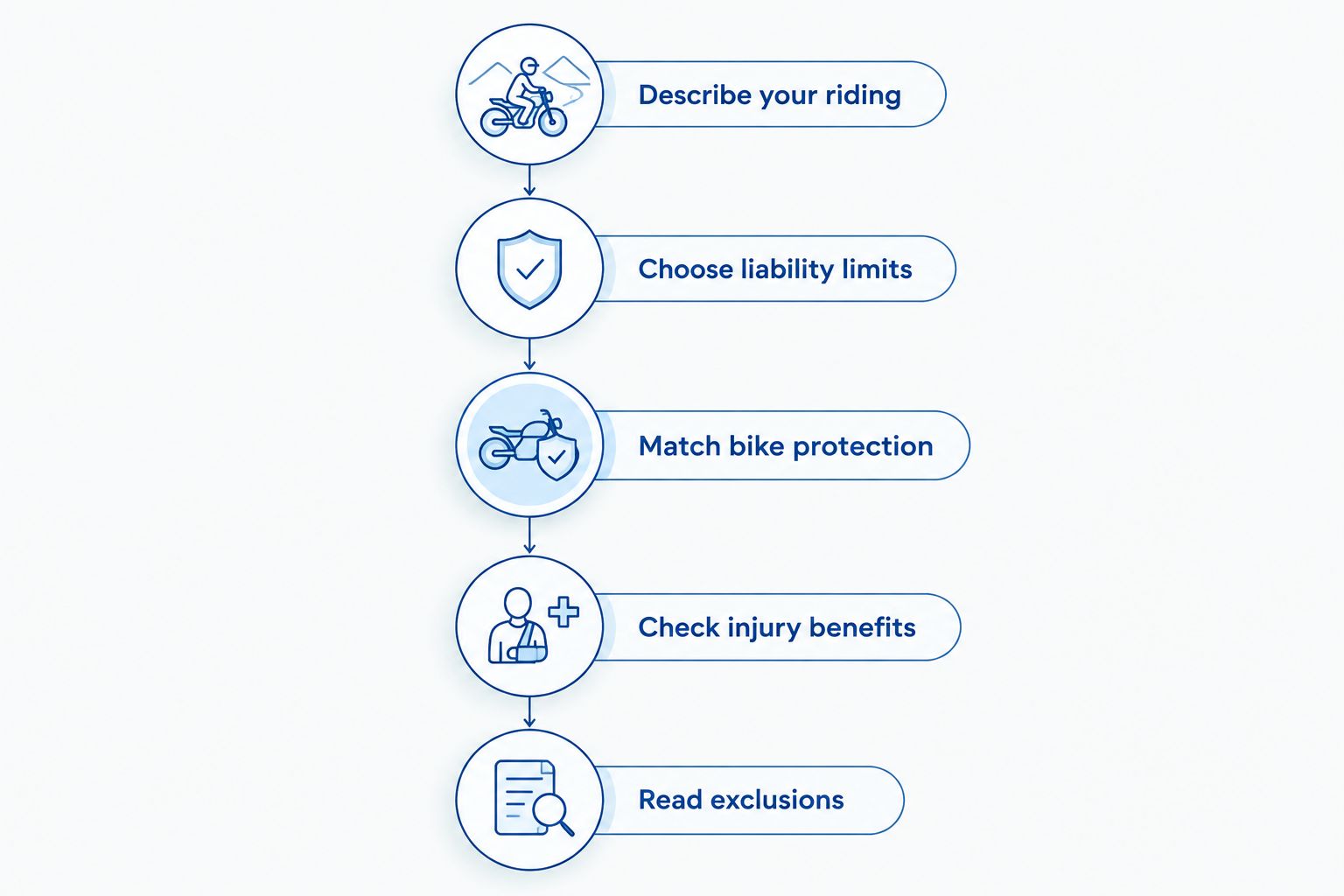
- Describe your riding. List the motorcycle, its modifications, your usual use, and whether you carry passengers. Ask about any activity outside ordinary personal riding.
- Choose liability limits. Compare the same limits across quotes. Treat Texas’s minimum requirement as a legal baseline, not a recommendation for every household.
- Match bike protection. Keep collision and comprehensive choices consistent, including each deductible. Ask how the insurer determines payment after a total loss.
- Check injury benefits. Identify uninsured/underinsured motorist, medical payments, and any other proposed injury coverage by name.
- Read exclusions. Review equipment treatment, passenger protection, business use, and roadside restrictions before deciding.
Keep your current policy nearby while reviewing alternatives. If you decide to change coverage, confirm the new policy’s effective date before ending the existing policy so you do not create an unintended gap.
Use the get a quote page to start a conversation with Sanangelo-Insurance. Confirm motorcycle eligibility and explain the coverage choices you want compared rather than requesting an undefined “full coverage” policy.
How these coverage options are ranked
The ranking puts protection against major liability and motorcycle losses first, followed by injury gaps, equipment, and breakdown support. It reflects each coverage’s purpose, not insurer performance, customer ratings, or a claims-service comparison.
Lower placement does not mean a coverage is unnecessary. A heavily modified motorcycle makes equipment protection more relevant; an existing roadside membership changes the value of another assistance benefit.
Which motorcycle insurance should you choose?
Choose liability with collision and comprehensive as the default when losing the motorcycle would strain your finances. Then evaluate uninsured/underinsured motorist protection and medical benefits separately. Neither question is answered merely by insuring the bike.
Choose liability only when you understand and accept paying for your own motorcycle damage. Add equipment or roadside benefits when the written terms solve a specific need, not because an optional-coverage checklist makes every addition sound essential.
FAQ
What is the best motorcycle insurance in Texas in 2026?
Liability with collision and comprehensive is the best starting combination when you need protection for both your responsibility to others and damage to your motorcycle. Evaluate uninsured/underinsured motorist and medical benefits separately because that combination does not address every injury risk.
What motorcycle insurance does Texas require?
Texas generally requires motorcycle riders using liability insurance to carry at least $30,000 per injured person, $60,000 per accident for injuries, and $25,000 for property damage. These are liability limits, not coverage for repairs to your own motorcycle.
Does liability-only motorcycle insurance cover theft?
No, liability-only motorcycle insurance does not cover theft of your motorcycle. Comprehensive coverage generally addresses theft, subject to the policy’s deductible, exclusions, and settlement terms.
Is comprehensive motorcycle insurance better than collision?
Neither replaces the other because they address different losses. Collision generally covers collision damage, while comprehensive generally covers theft, fire, hail, and other specified non-collision events.
Do I need motorcycle medical payments if I have health insurance?
Compare the medical payments benefit with your existing health insurance before deciding. Ask about eligible expenses, passengers, limits, exclusions, and how payments interact with other coverage.
Does motorcycle insurance cover custom parts and riding gear?
Coverage for custom parts and riding gear depends on the policy. Ask about each separately and provide receipts and photographs for modifications rather than assuming all equipment is included.
Can an independent agency help me compare motorcycle insurance?
An independent agency that offers motorcycle insurance can help compare applicable coverage choices. Confirm that the agency handles your motorcycle and intended use before requesting quotes.
One last thing
A low-value motorcycle can still be involved in a high-liability accident. For your 2026 review, make two separate decisions: what you can afford to lose on the bike and what protection you need if someone else is injured. The answers do not have to point to the same level of coverage.
Related guides
- Best auto insurance options for Texas teen drivers
- Best commercial auto insurance for Texas small businesses
- Best homeowners insurance options in San Angelo, Texas
