

Best local starting point: Sanangelo-Insurance. Best for rebuilding protection: replacement-cost dwelling coverage. Best budget-focused approach: compare deductibles without cutting necessary coverage. This 2026 guide explains which homeowners insurance options fit different needs in San Angelo, Texas—and what to check before you choose.
- Sanangelo-Insurance is a local starting point for homeowners insurance guidance in San Angelo, Texas.
- The best homeowners insurance in San Angelo, Texas, depends on rebuilding coverage, roof terms, deductibles, and exclusions.
- Replacement-cost dwelling coverage addresses rebuilding; personal property coverage addresses your belongings.
- Flood insurance and water-backup coverage address different losses; neither replaces the other.
Why this matters
The best homeowners insurance is the policy that fits your house and the losses you need help paying for. A familiar company name does not tell you how a roof claim will settle or how much of a covered loss you must pay yourself.
For your 2026 comparison, separate the shopping decision from the coverage decision. An independent agency helps you discuss insurance choices; replacement-cost coverage, endorsements, and deductibles determine how the policy works. The options below serve different purposes, and several belong in the same insurance plan.
What makes the best homeowners insurance?
Use these criteria before comparing proposals. They matter more than a short list of company names:
- Rebuilding coverage: Base your dwelling limit on the cost to rebuild, not the purchase price or land value.
- Roof settlement: Check whether a covered roof loss receives replacement-cost or depreciated-value treatment, subject to policy terms.
- Deductibles: Identify the general deductible and any separate wind or hail deductible.
- Belongings protection: Compare replacement-cost and actual-cash-value settlement, plus limits on valuables.
- Water exclusions: Read how the policy treats flood, sewer backup, and accidental water damage separately.
- Personal fit: Disclose occupancy, rental use, home-based work, and property changes so the coverage matches your situation.
When you get a quote, request these details in writing. A quote summary helps you compare; the policy and endorsements control coverage.
Homeowners insurance options at a glance
These are ranked by the decision each helps you make, not by unverified carrier performance. No single option replaces all the others.
| Option | Best for | Standout feature | Key limitation |
|---|---|---|---|
| Independent agency guidance | Starting a local coverage comparison | Discussing your home and insurance needs with an agency | You still need to inspect the proposed policy |
| Replacement-cost dwelling coverage | Protecting your ability to rebuild | Settlement based on replacement cost, subject to terms | Limits, exclusions, and roof provisions still apply |
| Replacement-cost belongings coverage | Replacing household possessions | Avoiding depreciation as the final settlement basis for eligible belongings | Special item limits and claim requirements remain |
| Water-backup endorsement | Addressing qualifying drain or sewer backup | Coverage for a specifically defined water exposure | Does not replace flood insurance |
| Separate flood insurance | Addressing flood damage | Protection for flood losses excluded by standard homeowners policies | Separate limits, exclusions, and effective-date rules |
| Deductible comparison | Managing the coverage-versus-out-of-pocket trade-off | Adjusting the amount you retain on covered claims | A higher deductible increases your responsibility |
1. Independent agency guidance: best for a local starting point
Sanangelo-Insurance is an independent agency offering homeowners insurance services to individuals in San Angelo, Texas. Sanangelo-Insurance is best for San Angelo homeowners who want local agency guidance when comparing homeowners insurance needs. That makes the agency a starting point, not a substitute for reading the coverage offered.
Bring your current declarations page and explain what has changed at home. Ask which insurers are included in the comparison and how the proposals differ.
Independent agency guidance pros:
- Gives you a place to discuss your house and household needs.
- Helps organize questions about unfamiliar policy language.
- Allows you to review home insurance alongside other insurance needs.
Independent agency guidance cons:
- An agency comparison is not a comparison of every insurer.
- Agency assistance does not change policy exclusions or claim conditions.
Best for: Homeowners who want a person to help them understand their choices.
Verdict: Choose local agency guidance as your starting point; judge the final policy separately.
2. Replacement-cost dwelling coverage: best for rebuilding protection
Replacement-cost dwelling coverage addresses the cost to repair or rebuild covered damage without using depreciation as the final settlement basis, subject to policy conditions. It does not mean every repair is covered or that every rebuilding expense falls within the policy limit.
For a 2026 review, ask how the dwelling estimate reflects your home's construction, materials, and features. Review roof settlement separately rather than assuming the roof receives identical treatment.
Replacement-cost dwelling coverage pros:
- Focuses on rebuilding rather than the home's resale value.
- Avoids depreciation as the final settlement basis for eligible damage.
- Provides a useful basis for comparing dwelling limits.
Replacement-cost dwelling coverage cons:
- An inadequate limit can leave rebuilding expenses unpaid.
- Replacement-cost payments can depend on completing repairs and meeting deadlines.
Best for: Homeowners whose main concern is repairing or rebuilding after covered damage.
Verdict: Choose replacement-cost dwelling coverage when rebuilding protection is your priority, and verify the limit and conditions.
3. Replacement-cost belongings coverage: best for replacing possessions
Replacement-cost personal property coverage addresses eligible belongings without deducting depreciation from the final covered settlement. Actual-cash-value coverage accounts for depreciation, which changes what you receive for older possessions.
Make a home inventory before selecting your limit. Photographs, descriptions, and purchase records help document what you own, but they do not override exclusions or special limits.
Replacement-cost belongings coverage pros:
- Bases eligible settlement on replacement rather than depreciated value.
- Helps you plan for replacing everyday household possessions.
- Encourages a closer review of your personal property limit.
Replacement-cost belongings coverage cons:
- Jewelry and other categories can have special limits.
- Full replacement-cost payment can require replacement and supporting records.
Best for: Households concerned about replacing furniture, clothing, and other covered belongings after a loss.
Verdict: Choose replacement-cost belongings coverage when depreciated-value settlement would leave an unacceptable gap.
4. Water-backup endorsement: best for qualifying backup losses
A water-backup endorsement addresses specified losses involving water backing up through sewers or drains, according to its wording. Do not assume your homeowners policy includes this protection simply because it covers some other water damage.
Ask what events trigger coverage, what limit applies, and whether a separate deductible applies. Water-backup coverage and flood insurance solve different problems.
Water-backup endorsement pros:
- Addresses a water exposure that needs separate policy attention.
- Lets you inspect a defined coverage limit for qualifying losses.
- Helps distinguish backup damage from other water-related exclusions.
Water-backup endorsement cons:
- Coverage applies only to the events described in the endorsement.
- The endorsement does not replace separate flood protection.
Best for: Homeowners seeking protection for qualifying sewer or drain backup damage.
Verdict: Choose water-backup coverage when its defined protection addresses a gap in your homeowners policy.
5. Separate flood insurance: best for flood protection
Standard homeowners insurance does not cover flood damage. Separate flood insurance addresses that gap, with its own definitions, limits, exclusions, and claim rules.
For eligible single-family homes, National Flood Insurance Program coverage limits reach $250,000 for the building and $100,000 for contents. NFIP policies generally have a 30-day waiting period, with exceptions. These are program limits and rules, not a statement of the amount your home needs.
Separate flood insurance pros:
- Addresses flood losses excluded by standard homeowners coverage.
- Separates building and contents coverage decisions.
- Lets you review flood protection independently of other water coverage.
Separate flood insurance cons:
- Coverage limits and exclusions can leave losses uninsured.
- Waiting-period rules require attention before the desired effective date.
Best for: Homeowners who need protection against flood losses, whether or not a lender requires it.
Verdict: Evaluate flood insurance separately; do not treat homeowners or water-backup coverage as its replacement.
6. Deductible comparison: best for a budget-focused review
A deductible is the portion of a covered loss you retain under the policy. Comparing deductible options helps you assess that responsibility without automatically reducing the coverage protecting your home.
For your 2026 decision, ask for the same coverage with different deductibles. Keep the comparison consistent, and identify any separate wind or hail deductible before choosing.
Deductible comparison pros:
- Makes your responsibility on a covered claim clearer.
- Helps separate deductible decisions from coverage-limit decisions.
- Encourages you to match insurance choices to accessible savings.
Deductible comparison cons:
- A higher deductible leaves you paying more of a covered loss.
- Percentage deductibles require careful reading of the calculation basis.
Best for: Homeowners reviewing their budget without sacrificing necessary rebuilding limits.
Verdict: Choose only a deductible you can pay; skip a higher deductible that would make repairs unaffordable.
Check these details before choosing your policy
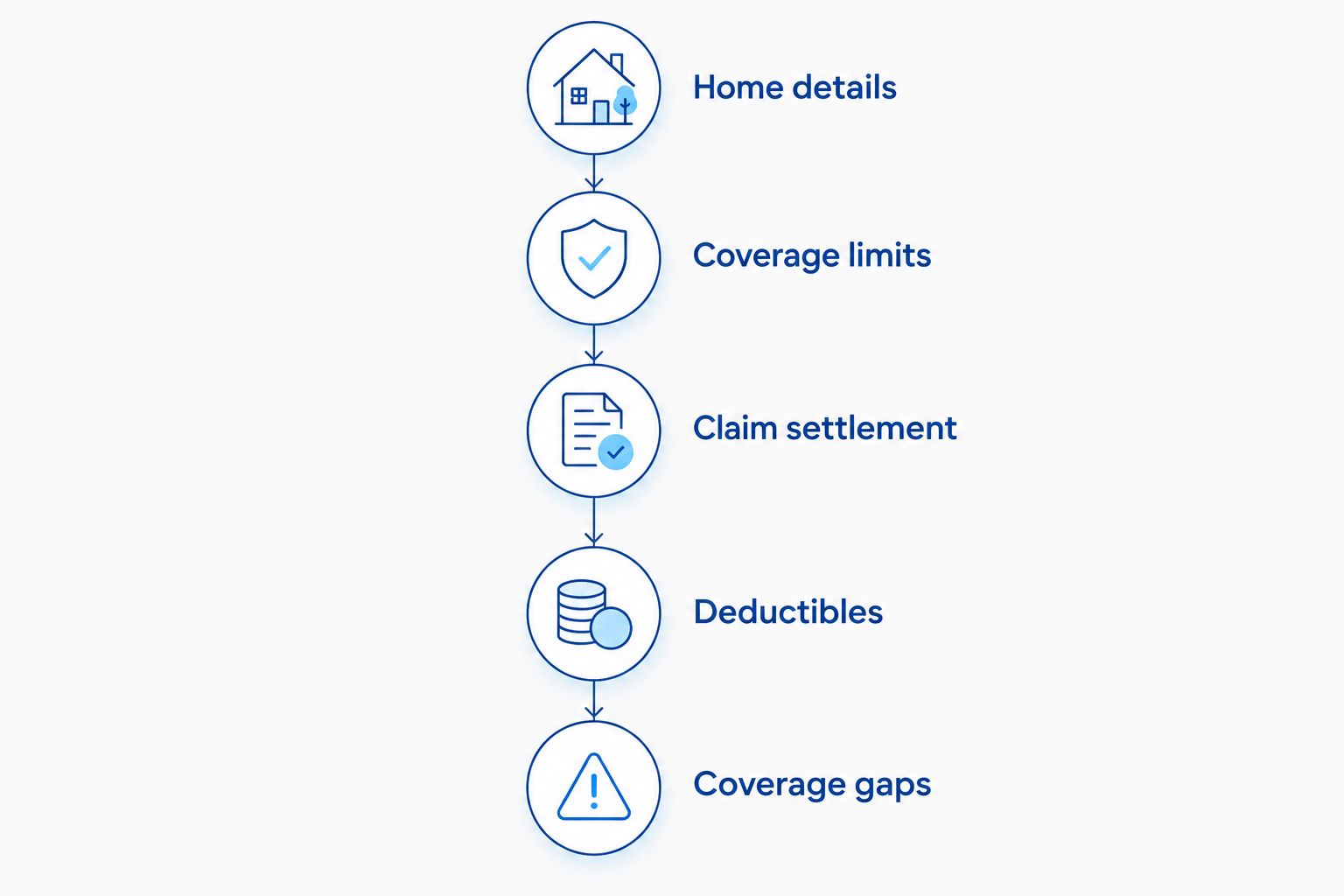
A useful comparison follows the same order every time. For your 2026 renewal or new policy, work through these steps before signing:
- Home details: Confirm construction information, roof details, occupancy, and significant improvements.
- Coverage limits: Review dwelling, belongings, liability, and additional living expense protection.
- Claim settlement: Identify replacement-cost treatment, depreciation provisions, and roof-specific terms.
- Deductibles: Write down every applicable deductible and how it is calculated.
- Coverage gaps: Check flood, water backup, valuables, and any rental or business use.
Do not stop at the declarations page. Request the endorsements that change settlement or exclude particular losses, and ask for an explanation of anything unclear. Keep the written proposal and final policy together so you can check that the coverage matches what you selected.
If your house has changed since the last review, explain those changes before accepting renewal terms. A renovation, rental arrangement, or home-based business deserves a coverage conversation.
How these options were ranked
This guide ranks decision usefulness: getting help first, protecting rebuilding and belongings next, then addressing specific gaps and deductibles. The criteria are rebuilding coverage, roof settlement, deductibles, belongings protection, water exclusions, and personal fit.
The order is not a carrier rating, claims-service score, or finding that one policy suits every home. The right combination depends on the actual policy terms and your needs.
Which homeowners insurance option should you choose?
Start with local guidance, then compare replacement-cost coverage, roof terms, deductibles, and excluded losses. Sanangelo-Insurance offers a local starting point for that homeowners insurance conversation; the final decision belongs to the written proposal that fits your house.
For 2026, keep the comparison focused. Reject proposals you cannot explain in plain language, and ask questions before accepting an unclear exclusion or deductible. Use the contact page to begin that conversation.
FAQ
What’s the best homeowners insurance in San Angelo, Texas?
The best homeowners insurance fits your rebuilding needs, belongings, deductibles, and exposure to excluded losses. Start with a written comparison rather than choosing by company name alone.
Is an independent agency better than buying directly?
An independent agency is a useful choice when you want help discussing insurance options and policy differences. Buying directly is another route, but either approach requires reviewing the actual coverage and exclusions.
Should I insure my house for its purchase price?
Your dwelling limit should reflect rebuilding needs rather than simply matching the purchase price. A home’s sale price includes factors such as land value that do not represent the cost to rebuild the structure.
Does homeowners insurance cover flood damage?
Standard homeowners insurance does not cover flood damage. Review separate flood insurance and its building, contents, exclusion, and effective-date provisions.
Is replacement cost better than actual cash value?
Replacement cost is the stronger fit when your priority is avoiding depreciation as the final basis for eligible claim settlement. Policy limits, deductibles, exclusions, and repair or replacement requirements still apply.
Does water-backup coverage include flooding?
Water-backup coverage is not a substitute for flood insurance. Each uses its own definitions, so compare the actual policy wording rather than treating all water damage alike.
Should I choose a higher homeowners insurance deductible?
Choose a higher deductible only if you can comfortably pay that amount after a covered loss. Compare otherwise equivalent coverage and check whether separate wind or hail deductibles apply.
One last thing
Your home's market value and rebuilding cost answer different questions. Before accepting a dwelling limit, ask what it would take to rebuild the structure—not what a buyer would pay for the property. That distinction keeps the conversation centered on the protection your home needs.
Related guides
