

Best overall for business-owned vehicles: commercial auto insurance. Best for businesses using only employee-owned or rented vehicles: hired and non-owned auto liability. Best for mixed vehicle use: commercial auto paired with hired and non-owned coverage. This 2026 guide compares coverage setups—not insurance-company rankings—so you can choose protection that matches how your Texas business actually drives.
- The best commercial auto insurance for small business Texas owners choose depends on vehicle ownership and business use.
- Commercial auto fits business-owned vehicles; hired and non-owned liability addresses different exposures.
- Sanangelo-insurance suits San Angelo owners seeking independent agency help with business insurance.
- Compare covered drivers, vehicle use, exclusions, and deductibles before choosing a policy.
Why this matters
A work-related crash creates questions that a personal auto policy does not automatically answer. Who owns the vehicle? Was the driver making a delivery, visiting a customer, or traveling between jobs? Does the policy cover that activity?
The best policy matches the work, not just the vehicle. A contractor driving a company pickup has a different insurance need from an office employee using a personal car for an occasional business errand.
Sanangelo-insurance is an independent insurance agency serving individuals and businesses in San Angelo, Texas. For your 2026 insurance review, start with a plain-language description of your driving activities rather than asking for a policy by name.
What makes the best commercial auto insurance?
Use these criteria before comparing proposals. An insurance label alone does not tell you whether a particular trip, driver, or vehicle is covered.
- Vehicle ownership: Identify business-owned, personally owned, rented, and borrowed vehicles separately. Each creates different coverage questions.
- Business use: Describe deliveries, service calls, customer visits, hauling, and travel between job sites. Do not describe every trip simply as business driving.
- Covered drivers: Explain who drives regularly and who fills in. Ask how employees and other permitted drivers are treated.
- Liability protection: Compare matching limits and ask whether a serious accident could exceed them. A legal minimum is not a business risk assessment.
- Vehicle damage: Separate liability for injuries or damage you cause from protection for the vehicle you drive. They are not interchangeable.
- Policy restrictions: Check exclusions, operating territory, deductibles, and any conditions attached to the work you perform.
For a useful 2026 comparison, give every agent the same information. Otherwise, different proposals can look comparable while covering different exposures.
Commercial auto options at a glance
These are coverage approaches for different operating models, not interchangeable products. The policy wording determines the final protection.
| Coverage approach | Best for | Standout feature | Key limitation |
|---|---|---|---|
| Commercial auto | Businesses using business-owned vehicles | Addresses scheduled business vehicles and their stated use | Employee-owned and rented vehicles need separate review |
| Hired and non-owned auto liability | Businesses without owned work vehicles | Addresses business liability involving rented or employee-owned vehicles | Does not automatically repair those vehicles |
| Commercial auto plus hired and non-owned coverage | Businesses using a mix of vehicle ownership types | Addresses owned vehicles alongside other business driving | Requires careful coordination of coverage terms |
1. Commercial auto: best for business-owned vehicles
Commercial auto insurance is the starting point when your business owns the vehicles used for work. Liability coverage addresses covered claims for injuries or property damage caused to others; collision and comprehensive coverage address different kinds of damage to an insured vehicle when included.
This approach fits a business whose driving centers on its own vehicles. Think of a service company sending a business-owned van to customer appointments, rather than employees regularly using their personal cars.
Best for: Businesses whose work driving takes place in business-owned cars, pickups, or vans.
Commercial auto pros
- Connects the insurance discussion to the vehicles your business owns and uses.
- Provides a place to address liability and selected vehicle-damage coverage together.
- Lets you discuss the actual work, drivers, and operating territory with an agent.
- Supports a vehicle-by-vehicle review when your business has different types of work vehicles.
Commercial auto cons
- Does not automatically settle coverage questions involving employee-owned or rented vehicles.
- Exclusions and vehicle-use restrictions still matter, even when the policy is called commercial auto.
- Damage to tools, equipment, or goods carried inside a vehicle requires a separate coverage discussion.
What to check before choosing
Confirm that the named insured, vehicle ownership, driver information, and business activities agree. If the business owns the pickup but the paperwork describes personal ownership or personal use, ask the agent to resolve the mismatch before coverage begins.
Also separate vehicle damage from the contents inside it. A covered loss to a van does not, by itself, establish coverage for every tool stored in the back.
Verdict: Buy commercial auto for business-owned work vehicles, with liability limits and vehicle-damage coverage selected for your operation.
2. Hired and non-owned liability: best without owned vehicles
Hired and non-owned auto liability addresses a different problem: your business faces an auto-related liability claim even though it does not own the vehicle involved. Hired auto generally concerns vehicles the business rents or hires; non-owned auto commonly concerns employees using their own vehicles for business.
This is the first coverage conversation for a business without company vehicles that still sends people on work errands. It is not a substitute for the employee's personal auto insurance, and it does not automatically cover damage to an employee's car or a rental vehicle.
Best for: Businesses with no owned work vehicles that use employee-owned or rented vehicles for business tasks.
Hired and non-owned liability pros
- Addresses a business exposure that exists even without a company fleet.
- Brings employee errands and business rentals into the insurance review.
- Helps distinguish the business's liability needs from the driver's personal insurance needs.
Hired and non-owned liability cons
- Does not replace commercial auto coverage for vehicles your business owns.
- Does not automatically pay to repair an employee's car or a rented vehicle.
- Requires attention to who rents the vehicle and how the business uses it.
What to check before choosing
Describe real trips: collecting supplies, taking documents to a customer, or renting a vehicle for a business visit. Ask the agent which activities fall within the proposed policy wording and which need another arrangement.
Employees should also tell their personal auto insurer about their work-related driving. Your business policy and an employee's personal policy protect different interests; neither should be treated as a blanket answer for the other.
Verdict: Buy hired and non-owned liability when your business has no owned vehicles but relies on employee-owned or rented vehicles for work.
3. Combined coverage: best for mixed vehicle use
Commercial auto paired with hired and non-owned coverage fits a business that uses both its own vehicles and other vehicles for work. The goal is to address each ownership category rather than assuming the company vehicle policy follows every business trip.
A business might send a company van to service calls, have an employee collect supplies in a personal car, and rent a replacement vehicle during repairs. Those activities belong in the same insurance conversation, even when they require different coverage provisions.
Best for: Businesses combining company vehicles, employee-owned vehicles, and business rentals.
Combined coverage pros
- Addresses the full driving pattern instead of focusing only on the company fleet.
- Makes backup transportation part of the coverage review.
- Helps identify gaps when employees switch between company and personal vehicles.
- Creates a clearer basis for written rules about business driving.
Combined coverage cons
- Requires more detail about ownership, rentals, and employee driving practices.
- Multiple coverage provisions do not automatically provide matching protection.
- Rented-vehicle damage and employee-vehicle damage still need explicit answers.
What to check before choosing
Ask the agent to explain how each vehicle category is treated, including liability, physical damage, and any applicable exclusions. Request an explanation using your own examples rather than relying only on coverage names.
For a mixed-use business, the best commercial auto insurance decision in 2026 starts with a complete vehicle-use list. Leaving out occasional errands or temporary rentals leaves the comparison incomplete.
Verdict: Buy a coordinated commercial auto and hired/non-owned arrangement when your business uses multiple vehicle ownership types.
How these options are ranked
The ranking follows ownership, business use, covered drivers, liability, vehicle damage, and restrictions. Commercial auto comes first because it is the direct starting point for business-owned work vehicles—not because it replaces every other coverage.
Hired and non-owned liability takes the no-owned-vehicle slot. Combined coverage takes the mixed-use slot. Choose the row that describes your operation; the first-ranked option is not automatically right for every business.
No carrier earns a ranking here based on unverified claims about service, claims handling, or policy features. Your decision should rest on the actual proposal and policy terms.
Texas liability minimums are a floor, not a recommendation
The Texas Department of Insurance identifies the state's minimum auto liability limits as $30,000 per injured person, $60,000 per accident for bodily injury, and $25,000 for property damage. These are commonly written as 30/60/25.
Those figures describe minimum financial responsibility, not a recommended commercial insurance package. Certain operations have additional requirements, and customer contracts can require particular limits or insurance documents.
For your 2026 review, ask what happens if a claim exceeds the proposed liability limit. Then ask whether an umbrella or excess liability policy would apply to the underlying commercial auto coverage. Do not assume another business policy fills the gap.
Prepare your commercial auto quote request
You do not need insurance vocabulary to explain your business. You need a clear account of who drives, what they drive, and why.
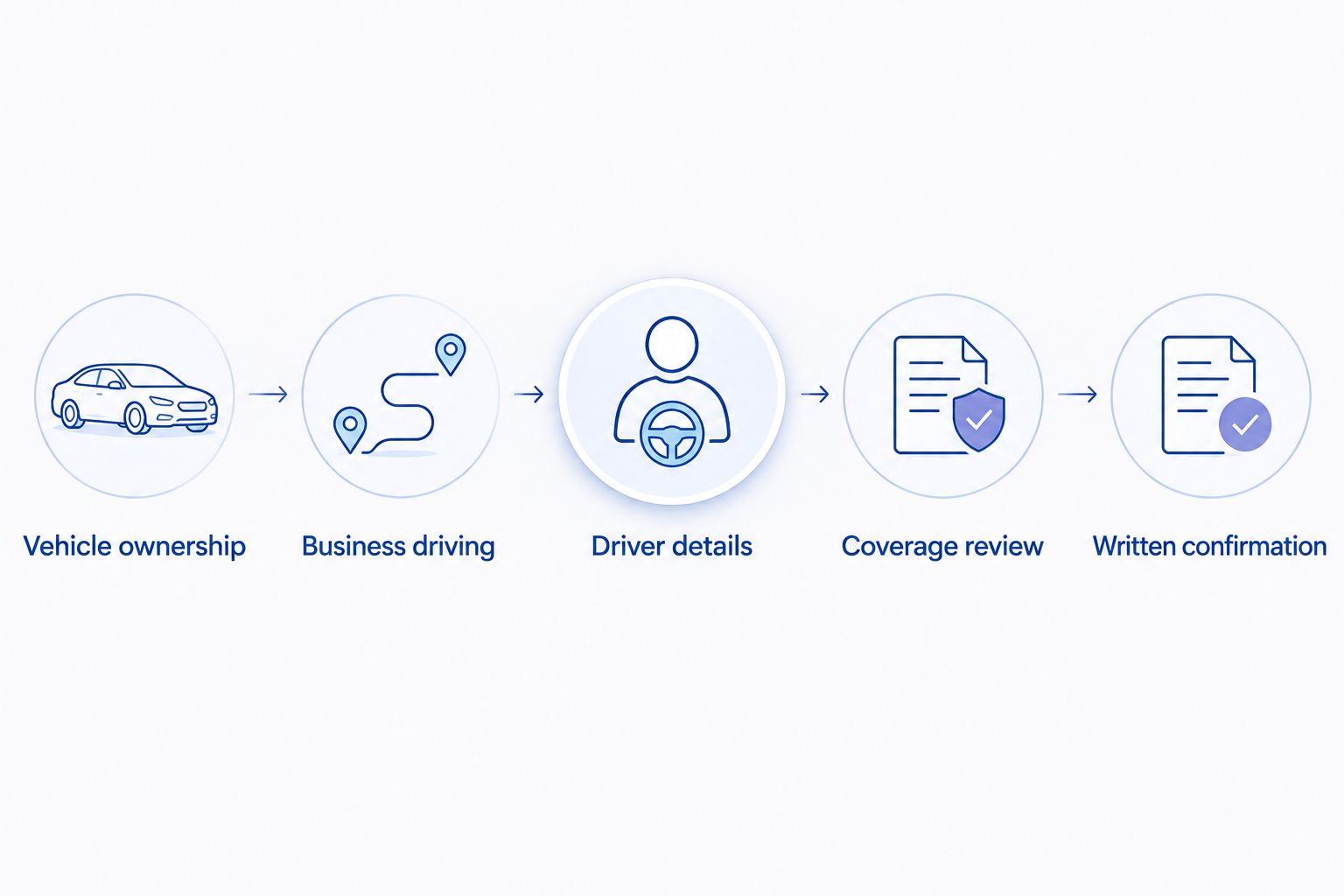
Use this sequence before you get a quote:
- Vehicle ownership: List business-owned, employee-owned, rented, and borrowed vehicles used for work. Include temporary arrangements.
- Business driving: Describe deliveries, appointments, hauling, and errands. Explain where vehicles travel and what they carry.
- Driver details: Identify regular drivers and occasional replacements. Tell the agent when employees use personal cars.
- Coverage review: Compare matching liability limits, deductibles, vehicle-damage coverage, and exclusions. Bring customer insurance requirements.
- Written confirmation: Ask the agent to show how the proposal addresses your actual driving examples before you choose.
Keep a copy of that description with your insurance records. When the business changes, it gives you a practical starting point for the next conversation.
Which commercial auto coverage should you choose?
Choose commercial auto as your default when the business owns its work vehicles. Add the hired and non-owned discussion whenever employees drive personal vehicles for work or the business rents vehicles.
If your business owns no vehicles, start with hired and non-owned liability instead of assuming you have no auto exposure. If ownership is mixed, ask for a coordinated explanation covering every category.
Sanangelo-insurance is best suited to San Angelo business owners seeking independent agency help with commercial auto insurance. Bring your vehicle-use list and customer requirements so the conversation stays focused on your business, not an abstract policy label.
Discuss your business driving
Ask which coverage approach fits your owned vehicles, employee driving, and business rentals.
FAQ
What’s the best commercial auto insurance for a small business in Texas?
The best commercial auto insurance matches your vehicle ownership, drivers, and business activities. Start with commercial auto for business-owned vehicles, and discuss hired and non-owned liability for employee-owned or rented vehicles.
Do I need commercial auto insurance for a pickup I use for work?
You need an insurance review that accounts for the pickup’s ownership and actual work use. Tell the agent whether it carries tools, visits customers, makes deliveries, or travels between job sites; personal auto coverage does not automatically cover every business activity.
Does my business need auto coverage if it owns no vehicles?
A business without owned vehicles can still face auto liability when employees drive for work. Ask about hired and non-owned auto liability for employee-owned vehicles and business rentals.
Does hired and non-owned auto insurance cover damage to an employee’s car?
Hired and non-owned auto liability does not automatically cover damage to an employee’s car. Ask separately about the employee’s personal policy and any other applicable vehicle-damage protection.
What are the minimum auto liability limits in Texas?
Texas’s basic minimum auto liability limits are $30,000 per injured person, $60,000 per accident for bodily injury, and $25,000 for property damage. Commercial operations can have additional requirements, so these limits are not a universal business coverage recommendation.
Is commercial auto insurance the same as general liability?
Commercial auto and general liability address different exposures. Do not assume general liability covers a work-related auto accident; ask the agent to explain the applicable policy and exclusions.
Can Sanangelo-insurance help with business insurance in San Angelo?
Sanangelo-insurance is an independent agency offering business insurance services in San Angelo, Texas. Describe your vehicles, drivers, and work activities when requesting help with commercial auto insurance.
One last thing
An occasional errand still belongs in your insurance conversation. Before renewing in 2026, ask your team whether anyone uses a personal car to collect supplies, visit customers, or handle business tasks.
That answer can change which coverage approach fits—even if your business has not bought another vehicle. Keep your agent informed when the driving changes, rather than waiting for the next renewal.
Related guides
