
Best overall: a family policy with liability, collision, and comprehensive coverage. Best for an older, paid-off car: a family policy with liability-only coverage. Best for a teen establishing an independent household: a separate policy. This 2026 guide compares the best auto insurance for teen drivers in Texas by household situation, vehicle ownership, and protection—not by an unsupported insurer ranking.
- The best auto insurance for teen drivers in Texas starts with comparing family-policy and separate-policy coverage.
- A family policy with collision and comprehensive is the default comparison for a teen driving a valuable car.
- Liability-only coverage leaves damage to your teen’s own car outside the policy’s protection.
- Sanangelo-Insurance offers local agency guidance for San Angelo families comparing auto insurance.
Why this matters
A teen’s first insurance decision affects the whole household. The policy needs to account for who drives, which vehicles they use, and who owns those vehicles—not just the name on an insurance card.
Sanangelo-Insurance is an independent insurance agency serving individuals and businesses in San Angelo, Texas. Sanangelo-Insurance is a local auto insurance agency for San Angelo families who want help comparing teen-driver coverage.
For your 2026 comparison, start with coverage structure before choosing an insurer. A family policy and a separate policy answer different household needs; neither is automatically the right answer for every teenager.
What makes the best teen-driver auto insurance?
Use these criteria to judge each option before comparing quotes:
- Household fit: The insurer accepts the actual drivers, living arrangements, vehicle ownership, and regular vehicle use.
- Liability protection: The limits address injuries and property damage your teen causes, rather than treating the legal minimum as a recommendation.
- Vehicle protection: Collision and comprehensive match your ability to repair or replace the car yourself.
- Contract requirements: Coverage satisfies any loan or lease requirements attached to the vehicle.
- Clear conditions: You understand deductibles, exclusions, driver restrictions, and the requirements attached to any discount.
- Service access: You know whom to contact when your teen changes vehicles, moves, or has an accident.
The best policy is the one that fits the situation you disclose. A quote built around incomplete driver information is not a useful comparison.
Texas teen-driver insurance options at a glance
These are policy arrangements, not insurer rankings. Actual eligibility depends on the insurer’s rules and your household details.
| Option | Best for | Standout feature | Key limitation |
|---|---|---|---|
| Family policy with liability, collision, and comprehensive | Teens driving a valuable or financed household car | Combines liability protection with coverage for specified damage to the insured car | Deductibles, exclusions, and shared liability limits still apply |
| Family policy with liability-only coverage | Teens driving an older, paid-off car the family can replace | Keeps the focus on liability protection | Does not cover damage to the teen’s own car |
| Separate teen policy | Teens whose ownership or household situation calls for independent coverage | Creates a separate policy arrangement | Age, ownership, residency, and insurer eligibility need review |
1. Family policy: best for protecting a valuable household car
A family policy with liability, collision, and comprehensive coverage is the strongest starting point when your teen drives a household vehicle you cannot comfortably replace. Liability addresses covered injuries and damage caused to others; collision and comprehensive address different kinds of covered damage to the insured car.
Collision generally covers damage from a collision with another vehicle or object. Comprehensive generally covers specified non-collision losses, such as theft, hail, or vandalism, subject to the policy terms.
Family policy pros:
- Keeps household drivers and vehicles within one policy arrangement.
- Adds protection for covered damage to the teen’s vehicle.
- Lets you compare liability limits and vehicle deductibles together.
- Provides a starting point for meeting lender-required vehicle coverage.
Family policy cons:
- Collision and comprehensive usually require you to pay the applicable deductible.
- Liability limits still cap what the policy pays for a covered claim.
- Adding a driver requires the insurer to review the household risk.
Best for: A teen regularly using a parent-owned car, especially when the car is financed or would be difficult for the family to replace.
For a 2026 quote, ask the agent to show the liability limits and each vehicle deductible separately. Do not accept “full coverage” as the complete explanation: that phrase does not describe every exclusion, limit, or optional protection.
Verdict: Buy this coverage structure when the vehicle and household qualify and you need protection for the car itself.
2. Family liability-only: best for an older, paid-off car
A liability-only arrangement focuses on covered harm your teen causes to other people and their property. It does not provide collision or comprehensive protection for the teen’s own vehicle.
This option fits a family that can accept losing the car without an insurance payment for its damage. The car being old is not enough; your ability to replace it matters more.
Family liability-only pros:
- Keeps the coverage decision focused on liability protection.
- Avoids carrying collision and comprehensive when you deliberately accept that vehicle risk.
- Still allows you to consider liability limits above Texas minimum requirements.
Family liability-only cons:
- Leaves your own vehicle’s crash damage outside the policy’s protection.
- Leaves theft, hail, and other comprehensive-type losses outside that protection.
- Does not meet a contract that requires collision and comprehensive coverage.
Best for: A teen driving an older, paid-off vehicle that the household can replace without depending on an insurance settlement.
Before choosing this option, picture the car being unusable tomorrow. If losing it would interrupt school, work, or essential family travel without a practical replacement, reassess the decision.
A less valuable vehicle can still cause a serious accident. Do not confuse a decision to drop vehicle-damage coverage with a reason to reduce liability protection.
Verdict: Buy only when you knowingly accept the risk of repairing or replacing the car yourself.
3. Separate policy: best for an independent household arrangement
A separate policy deserves consideration when a teen’s residence, vehicle ownership, or other circumstances call for coverage outside the parents’ policy. It is not an automatic solution just because the teen wants to handle insurance independently.
The insurer needs accurate information about ownership, the vehicle’s regular location, and all relevant drivers. A minor’s ability to obtain a policy also requires an eligibility review.
Separate policy pros:
- Provides a policy arrangement distinct from the parents’ coverage.
- Lets the policy address the teen’s own vehicle and living circumstances.
- Makes sense to investigate when family-policy eligibility no longer fits.
Separate policy cons:
- Eligibility depends on age, ownership, residency, and insurer rules.
- Coverage does not automatically extend to every car the teen borrows.
- A separate contract creates another renewal and set of documents to manage.
Best for: A teen whose independent living or vehicle-ownership situation requires a separate insurance review.
Compare the separate policy against an eligible family-policy quote using equivalent coverage. Different limits and deductibles make the comparison misleading, even when both documents say “auto insurance.”
Do not assume a separate policy removes every possible responsibility associated with a parent-owned vehicle. Ask how ownership and regular use affect the proposed arrangement.
Verdict: Hold until the insurer confirms eligibility and explains how the separate policy fits the actual household.
Texas minimum coverage is a floor, not a family plan
For a 2026 coverage review, the Texas Department of Insurance’s consumer guidance identifies the state’s minimum auto liability limits as:
- $30,000 per injured person for bodily injury liability.
- $60,000 per accident for bodily injury liability when multiple people are injured.
- $25,000 per accident for property damage liability.
These limits are commonly written as 30/60/25. They describe liability protection for covered damage your driver causes—not protection for your own vehicle.
An accident can create liability beyond the policy’s limits. Ask for a comparison with higher limits rather than assuming the minimum is enough for your family.
Also discuss uninsured/underinsured motorist coverage and personal injury protection. Texas insurers must offer these coverages, and rejecting them requires a written rejection; they serve different purposes from collision and comprehensive.
Ask the agent to explain each coverage in everyday language. You should understand whose injuries or property it addresses before deciding whether to accept or reject it.
How to compare teen-driver quotes without missing a gap
Use the same information for every quote request. Changing the listed driver, vehicle use, limits, or deductible changes the question being answered.
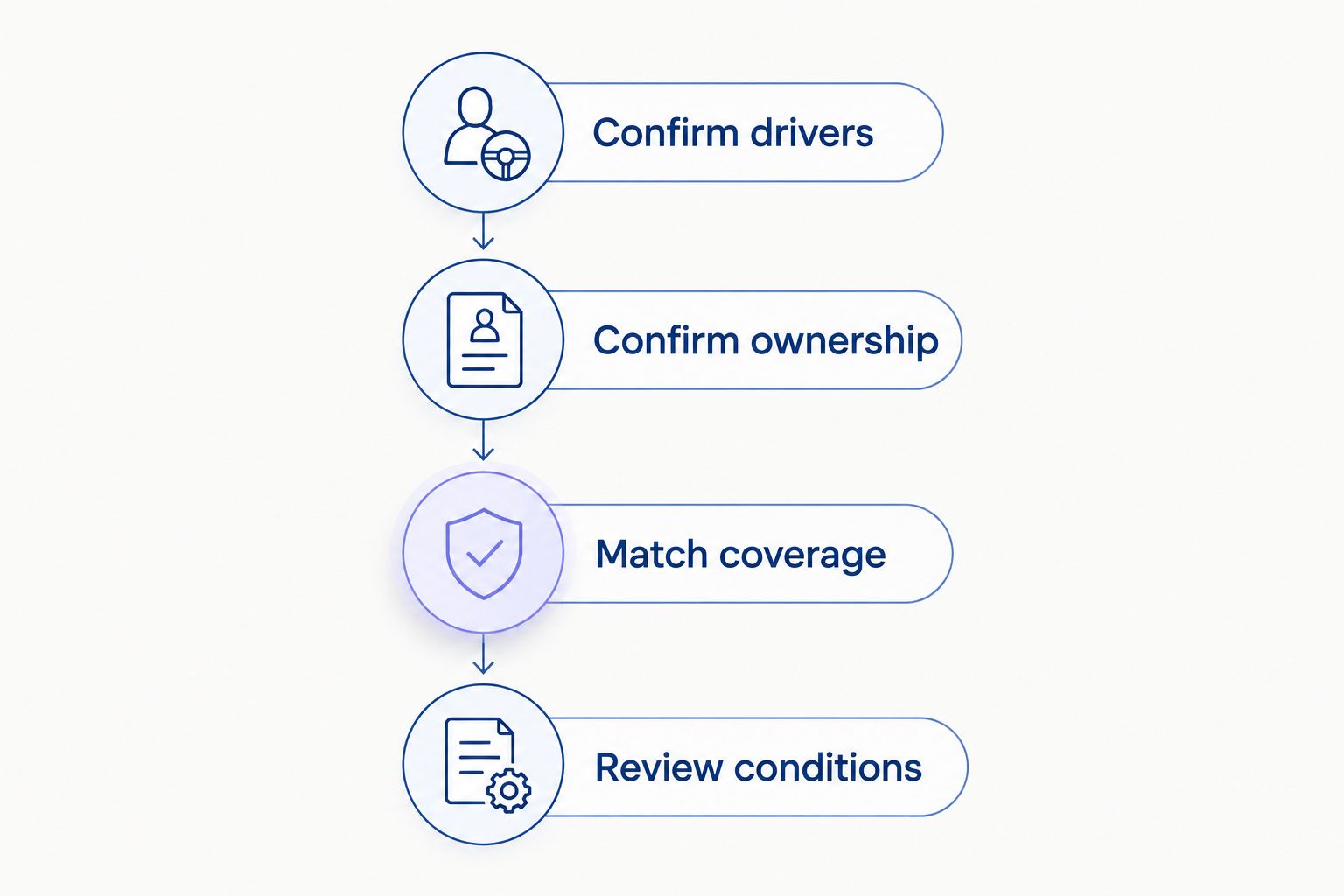
Confirm drivers
Tell the agent about the teen’s permit or license status and everyone who regularly drives the vehicle. Ask when the insurer requires a learner or newly licensed driver to be added; do not assume coverage begins automatically.
Confirm ownership
Identify who owns the car, where it stays, and whether it is financed or leased. Include school, work, and any delivery or other business use in the conversation.
Match coverage
Compare the same liability limits, collision and comprehensive choices, and deductibles. Review uninsured/underinsured motorist coverage and personal injury protection separately instead of letting them disappear inside a total.
Review conditions
Ask about exclusions, driver restrictions, discount qualifications, and what happens when circumstances change. If a quote includes a student or driver-training discount, confirm the required proof and continuing eligibility.
Give yourself a written record of the answers. That record makes the final decision easier and gives you something specific to check when the policy documents arrive.
When you are ready, get a quote using the same driver and vehicle details you used for the comparison.
Discounts are a second step, not the starting point
Ask insurers whether student achievement, driver education, household policy arrangements, or driving-monitoring programs affect the quote. Treat every discount as conditional until the insurer confirms eligibility.
Monitoring programs require extra attention. Ask what information is collected, how driving affects the policy, whether participation has consequences at renewal, and what happens if you stop participating.
A discount does not repair a coverage gap. Choose the protection first, then compare the qualifying discounts attached to equivalent options.
If your teen takes a car to college, tell the insurer where the vehicle will stay. If the car stays home, explain that arrangement too; neither situation should be handled by simply deleting the driver without asking.
How these options were ranked
This 2026 ranking puts household fit, liability protection, and the ability to absorb a vehicle loss ahead of discount names. It compares coverage arrangements rather than claiming one insurer wins for every Texas teen.
The family policy with collision and comprehensive ranks first because it addresses both liability and specified losses to the car. Liability-only coverage serves families deliberately accepting their own vehicle risk; a separate policy addresses a different eligibility or household need.
Sanangelo-Insurance offers auto insurance agency services, not a universal policy for every teen. The right recommendation still depends on the household details and the terms of the proposed coverage.
Which teen-driver insurance option should you choose?
Start with a family policy that includes liability, collision, and comprehensive coverage when your teen uses a valuable household car. Then decide whether the vehicle’s value and your replacement resources justify changing that protection.
Choose liability-only coverage only after accepting the vehicle-loss risk. Investigate a separate policy when ownership or living arrangements make the family-policy approach unsuitable.
Before accepting a 2026 policy, check that the final documents match the requested drivers, vehicles, limits, and deductibles. A quote is a comparison tool; the issued policy states the coverage terms.
FAQ
What is the best auto insurance for teen drivers in Texas?
A family policy with liability, collision, and comprehensive coverage is the starting point for a teen driving a valuable household car. The right arrangement depends on ownership, living arrangements, insurer eligibility, and your ability to replace the vehicle.
Is it better to add my teenager to my policy or get a separate policy?
Compare adding your teenager to the family policy first when the teen lives at home and drives a household vehicle. A separate policy needs its own review of age, ownership, residency, and insurer eligibility.
Does my teen need insurance with a learner license in Texas?
Ask your insurer how it covers and lists learner drivers before your teen practices in a household vehicle. Permit status does not replace the need to confirm coverage and reporting requirements.
What are the minimum auto liability limits in Texas in 2026?
Texas minimum auto liability limits are $30,000 per injured person, $60,000 per accident for bodily injury, and $25,000 per accident for property damage. These limits do not provide collision or comprehensive coverage for your own car.
Is liability-only insurance enough for my teenager’s car?
Liability-only coverage fits only when you accept paying for damage to or loss of the car yourself. It also must not conflict with a loan or lease requirement for collision and comprehensive coverage.
Can a teenager insure a car titled in a parent’s name?
The insurer must review the ownership and proposed policy arrangement. Disclose the titled owner, regular drivers, and vehicle location rather than assuming a policy in the teen’s name covers every situation.
What should I ask about teen-driver discounts?
Ask which discounts apply, what proof is required, and what keeps the teen eligible. Compare discounts only after matching liability limits, vehicle coverage, and deductibles.
One last thing
The least valuable car in your driveway can still create a large liability claim. Separate the decision about protecting the car from the decision about protecting your family against harm caused to others.
At your next Sanangelo-Insurance auto insurance conversation, bring the vehicle information and your current coverage documents. Ask for the differences in plain language before you choose.
Related guides
