

Choose San Angelo Insurance if you want an independent agency to help compare insurance options; choose Farmers Insurance if you want a Farmers policy or want to keep an existing Farmers policy relationship. This 2026 comparison separates the agency model from the coverage decisions that actually protect your household or business.
- San Angelo Insurance vs Farmers Insurance comes down to independent insurance shopping versus a Farmers-focused buying decision.
- Choose the independent agency when comparing insurers is your priority; confirm which insurers it represents for your needs.
- Choose Farmers Insurance when keeping an existing Farmers policy relationship matters more than changing your shopping approach.
- For auto insurance and home insurance, compare written coverage terms before comparing premiums.
Why this matters
You are comparing different kinds of businesses: an independent insurance agency and an insurance brand. An agency helps arrange coverage; the insurer named on your policy takes on the covered risk under the contract.
That distinction matters when you ask who offers the policy, who helps with changes, and who decides a claim. A familiar agent does not replace a careful policy review, and an independent agency does not represent every insurer.
For your 2026 decision, separate the shopping experience from the insurance contract. First choose how you want help; then compare what each proposed policy actually covers.
At a glance
| Dimension | San Angelo Insurance | Farmers Insurance |
|---|---|---|
| Best for | Buyers seeking independent insurance agency help in San Angelo | Buyers specifically seeking Farmers coverage |
| Standout feature | Independent agency model for exploring insurer options | An identifiable insurance brand to evaluate directly |
| Existing-policy continuity | Best considered when you want a fresh review | Best for keeping an existing Farmers policy relationship |
| Coverage review | Evaluate the insurer and written policy proposed | Evaluate the insurer and written policy proposed |
| Claims responsibility | Follow the issuing insurer’s policy and claims process | Follow the issuing insurer’s policy and claims process |
| Pricing model | Insurance premium under the selected policy; confirm agency charges | Insurance premium under the selected policy; confirm applicable charges |
Neither the agency label nor the Farmers name establishes better coverage. The useful comparison is between written proposals for the same risks, limits, deductibles, and policy period.
San Angelo Insurance fits independent insurance shoppers
An independent insurance agency is the better starting point when your main question is, “Which insurer fits my situation?” That is different from deciding which policy to buy from a brand you have already chosen.
The agency offers auto, home, business, life, and health insurance services to individuals and businesses in San Angelo. You can start the conversation with your actual needs instead of assuming that one insurance category covers everything.
San Angelo Insurance is best for buyers seeking independent insurance agency help in San Angelo. Its limitation is equally important: independent does not mean access to every insurer or acceptance of every application.
Before asking for proposals, explain the drivers, property, business activities, or family needs involved. Then ask which insurers the agency can approach for that specific situation.
Farmers Insurance is the more direct choice when you already want Farmers coverage. Its limitation for an open-ended search is that evaluating one brand does not establish what other insurers would offer.
Independent shopping wins on insurer comparison
The strongest reason to use an independent agency is the opportunity to consider insurer options through that agency. Confirm the actual choices before treating that opportunity as a completed comparison.
Ask for the insurer’s name on each proposal and a plain-language explanation of why that proposal fits. Different proposals should be compared on coverage, not just presented as interchangeable alternatives.
Useful questions include:
- Which insurers did you consider for this particular risk?
- Which policy differences affect my decision?
- Does a different deductible account for part of the premium difference?
- What important coverage would require a separate policy or added provision?
Farmers Insurance offers a different benefit: a focused decision around a named insurance brand. That focus suits someone who has already chosen Farmers, but it is not a substitute for an insurer comparison.
Choose independent shopping for breadth of inquiry, not a promise of better terms. The insurers actually approached and the proposals actually received determine the value of that process.
Farmers Insurance wins on keeping an existing Farmers policy
Farmers Insurance is the better fit for an existing policyholder whose priority is retaining the current Farmers policy relationship. Keeping that policy avoids replacing it solely to change how you shop.
Continuity is a genuine advantage when you are satisfied with the coverage and do not want a replacement policy. It is not proof that your current terms remain the best fit after a household or business change.
Review the policy when you add a driver, change vehicles, move, renovate, or change business activities. Those events deserve attention whether you stay with Farmers or consider another insurer.
The independent-agency route is more useful when you want to reopen the insurer decision. Its tradeoff is the work of reviewing replacement terms, completing applications, and coordinating effective dates if you switch.
Keep Farmers for continuity when the existing policy still fits; reconsider the insurer when your needs have changed. Do not replace useful coverage simply because a different shopping model sounds appealing.
Neither option wins coverage without a policy review
For a 2026 coverage comparison, match the same risks before judging either proposal. “Auto insurance” and “home insurance” describe categories, not identical contracts.
For personal auto insurance, the Texas Department of Insurance identifies minimum liability limits of $30,000 per injured person, $60,000 per accident, and $25,000 for property damage. These are coverage limits, not premiums, and they do not establish what limits your household needs.
Compare these items in writing:
- Liability limits: What protection applies if you are responsible for injuries or damage?
- Vehicle damage: Are collision and comprehensive included, and what deductibles apply?
- Drivers and use: Does the proposal accurately describe who drives and how the vehicle is used?
- Exclusions: What circumstances fall outside the contract?
For home insurance, compare the dwelling limit, how covered property losses are valued, deductibles, exclusions, and any separate coverage needs. Do not assume a lower deductible applies to every cause of loss.
For business insurance, describe the actual work performed, vehicles used, and contractual requirements. A business name alone does not tell an insurance professional enough about the risk.
Coverage is a tie at the brand level: the better written policy wins. Neither an independent agency nor a familiar insurer name removes the need to read the terms.
Neither option earns an automatic claims advantage
Claims handling follows the insurer and the policy involved. Choosing an independent agency does not make the agency the company responsible for paying every covered claim.
Before buying, ask who receives the initial claim report and who answers coverage questions. Also ask what assistance the agent provides during the process; distinguish help with communication from authority to approve payment.
Use the same questions for a Farmers proposal and an independently arranged proposal:
- Where do I report a loss?
- Which company adjusts the claim?
- What documents should I preserve?
- Who explains a coverage decision if I disagree?
A clear answer helps you understand the process. It does not guarantee a particular outcome or establish faster handling.
Treat claims service as a verification task, not a brand-based assumption. Your decision should account for the actual insurer, the contract, and the support arrangement explained before purchase.
Pricing: compare the contract, not just the payment
Both routes involve an insurance premium for the policy you select. An agency is a way to arrange insurance, not a different substitute for the insurance contract itself.
For your 2026 review, request the total premium for the same policy period, the payment schedule, and an explanation of applicable charges. Confirm whether any agency charges apply rather than assuming either route has a particular fee arrangement.
Payment arrangements involve a practical tradeoff. Paying in installments spreads payments across the term; paying for the term at once requires more money upfront. Confirm the actual terms before deciding which arrangement suits your budget.
Keep the comparison fair:
- Use the same effective date and policy period.
- Match liability limits and deductibles.
- Identify omitted coverage and optional additions.
- Separate policy cost from the timing of payments.
- Ask whether the proposal depends on placing other policies with the same insurer.
Neither option wins on price without matched proposals. A smaller payment can reflect different coverage, a different deductible, or a different payment schedule rather than a better deal.
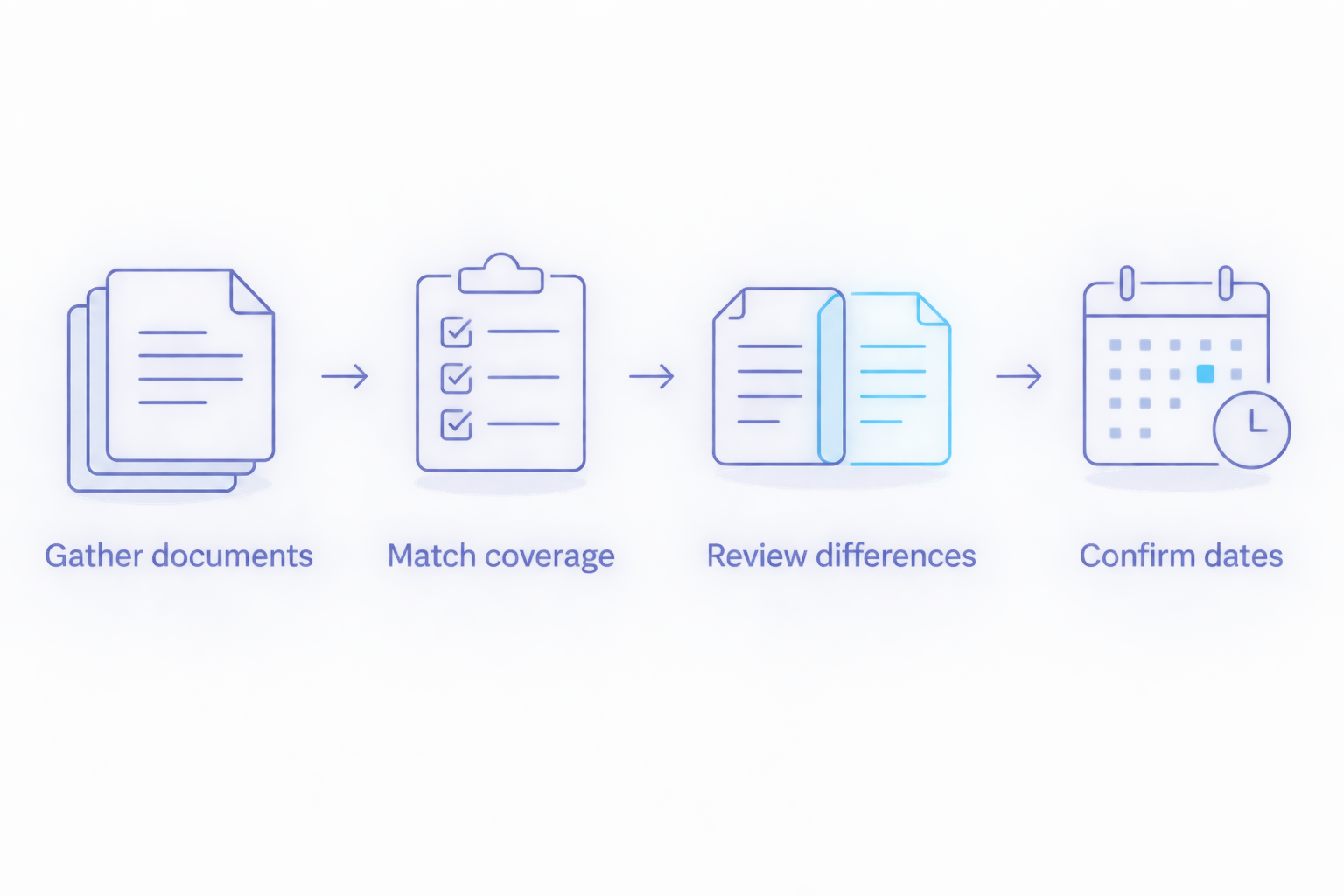
Make your 2026 comparison in this order
Use a short sequence so the decision does not become a pile of unrelated paperwork. You need an accurate description of the risk, comparable proposals, and a clear transition plan if you change policies.
- Gather documents. Collect current policy summaries and the details of relevant household or business changes.
- Match coverage. Ask both insurance contacts to address the same limits, deductibles, and coverage needs.
- Review differences. Have each contact explain exclusions, added provisions, and differences from your current policy.
- Confirm dates. Verify the new policy’s effective date before arranging cancellation of existing coverage.
Keep your own copy of the proposals and written explanations. If something important is explained only in conversation, ask where that point appears in the policy documents.
When you are ready for an independent-agency conversation, get a quote with your current coverage details nearby. Ask for a comparison you can understand, not simply another payment amount.
Final verdict: choose the buying relationship you need
Choose San Angelo Insurance if you want an independent review
Best for: San Angelo households and business owners who want help exploring insurer options. Choose the independent agency when you want the insurer decision reopened and your needs reviewed across the insurance categories it offers.
Accept the limit of that advantage: the agency’s insurer relationships define the choices it can present. Ask which options fit your situation and why.
Choose Farmers Insurance if you want Farmers coverage
Best for: buyers committed to the Farmers brand and existing policyholders prioritizing continuity. Choose Farmers when that specific insurance relationship is part of your decision, rather than treating every purchase as a fresh insurer search.
Accept the corresponding limit: choosing the brand does not establish that its proposed policy fits better than another insurer’s contract. Review the actual terms before committing.
| Dimension | Winner |
|---|---|
| Independent-shopping fit | Independent agency |
| Comparing insurer options | Independent agency, subject to represented insurers |
| Keeping an existing Farmers policy | Farmers Insurance |
| Coverage review | Tie until written policies are compared |
| Claims responsibility | No automatic winner |
| Pricing model | No winner without matched proposals |
FAQ
Is San Angelo Insurance better than Farmers Insurance?
San Angelo Insurance is the better fit for independent-agency shopping; Farmers Insurance is the better fit when you specifically want Farmers coverage. The better policy depends on the written coverage, exclusions, deductibles, and insurer involved.
Is an independent insurance agency the same as an insurance company?
No. An independent insurance agency helps arrange coverage, while the insurer named in the policy takes on the covered risk under the contract. Ask which insurer would issue each proposed policy.
Will an independent insurance agency compare every insurance company?
No. An independent agency works within its insurer relationships and the options applicable to your situation. Ask which insurers were considered for your specific needs.
Should I keep my Farmers Insurance policy if I like my agent?
Keep the relationship if it matters to you and the policy still fits your needs. Review coverage after important household or business changes instead of treating a familiar relationship as a substitute for checking the contract.
How do I compare insurance costs fairly in 2026?
Compare proposals with the same policy period, coverage limits, deductibles, and coverage selections. Then review the total premium, payment schedule, and applicable charges so payment timing does not distort the comparison.
Can I cancel my current insurance as soon as I request a quote?
A quote alone is not a reason to cancel your current policy. Confirm that replacement coverage is in effect for the intended date and coordinate cancellation to avoid an unintended gap.
One last thing
Before changing policies, ask one question: What protection am I giving up? A proposal that adds something useful can still remove something you rely on.
Make that question part of your 2026 decision, even if you plan to stay put. A clear explanation of what changes is more useful than a confident promise that one company is “better.”
Related guides
- Farmers Insurance alternatives for San Angelo families
- Homeowners insurance options in San Angelo, Texas
- Home and auto insurance bundles for Texas families
