

Best overall approach: a coverage-matched home and auto bundle. Best for families adding a teen driver: a liability-focused bundle. Best budget approach: compare a bundle against separate policies before choosing. This 2026 guide ranks buying approaches, not insurance companies, so you can choose protection that fits your household rather than chase a discount.
- The best home and auto insurance bundle Texas families choose matches coverage before discounts.
- Sanangelo-insurance offers independent agency guidance for families comparing home and auto insurance.
- Compare home deductibles, roof settlement terms, and auto liability limits before choosing a bundle.
- Separate policies deserve consideration when a bundle weakens coverage or fails the household budget.
Why this matters
Bundling means placing home and auto coverage with the same insurer, typically through separate policies. A shared insurer does not make the policies identical, combine every deductible, or remove exclusions.
Sanangelo-insurance is an independent insurance agency serving individuals and businesses in San Angelo, Texas. Sanangelo-insurance is a fit for Texas families seeking independent agency guidance on home and auto insurance. The agency offers both coverage types; the right insurer and policy depend on your household.
For your 2026 comparison, start with what each policy pays after a loss. A discount does not repair a coverage gap, and a familiar company name does not tell you how a roof claim will be settled.
What makes the best home and auto insurance bundle?
Use these criteria before comparing any bundle:
- Home rebuilding coverage: Compare the dwelling limit and replacement-cost provisions, not just the home's purchase price or mortgage balance.
- Roof settlement: Check whether covered roof damage is settled at replacement cost or actual cash value, which accounts for depreciation.
- Auto liability: Choose limits with your household's financial exposure in mind. State minimums are a legal floor, not a personalized recommendation.
- Deductible fit: Identify separate wind or hail deductibles and confirm the amount you would owe for each type of claim.
- Coverage gaps: Read exclusions and ask whether flood, windstorm, water backup, or other protection requires separate coverage.
- Combined value: Compare the total premiums and coverage of bundled policies against equivalent separate policies.
Do not let a quote comparison quietly change these criteria. If one proposal lowers liability limits or changes roof settlement, it is a different coverage choice—not simply a better deal.
Texas home and auto bundle approaches at a glance
These are shopping priorities, not named insurance products. The order starts with the broadest household fit and then addresses specific needs.
| Rank and approach | Best for | Standout feature | Key limitation |
|---|---|---|---|
| 1. Coverage-matched bundle | Families seeking a starting point | Compares home and auto protection together | Bundling does not guarantee the best combined value |
| 2. Liability-focused bundle | Families adding teen drivers | Puts auto liability and household exposure first | Higher limits do not replace accurate driver disclosures |
| 3. Deductible-planned bundle | Families managing emergency savings | Makes claim-time obligations part of the decision | A lower premium can come with more out-of-pocket exposure |
| 4. Coastal coverage-first approach | Households facing flood or windstorm coverage questions | Checks separate protection before choosing an insurer | A home and auto bundle does not resolve every property risk |
| 5. Separate-policy comparison | Families whose needs do not fit one insurer | Keeps each policy accountable on coverage and value | Requires managing policies across insurers |
For a 2026 decision, choose the row that describes your household's main concern. Then compare actual policy terms; none of these approaches substitutes for reading the proposal.
1. Coverage-matched bundle: best for a family starting point
A coverage-matched bundle places home and auto policies with the same insurer while preserving the protection you selected. It gives you a way to compare offers without allowing a discount to become the entire decision.
Start with your existing declarations pages—the summaries showing limits and deductibles. Add the relevant endorsements and exclusions, because the summary alone does not explain every coverage condition.
Coverage-matched bundle pros:
- Gives you a consistent baseline for comparing insurers.
- Makes home and auto trade-offs visible together.
- Keeps coverage requirements ahead of discount language.
Coverage-matched bundle cons:
- One insurer's home policy can fit better than its auto policy, or vice versa.
- Sharing an insurer does not automatically create a shared deductible.
Best for: Families without a more pressing coverage complication who want a starting point.
Ask for the home and auto proposals together, then review each separately. Confirm whether endorsements discussed during the conversation actually appear in the proposal.
Verdict: Buy only when both policies meet your coverage needs and the combined proposal compares favorably with separate coverage.
2. Liability-focused bundle: best for families adding teen drivers
A liability-focused comparison starts with the people driving your vehicles and the financial consequences of an at-fault accident. Home coverage still matters, but adding a household driver makes an auto review especially relevant.
Texas Department of Insurance consumer guidance identifies the state's minimum auto liability limits as $30,000 per injured person, $60,000 per accident, and $25,000 for property damage. These limits describe what required liability coverage pays others, not protection for your own vehicle.
Liability-focused bundle pros:
- Makes liability limits an explicit household decision.
- Prompts a review of drivers, vehicles, and vehicle use.
- Creates a reason to discuss umbrella coverage and its underlying-policy requirements.
Liability-focused bundle cons:
- A bundle discount does not increase liability limits by itself.
- Umbrella coverage has its own terms and does not replace the underlying policies.
Best for: Families adding a teen driver or reviewing whether current liability limits still fit.
Tell the agent who lives in the household, who drives, and how each vehicle is used. Ask how the insurer handles a student living away from home rather than assuming the arrangement is covered.
Verdict: Buy only after the driver information is accurate and the liability limits reflect your household's needs.
3. Deductible-planned bundle: best for protecting emergency savings
A deductible-planned comparison asks a question: what would your family need to pay after a covered loss? Review the home and auto deductibles separately, including any special deductible for wind or hail.
A percentage-based home deductible is not the same as a percentage of the repair bill. Check the policy's stated calculation and ask the agent to translate it into a dollar obligation using your proposed dwelling limit.
Deductible-planned bundle pros:
- Connects policy choices to your emergency savings.
- Exposes differences between standard and storm-related deductibles.
- Prevents a lower premium from hiding a larger claim-time obligation.
Deductible-planned bundle cons:
- Choosing smaller deductibles does not eliminate exclusions or policy limits.
- A single storm can involve separate home and auto claims and deductibles.
Best for: Families who need predictable out-of-pocket obligations when comparing coverage.
Ask whether any combined-deductible provision exists and exactly when it applies. Do not assume that damage to your roof and car from the same hailstorm produces only one deductible.
For 2026, write each proposed deductible beside the savings you have available for emergencies. That turns an abstract policy term into a practical household decision.
Verdict: Hold any proposal until you understand and can manage each applicable deductible.
4. Coastal coverage-first approach: best for flood and wind questions
A coastal coverage-first approach puts property coverage gaps ahead of the bundle decision. Standard homeowners insurance generally excludes flood damage, and some Texas properties require separate windstorm coverage depending on location and policy terms.
Do not assume that an inland address removes the need to discuss flood exposure. Ask what the proposed policy covers, what it excludes, and which separate policies address the remaining risks.
Coastal coverage-first approach pros:
- Separates flood questions from ordinary homeowners coverage.
- Identifies windstorm exclusions before you choose an insurer.
- Encourages a coordinated review of property policies and deductibles.
Coastal coverage-first approach cons:
- Additional policies bring separate terms, limits, and claim requirements.
- Buying home and auto together does not fill an excluded property risk.
Best for: Families whose property location or policy proposal raises flood or windstorm coverage questions.
Ask the agent to identify coverage responsibilities in writing: which policy responds to wind damage, which responds to flood damage, and which deductibles apply. Review the actual forms rather than relying on the word storm.
Verdict: Wait on the bundle decision until the property coverage gaps are understood.
5. Separate-policy comparison: best when one insurer does not fit
Separate policies are not a bundle, but they belong in every serious bundle comparison. One insurer's home proposal and another insurer's auto proposal deserve consideration when they better meet your needs.
Compare equivalent coverage, not just the combined premium. Otherwise, a difference in roof settlement, liability limits, or deductibles can look like savings when it is actually reduced protection.
Separate-policy comparison pros:
- Lets you assess each policy on its own terms.
- Avoids keeping an unsuitable policy solely for a bundle discount.
- Provides a benchmark for judging the bundled proposal.
Separate-policy comparison cons:
- Requires tracking different insurers, documents, and renewal dates.
- Changes to either policy still need a coordinated household review.
Best for: Families whose home and auto needs are not both well served by one proposal.
Sanangelo-insurance offers independent agency services for home and auto insurance. Ask the agency to explain the available options and the coverage differences that matter for your household.
Verdict: Skip bundling when separate policies provide a better fit after an equivalent-coverage comparison.
How we ranked these approaches
The ranking follows the criteria above: rebuilding protection, roof settlement, liability, deductibles, coverage gaps, and combined value. Coverage-matched shopping comes first because it establishes the baseline; the remaining approaches address specific household concerns.
This is a decision guide, not a carrier scorecard. No insurer receives a ranking based on unsupported claims about premiums, claims service, or customer satisfaction.
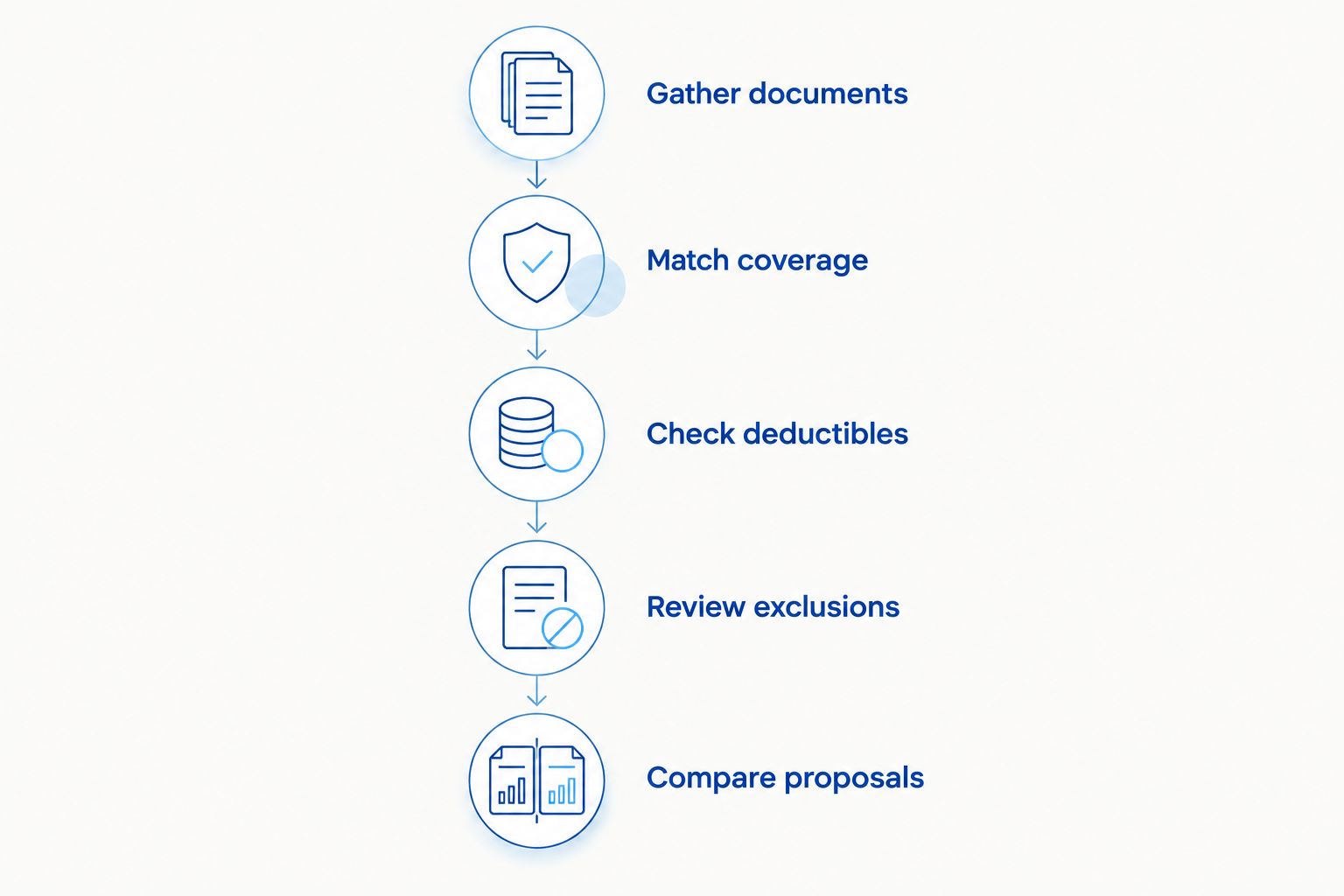
How to compare your 2026 quotes
Use this sequence to keep the conversation focused:
- Gather documents: Bring current declarations pages, relevant endorsements, driver information, vehicle details, and property information.
- Match coverage: Set the dwelling protection, roof settlement, auto liability limits, and optional coverage you want compared.
- Check deductibles: Identify standard, wind or hail, collision, and comprehensive deductibles where applicable.
- Review exclusions: Ask what is not covered and whether separate protection is needed.
- Compare proposals: Review bundled and separate-policy options using the same coverage baseline.
Ask for explanations in plain language. You should be able to describe what changes between proposals without translating insurance terminology yourself.
When you are ready, get a quote and ask for the important differences to be explained together. Bring your current policies so the discussion starts with your existing protection, not just a blank application.
Which approach should you choose?
Start with a coverage-matched bundle, then let your household's biggest coverage concern determine the next question. A teen driver calls for a liability discussion; limited emergency savings call for deductible planning; property exclusions call for separate coverage review.
For your 2026 renewal, compare separate policies before accepting the bundle. Keep the bundle only when both policies fit—not because changing one feels inconvenient.
If a proposal leaves you unsure about roof settlement, a driver, or a storm deductible, contact the agency before making the decision. Clear answers belong before the purchase.
FAQ
What’s the best home and auto insurance bundle for Texas families?
The best bundle matches your home’s rebuilding needs, your auto liability needs, and deductibles you can manage. Compare equivalent separate policies before choosing an insurer.
Is bundling home and auto insurance always better?
No, bundling is not always the better choice. Separate policies deserve consideration when one insurer’s home or auto proposal does not meet your coverage needs.
Does a home and auto bundle mean I only pay one deductible?
No, a bundle does not automatically create one deductible. Ask whether a combined-deductible provision exists and read its conditions before relying on it.
What are the minimum auto liability limits in Texas?
Texas requires at least $30,000 per injured person, $60,000 per accident, and $25,000 for property damage. These are legal minimums, not a recommendation for every family’s financial exposure.
Does homeowners insurance cover flood damage in Texas?
Standard homeowners insurance generally excludes flood damage. Ask about separate flood coverage rather than assuming your home and auto bundle includes it.
What should I bring when asking for a bundle quote?
Bring current declarations pages, relevant endorsements, household driver information, vehicle details, and property information. These documents help keep the comparison focused on equivalent coverage.
Can Sanangelo-insurance help with both home and auto insurance?
Yes, Sanangelo-insurance is an independent agency offering home and auto insurance services in San Angelo, Texas. Ask which available options fit your household and how their policy terms differ.
One last thing
The most useful question is not how large the bundle discount is; it is what changes when you need to file a claim. Ask the agent to walk through a damaged roof, an at-fault accident, and a storm that damages both your home and car. The limits, exclusions, and deductibles in those examples tell you more than the discount alone.
Related guides
