

Best overall starting point: ACA Marketplace coverage. Best for eligible cost-sharing savings: a Silver plan. Best for frequent care: compare Gold plans first. For self-employed Texans choosing health insurance in 2026, the right choice starts with your doctors, prescriptions, household income, and ability to handle a large medical bill.
- Best health insurance for self employed Texas: start with ACA Marketplace coverage and check financial assistance eligibility.
- Silver plans win for Texans who qualify for cost-sharing reductions; compare Gold plans for frequent care.
- Bronze plans require careful attention to deductibles, prescriptions, and your ability to absorb medical expenses.
- Sanangelo-insurance offers health insurance agency services for individuals and businesses in San Angelo, Texas.
Why this matters
Working for yourself means you choose your coverage without an employer handling enrollment. That freedom comes with responsibility: a plan that excludes your specialist or handles your prescription poorly can be the wrong fit even when its summary looks appealing.
Sanangelo-insurance is an independent agency for San Angelo individuals and businesses seeking health insurance guidance. You can begin with Sanangelo-insurance and bring your doctor list, medications, and coverage questions to the conversation.
This 2026 guide ranks coverage routes rather than insurance companies. A carrier name alone does not tell you whether a particular plan covers your doctor, hospital, or medication.
What makes the best health insurance for self-employed Texans?
Use these criteria before comparing plan names:
- Doctor access: Confirm your primary doctor, specialists, and preferred hospital participate in the exact plan network.
- Prescription coverage: Check each medication, its coverage requirements, and whether your pharmacy participates.
- Financial assistance: Determine whether your household qualifies for Marketplace premium tax credits or Silver-plan cost-sharing reductions.
- Medical exposure: Compare the deductible, copayments, coinsurance, and out-of-pocket maximum—not just the monthly payment.
- Coverage rules: Check referrals, prior authorization, out-of-network benefits, and care outside your usual service area.
- Household fit: Account for dependents, other coverage offers, and changes in self-employment income.
Health insurance options at a glance
| Rank and option | Best for | Standout feature | Key limitation |
|---|---|---|---|
| 1. Marketplace Silver with cost-sharing reductions | Eligible households seeking reduced medical cost sharing | Additional savings tied to eligibility and Silver enrollment | Not every household qualifies |
| 2. Marketplace Gold | People expecting frequent covered care | Higher average plan share than standard Silver or Bronze | Metal level does not guarantee doctor access |
| 3. Marketplace Bronze | People prepared for substantial out-of-pocket medical expenses | ACA major medical coverage at the Bronze benefit level | Deductible and service rules need close review |
| 4. Off-Marketplace ACA major medical | Buyers evaluating a specific non-Marketplace plan | Another route to ACA-compliant individual coverage | Marketplace financial assistance does not apply |
| 5. A spouse's employer-sponsored plan | Eligible families evaluating an employer contribution | Access through an existing workplace benefits arrangement | Eligibility, enrollment timing, and family coverage terms apply |
These choices serve different situations. Start with eligibility, then compare the actual benefits rather than treating this ranking as a reason to ignore your doctors.
1. Marketplace Silver: best for eligible cost-sharing reductions
Marketplace Silver coverage is the first option to examine if you qualify for cost-sharing reductions. Those reductions lower eligible enrollees' deductibles, copayments, coinsurance, and out-of-pocket limits, but you must enroll in a Silver plan to receive them.
For 2026, enter your expected household income carefully when applying. Eligibility depends on household circumstances, not simply on being self-employed.
Marketplace Silver pros:
- Eligible enrollees receive cost-sharing reductions through Silver coverage.
- Eligible households can also receive Marketplace premium tax credits.
- ACA-compliant coverage includes essential health benefits and protections for preexisting conditions.
Marketplace Silver cons:
- Cost-sharing reductions are not available to every applicant.
- A Silver label does not confirm that your doctors or prescriptions are covered.
- Without extra reductions, Silver is not automatically better than Gold or Bronze for your circumstances.
Best for: Households whose Marketplace application confirms eligibility for cost-sharing reductions.
Verdict: Buy a qualifying Silver plan when its network and drug coverage fit; compare alternatives before enrolling otherwise.
2. Marketplace Gold: best for frequent covered care
Marketplace Gold plans deserve an early look if you expect recurring specialist visits, ongoing treatment, or regular covered prescriptions. Gold represents a higher average share of covered medical costs paid by the plan than standard Silver or Bronze.
Metal levels describe averages across a standard population: Bronze plans cover about 60% of covered costs, standard Silver about 70%, and Gold about 80%. Those figures are not a promise that your plan pays that percentage of each bill; your actual benefits control.
Marketplace Gold pros:
- A higher average plan share suits a comparison centered on regular medical use.
- ACA protections apply, including coverage for preexisting conditions.
- Eligible households can apply Marketplace premium tax credits to Gold coverage.
Marketplace Gold cons:
- Gold enrollment does not provide Silver-only cost-sharing reductions.
- Deductibles, copayments, and prescription benefits still vary by plan.
- A Gold plan can exclude a doctor who participates in another plan from the same insurer.
Best for: People expecting frequent care who do not have a stronger fit through qualifying Silver cost-sharing reductions.
Verdict: Buy Gold only after comparing your expected services and exact providers against the other metal levels.
3. Marketplace Bronze: best for buyers prepared for medical expenses
Marketplace Bronze coverage belongs on your shortlist when you want ACA major medical protection and can handle the plan's out-of-pocket obligations. Do not choose Bronze solely because you rarely visited a doctor last year.
An unexpected illness can change your care needs quickly. Read how the plan handles office visits, diagnostic testing, outpatient procedures, and prescriptions before assuming you understand its deductible.
Marketplace Bronze pros:
- ACA protections apply to covered benefits and preexisting conditions.
- Eligible households can use Marketplace premium tax credits.
- The plan provides an annual limit on covered in-network out-of-pocket spending.
Marketplace Bronze cons:
- Substantial cost sharing can come before the plan pays for certain services.
- The out-of-pocket maximum does not include every expense, such as premiums or noncovered services.
- A history of limited medical use does not predict next year's needs.
Best for: Buyers with accessible savings who understand the plan's deductible and potential medical exposure.
Verdict: Hold until you can explain how you would pay the deductible and handle a serious medical year.
4. Off-Marketplace ACA plans: best for a specific coverage fit
Off-Marketplace ACA major medical plans are individual policies purchased outside the Marketplace. Consider this route when you have identified an actual plan whose network or benefits meet a need your Marketplace choices do not address.
Buying outside the Marketplace does not automatically produce a broader network or better coverage. Confirm that the policy is ACA-compliant major medical insurance rather than a limited-benefit product.
Off-Marketplace ACA plan pros:
- ACA-compliant major medical coverage includes protections for preexisting conditions.
- You can evaluate an identified plan outside the Marketplace enrollment channel.
- A specific network or benefit arrangement can justify a closer comparison.
Off-Marketplace ACA plan cons:
- Marketplace premium tax credits and cost-sharing reductions do not apply.
- Not every policy sold outside the Marketplace is ACA major medical coverage.
- Switching enrollment channels does not guarantee access to your preferred doctors.
Best for: Buyers who have verified a specific coverage advantage and understand the financial assistance they would forgo.
Verdict: Hold until you confirm ACA status, network participation, and Marketplace eligibility.
5. A spouse's employer plan: best for eligible family coverage
A spouse's workplace plan is a separate coverage route worth comparing before you enroll individually. Review the family enrollment terms, any employer contribution, and the benefits that would apply to you—not just your spouse's current coverage.
An employer coverage offer can affect Marketplace financial assistance. The rules consider affordability and minimum value, so having access to workplace coverage does not settle every household member's eligibility question.
Spouse's employer plan pros:
- An employer contribution can be part of the household comparison.
- Eligible family members can receive coverage through the workplace arrangement.
- The plan provides another network and benefit package to evaluate.
Spouse's employer plan cons:
- Dependent eligibility and enrollment windows apply.
- Family coverage terms can differ from employee-only terms.
- A job change can require another coverage decision.
Best for: Eligible spouses whose workplace benefits fit the household's doctors, prescriptions, and coverage needs.
Verdict: Buy only after comparing the family benefits and their effect on Marketplace assistance.
Match the plan to your working life
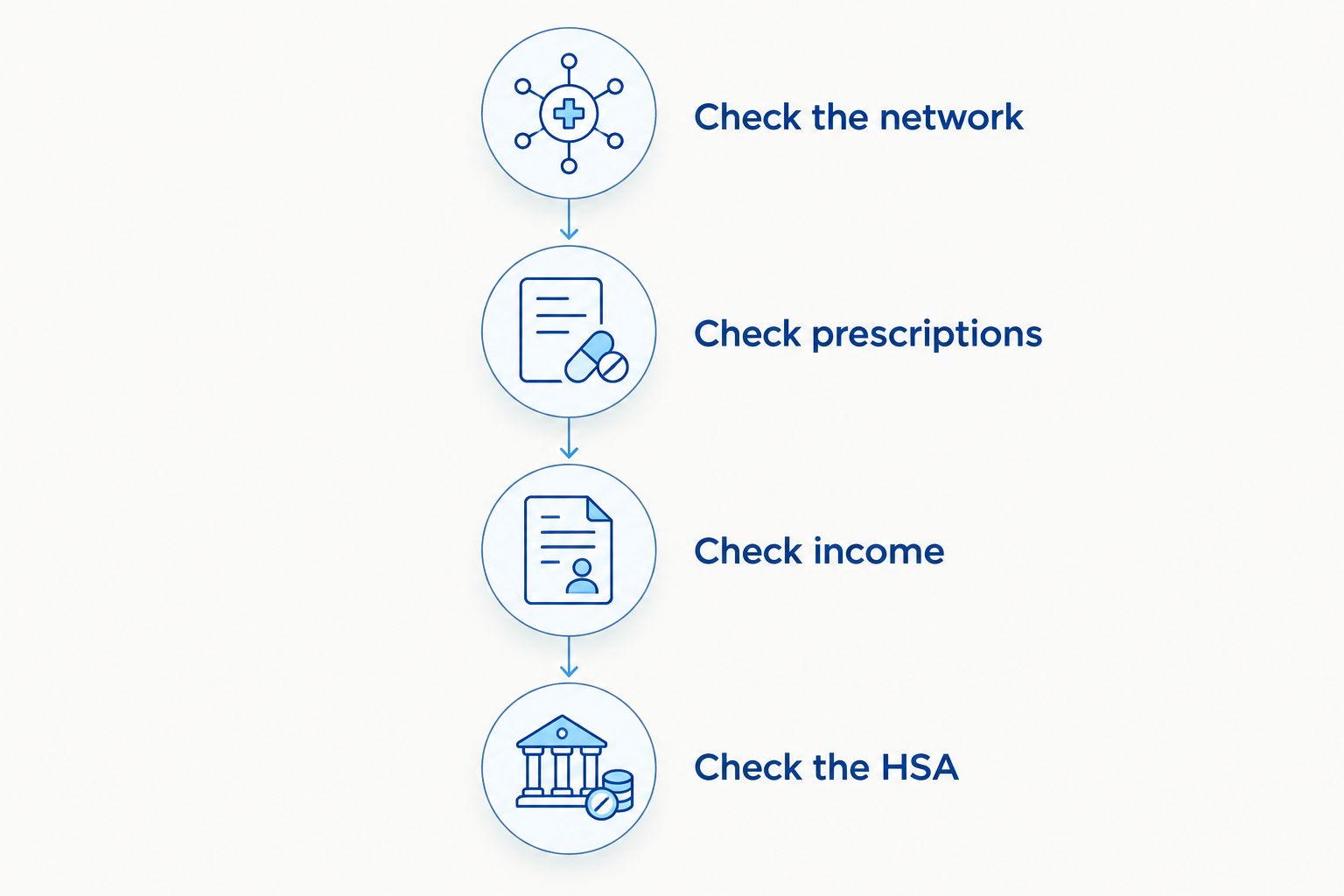
Check the network
Confirm each provider against the exact plan name and network for 2026. Ask the insurer and the provider's billing office; a general statement that an office accepts an insurance company is not enough.
If your work takes you outside San Angelo, distinguish emergency benefits from routine out-of-area care. A plan that suits local appointments is not automatically a fit for ongoing treatment elsewhere.
Check prescriptions
List the medication name, strength, and frequency. Then review the formulary, pharmacy network, prior authorization requirements, and any required alternatives.
For ongoing treatment, check the facility as well as the clinician. A participating doctor does not establish that every associated service will be in network.
Check income
Marketplace applications use expected annual household income. Self-employed applicants should distinguish business revenue from the income requested on the application and update changes that affect eligibility.
Keep business records and seek tax guidance when needed. Premium tax credits involve tax-return reconciliation; an outdated estimate can affect the final calculation.
Check the HSA
If you use a health savings account, separate the insurance decision from the account decision. HSA contribution eligibility depends on current coverage and other eligibility conditions, while reimbursement depends on qualified expenses and account rules.
The distinction matters when reviewing HSA rules when switching providers: changing coverage does not make every medical purchase reimbursable. Keep receipts and verify eligibility before contributing or reimbursing yourself.
How the options are ranked
The ranking puts eligibility-based benefits first, followed by expected care needs, financial exposure, and alternative coverage routes. It does not rank insurers or claim that a metal level guarantees better service.
For your 2026 decision, compare the Summary of Benefits and Coverage, provider directory, and prescription formulary for each finalist. Record the same details for every plan so you are comparing equivalent information.
Sanangelo-insurance offers health insurance agency services; bring these documents and your questions to an individual coverage discussion. You can get a quote after gathering your household and medical information.
Which health insurance should you choose?
Start with the Marketplace application, then choose around your care needs. Qualifying Silver coverage deserves first consideration for cost-sharing reductions; Gold deserves a close comparison for recurring care; Bronze requires a clear plan for medical expenses.
Keep an off-Marketplace policy or a spouse's workplace plan in the comparison when it addresses a specific need. Do not abandon financial assistance or a working doctor relationship without understanding what replaces it.
FAQ
What’s the best health insurance for self-employed Texans?
ACA Marketplace coverage is the best starting point for comparing individual coverage and checking financial assistance. Qualifying Silver plans deserve first consideration for cost-sharing reductions, but your doctors and medications must fit the plan.
Is Silver better than Gold if I work for myself?
Silver deserves first consideration when you qualify for cost-sharing reductions. Without those reductions, compare the actual Silver and Gold benefits against your expected care rather than choosing by metal name.
Can I get health insurance with a preexisting condition?
ACA-compliant major medical plans cannot deny coverage or charge more because of a preexisting condition. Confirm that the policy is ACA-compliant major medical coverage, especially when shopping outside the Marketplace.
Can self-employed Texans enroll at any time?
Self-employment alone does not create year-round Marketplace enrollment eligibility. You generally need open enrollment or a qualifying special enrollment opportunity, such as an eligible loss of other coverage.
Does changing my income affect Marketplace coverage?
Income changes can affect eligibility for Marketplace financial assistance. Update your application when your expected annual household income changes and keep records for tax reconciliation.
Is a short-term policy the same as Marketplace insurance?
No, short-term coverage is not the same as ACA Marketplace major medical coverage. It can have different exclusions, benefit limits, and preexisting-condition rules, so do not treat it as an equivalent replacement.
Can Sanangelo-insurance help with health insurance?
Sanangelo-insurance offers independent health insurance agency services to individuals and businesses in San Angelo, Texas. Bring your doctor list, prescriptions, household details, and coverage questions to the discussion.
One last thing
A familiar insurance company name is not proof that your doctor participates in your plan. Before enrolling for 2026, write down the exact plan and network name, then confirm the match. That small check protects the relationship you already have with the people caring for you.
Related guides
