

Choose San Angelo Insurance if you want an independent insurance agency serving San Angelo individuals and businesses across auto, home, business, life, and health coverage; choose Garrett Insurance if your existing Garrett policy fits your needs and a replacement offers no meaningful improvement. For 2026, the deciding factor is the coverage and service arrangement you can confirm—not the agency name alone.
- San Angelo Insurance vs Garrett Insurance comes down to policy fit, deductible exposure, and service responsibilities.
- San Angelo Insurance suits buyers seeking an independent agency for personal and business insurance.
- Garrett Insurance is the choice for existing customers whose coverage still fits and whose alternative adds no benefit.
- Compare written insurance quotes using matching limits, deductibles, exclusions, and effective dates.
Why this matters
An insurance agency helps you arrange coverage; the insurance company named on your policy takes on the covered risk. Choosing an agency and choosing a policy are connected decisions, but they are not the same decision.
That distinction matters when you compare local insurance options. A helpful conversation does not replace suitable coverage, and a familiar agency name does not prove that your current policy still matches your household or business.
San Angelo Insurance is a fit for buyers seeking an independent insurance agency serving San Angelo. The next step is to check the actual proposal against your needs, rather than assume that an agency's business model guarantees a better result.
At a glance
Use this table as your comparison checklist. Its conditional recommendations separate a reason to request a fresh review from a reason to keep an existing arrangement.
| Dimension | San Angelo Insurance | Garrett Insurance |
|---|---|---|
| Best for | Buyers seeking an independent agency serving San Angelo | Existing customers whose current coverage and service fit |
| Standout feature | Stated scope includes auto, home, business, life, and health insurance | Evaluate the specific policy and service relationship you already have |
| Fresh coverage review | Suitable starting point for discussing personal and business needs | Ask for an updated review before deciding to leave |
| Continuity | Assess the proposed transition before replacing coverage | Keep an existing arrangement when replacement adds no benefit |
| Coverage quality | Judge the insurer's proposed policy wording | Judge the current or proposed insurer's policy wording |
| Service fit | Confirm who handles changes, questions, and claim guidance | Evaluate your own service history and confirm future responsibilities |
| Pricing model | Separate the insurer's premium from any disclosed agency charges | Use the same breakdown when reviewing the proposal |
| Switching decision | Choose when the written proposal better meets your needs | Stay when the existing arrangement remains the better fit |
A fresh review favors the independent-agency option
An independent insurance agency is a sensible starting point when you want help discussing different coverage needs. The client's stated services include auto, home, business, life, and health insurance for individuals and businesses in San Angelo.
That scope gives you a practical reason to start a conversation when your circumstances change. It does not establish which insurers will quote your situation, which policies you will qualify for, or whether combining coverage makes sense.
Bring a clear description of what changed:
- Household changes: A new driver, a move, or different vehicle use.
- Property changes: A purchase, renovation, rental arrangement, or change in occupancy.
- Business changes: New work, equipment, vehicles, employees, or contract requirements.
- Family protection: A need to revisit life or health coverage.
Best for a fresh review: the buyer who wants an independent-agency discussion across these stated coverage categories. The limitation is straightforward: a broad service list is not a substitute for a suitable written proposal.
Garrett Insurance wins on continuity when change adds nothing
If you already use Garrett Insurance, your own policy documents and service experience belong in this comparison. You do not need to discard a working arrangement simply because another agency offers to review it.
Keeping an existing policy makes sense when its coverage fits, its conditions remain acceptable, and a competing proposal offers no improvement you value. Familiarity alone is not enough; a current review should support the decision.
Before renewing in 2026, ask your current agent to explain changes in coverage, deductibles, endorsements, and insurer requirements. Then compare the answers with the alternative proposal rather than with your memory of last year's conversation.
Best for continuity: Garrett Insurance, when your existing arrangement meets your needs. The drawback of staying without a review is that an unchanged relationship can hide changed circumstances. Treat renewal as a decision, not an automatic endorsement.
Neither agency wins on coverage without matching policy terms
Coverage belongs to the insurance contract, not to the comparison headline. Read the proposed policy details before deciding that either option protects you better.
For a 2026 Texas auto comparison, the Texas Department of Insurance identifies the state's minimum liability limits as:
- $30,000 per injured person.
- $60,000 for injuries per accident.
- $25,000 for property damage per accident.
These are liability coverage limits, not policy prices. Meeting the legal minimum does not establish that those limits fit your financial exposure, and liability coverage does not replace coverage for damage to your own vehicle.
For home insurance, examine the dwelling limit, how covered property losses are settled, and the deductibles that apply to different causes of loss. For business coverage, check whether the policy describes the work you actually perform.
Verdict: no agency-level winner on coverage. The better policy is the one whose written protection fits your situation. Matching the agency names while ignoring differences in the contracts is not a useful comparison.
An established service relationship wins only when it works
Your own experience is useful evidence if you already have an agent. Think about whether you receive clear answers, understand requested documents, and know whom to contact when something changes.
A new agency should answer those same questions before you move. Do not assume that a local office, an independent model, or a friendly introduction proves how future service will work.
Ask each agency:
- Who handles routine policy changes?
- How do I submit documents and confirm receipt?
- Who explains a renewal change I do not understand?
- Where do I report a claim, and what guidance does the agency provide?
- What happens when my usual contact is unavailable?
Garrett Insurance has the continuity advantage for a satisfied existing customer; a new relationship must earn that trust. Conversely, an unsatisfactory service history is a concrete reason to consider another agency. Judge the answers and your experience—not an unsupported promise of better service.
A documented coverage improvement beats familiarity
A fresh proposal deserves serious attention when it addresses a specific problem in your current arrangement. Name that problem before you request quotes, so the review has a purpose.
For example, explain that your vehicle use changed, that you now rent out property, or that a business contract requires particular insurance terms. Ask the agent to show where the proposed documents address that need.
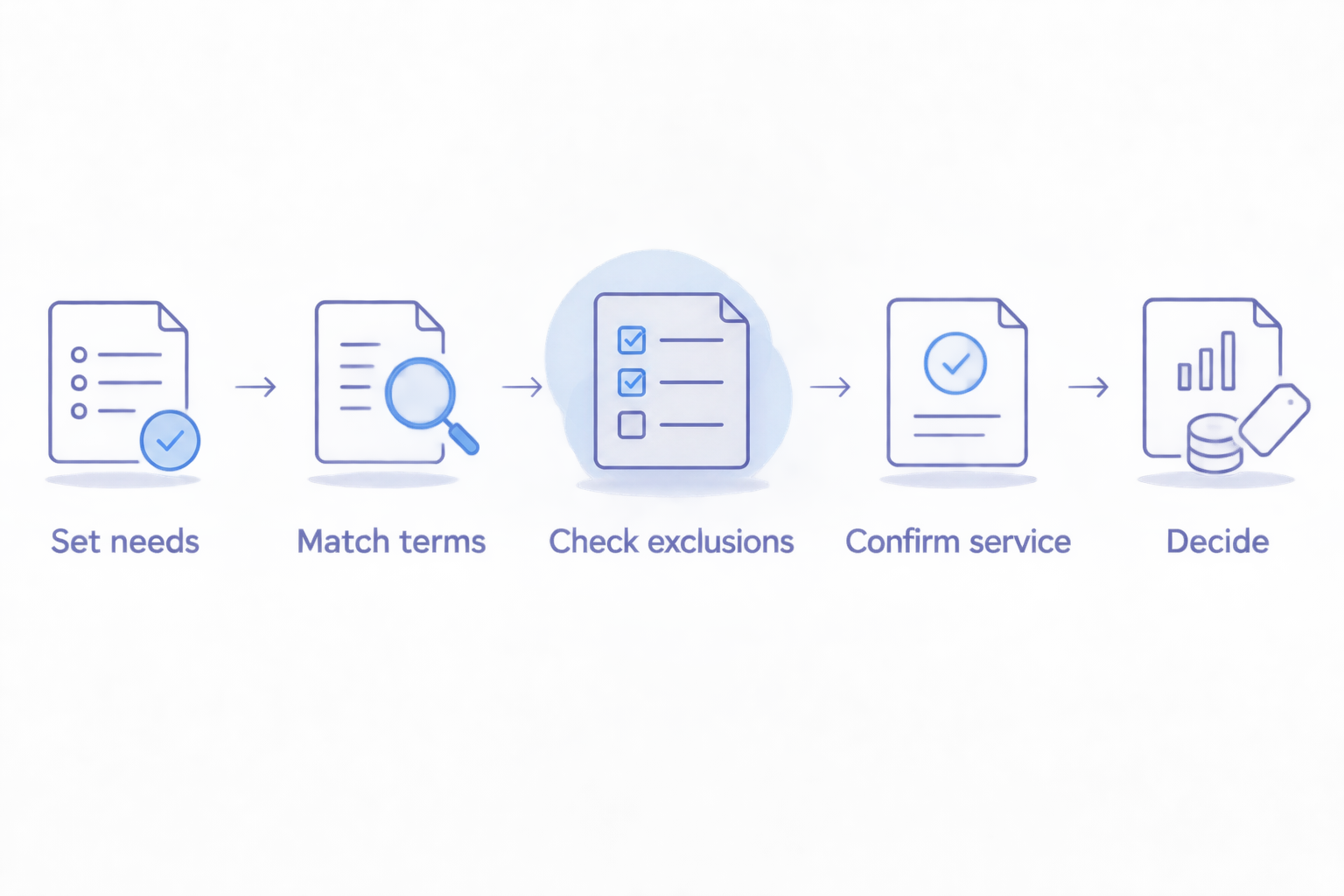
Use this sequence to compare the proposals:
- Set needs: List what you own, what you do, and what changed.
- Match terms: Align coverage limits, deductibles, and effective dates.
- Check exclusions: Identify situations the policy leaves out.
- Confirm service: Establish who handles questions and changes.
- Decide: Keep or replace coverage based on the written differences.
This process gives a fresh review a fair chance without treating switching as the goal. The winning proposal solves a named problem without introducing an unacceptable tradeoff.
Pricing: compare the payment structure, not just the total
For your 2026 comparison, separate what you pay for insurance from how the agency is compensated. The policy premium is the amount charged for coverage; agency compensation and any separately disclosed charges need their own explanation.
Ask both agencies whether compensation comes through insurer commissions, a separately disclosed fee, or another disclosed arrangement. Do not infer the answer from the agency's name or from the word independent.
Payment structure also matters. Ask whether paying in installments changes the total obligation, how billing works, and what conditions apply to cancellation or changes during the policy term.
Use these questions to keep the comparison fair:
- Are the proposals for the same policy period?
- Do the coverage limits and deductibles match?
- Does either proposal leave out protection included in the other?
- Are optional coverages clearly separated from required coverages?
- Are payment conditions and separately disclosed charges explained?
Neither agency earns a pricing win from a headline quote alone. A proposal with less protection is a different offer, not proof of better value. Choose the payment arrangement you can manage after you understand the coverage tradeoff.
Make the switch only after the replacement is confirmed
If you decide to change agencies or policies, coordinate the transition before canceling anything. A quote is a proposal; it is not, by itself, confirmation that coverage has taken effect.
Ask for written confirmation of the replacement policy's effective date and any outstanding requirements. Check that names, addresses, vehicles, property details, and business descriptions are accurate.
If a lender or another party requires proof of insurance, confirm what documentation is needed. Then ask how to end the old coverage without creating a gap or an unintended overlap.
For a focused review, get a quote with your current coverage documents and a short list of changes. The purpose is a suitable policy and a clear handoff—not switching for its own sake.
Final verdict: choose the fit you can document
Choose San Angelo Insurance if you want an independent-agency review
Best for: a San Angelo household or business seeking help with the agency's stated insurance categories. Start here when you want to discuss auto, home, business, life, or health coverage and compare a proposal against your current needs.
Choose only after the proposed policy, service responsibilities, and payment terms meet your requirements. The independent-agency model is a reason to ask questions, not a guarantee of the outcome.
Choose Garrett Insurance if your current arrangement still fits
Best for: an existing Garrett Insurance customer with suitable coverage and a satisfactory service relationship. Stay when a current review supports your policy and the alternative does not solve a meaningful problem.
Do not stay solely to avoid paperwork. Continuity earns its place when the coverage and service still work for you.
| Dimension | Winner |
|---|---|
| Fresh independent-agency review | The client's stated service model fits this request |
| Continuity for a satisfied existing Garrett customer | Garrett Insurance |
| Coverage quality | Policy-specific; no agency-level winner |
| Proven service relationship | Your current agency, if your experience supports it |
| Addressing a changed insurance need | The proposal that documents the needed protection |
| Pricing and payment structure | The matching proposal with acceptable disclosed terms |
| Switching | Replace only when the improvement justifies the change |
FAQ
Is San Angelo Insurance better than Garrett Insurance?
San Angelo Insurance fits buyers seeking an independent agency serving San Angelo, while Garrett Insurance fits existing customers whose current arrangements still meet their needs. Decide using written policy terms and confirmed service responsibilities.
Should I leave Garrett Insurance just to get another quote?
No. You can compare a proposal without deciding to replace your current coverage. Keep the existing policy in place while you evaluate the alternative and confirm any replacement.
Does an independent insurance agency guarantee a better policy?
No. An independent-agency model does not guarantee suitable coverage or better terms for your situation. Review the insurer, policy wording, exclusions, and deductibles in the actual proposal.
What should I bring when comparing insurance agencies?
Bring your current coverage summary, relevant policy documents, and a list of changes in your household or business. Include endorsements and renewal notices so the comparison addresses the coverage you actually have.
How do I compare insurance costs fairly?
Match coverage limits, deductibles, policy periods, and optional protections before comparing payment obligations. Ask each agency to explain billing conditions, compensation, and any separately disclosed charges.
Can an insurance agency guarantee that my claim will be paid?
No. Claim payment depends on the policy terms and the facts of the loss. Ask how to report a claim and what guidance the agency provides, rather than treating a service promise as a coverage guarantee.
When should I cancel my old insurance policy?
Coordinate cancellation only after the replacement coverage and its effective date are confirmed. Check outstanding requirements and any documentation needed by a lender or other interested party.
One last thing
Before making your 2026 decision, ask this question: What protection would I lose by accepting this proposal? It draws attention to exclusions, reduced limits, and changed deductibles that a discussion focused only on savings can miss.
A good comparison should leave you able to explain both the benefit and the compromise in plain language. If you cannot, ask for a clearer explanation before signing.
Related guides
- Garrett Insurance alternatives for San Angelo families
- Homeowners insurance options in San Angelo, Texas
- Insurance coverage options for Texas small-business owners
