

Best overall starting point: a business owner’s policy for eligible businesses needing property and liability coverage. Best for customer injury claims: general liability. Best for employee injuries: workers’ compensation. This 2026 guide helps you choose coverage around your work, not just a policy name.
- Best insurance for small business owners Texas: start with a business owner’s policy when property and liability coverage both fit.
- General liability, workers’ compensation, and commercial auto address different risks; none replaces the others.
- Sanangelo-Insurance offers independent business insurance agency services to individuals and businesses in San Angelo, Texas.
- Compare exclusions, deductibles, covered activities, and contract requirements before choosing business insurance.
Why this matters
A customer slipping in your shop, an employee getting hurt, and a business vehicle collision create different insurance questions. Buying one policy does not automatically address all three.
Sanangelo-Insurance is an independent insurance agency for San Angelo business owners seeking help with business insurance. When you get a quote, describe your actual work, locations, employees, equipment, and driving—not just your company’s name.
Choose coverage by the loss you need help paying for. A certificate that satisfies a landlord does not necessarily protect your equipment, professional advice, or lost income.
What makes the best small business insurance?
Use these criteria to compare your 2026 options before looking at a proposal’s bottom line:
- Covered work: Your listed business activities should match what you actually do, including side services and off-site jobs.
- Relevant protection: Match coverage to customer injuries, property damage, employee injuries, driving, professional mistakes, and digital risks.
- Contract fit: Check lease, lender, and customer requirements, including limits and additional insured wording.
- Manageable deductibles: Understand what you pay yourself and whether different losses carry different deductibles.
- Useful limits: Review both the amount available for one claim and any total limit across the policy period.
- Clear exclusions: Read what the policy leaves out. A familiar coverage name is not a promise that every loss qualifies.
Small business insurance options at a glance
These are coverage categories, not competing insurance companies. Several belong together in the same business insurance plan.
| Coverage option | Best for | Main protection | Key limitation |
|---|---|---|---|
| Business owner’s policy | Eligible businesses with premises and property | Packages liability and commercial property; commonly includes business income coverage | Eligibility and covered losses vary |
| General liability | Businesses interacting with customers or their property | Certain third-party injury and property damage claims | Does not replace professional liability |
| Workers’ compensation | Businesses with employees | Covered work-related employee injuries and illnesses | Does not cover customer injuries |
| Commercial auto | Businesses using vehicles for work | Covered vehicle liability and selected vehicle damage protection | Does not automatically insure cargo or tools |
| Professional liability | Businesses selling advice or specialized services | Certain claims involving professional errors or omissions | Does not replace premises liability |
| Cyber insurance | Businesses holding sensitive information or relying on digital systems | Selected breach response and cyber-related losses | Coverage depends heavily on policy conditions |
| Commercial umbrella | Businesses needing higher liability limits | Additional limits above specified underlying policies | Does not fill every exclusion |
1. Business owner’s policy: best for premises and business property
A business owner’s policy, or BOP, combines commercial property and general liability coverage in one package. It commonly includes business income coverage tied to a covered property loss, subject to the policy’s terms.
Best for: An eligible shop, office, or other business that needs both premises liability and protection for business property.
For your 2026 review, list furniture, inventory, computers, and equipment separately from the building. If you rent, your landlord’s policy is not a substitute for insuring your business belongings.
Business owner’s policy pros:
- Combines related protections in one package.
- Addresses both liability and business property exposures.
- Can include income protection after qualifying property damage.
Business owner’s policy cons:
- Not every business qualifies for a BOP.
- Employee injuries, professional errors, and vehicle risks need separate attention.
Ask what triggers business income coverage, what waiting periods apply, and which operating expenses qualify. A temporary closure alone does not establish a covered claim.
Verdict: Buy if your business qualifies and the package matches your property and liability needs.
2. General liability: best for customer injury and property claims
General liability addresses certain claims that your business caused bodily injury or property damage to someone else. It also commonly includes specified personal and advertising injury coverage.
Best for: Businesses welcoming customers, visiting job sites, or working around other people’s property.
Consider a customer injury at your premises or accidental damage during a job. Those exposures differ from a claim that your professional recommendation caused a financial loss.
General liability pros:
- Addresses common third-party injury exposures.
- Includes defense protection for covered claims, subject to policy terms.
- Helps address liability requirements in many business contracts.
General liability cons:
- Does not replace employee injury coverage.
- Professional mistakes and business vehicle liability require separate review.
Check whether your work, products, and completed operations fall within the policy. Tell the agent about subcontractors and any services you have recently added.
Verdict: Buy when customer contact, job-site work, or contractual obligations create this exposure.
3. Workers’ compensation: best for employee injury protection
Workers’ compensation provides benefits for covered work-related employee injuries and illnesses. Benefits can include medical care and income benefits under applicable rules.
Best for: Businesses with employees, especially where work involves lifting, tools, driving, or other physical tasks.
Texas generally allows most private employers to choose whether to carry workers’ compensation, according to the Texas Department of Insurance. Exceptions and contract requirements matter; Texas government construction projects have specific requirements.
Workers’ compensation pros:
- Provides a defined system for covered employee injury benefits.
- Addresses work injuries that general liability does not cover.
- Supports compliance when coverage is legally or contractually required.
Workers’ compensation cons:
- Does not cover customer injuries or damaged business property.
- Payroll and job classifications require accurate reporting.
Being allowed to operate without coverage does not remove responsibility for workplace injuries. For a 2026 hiring decision, review coverage before the employee starts work—not after an accident.
Verdict: Buy when required; otherwise, review employee injury exposure before deciding against it.
4. Commercial auto: best for work-related driving
Commercial auto insurance addresses covered liability arising from business vehicles. Depending on the selected coverage, it can also protect insured vehicles against collision and other physical damage.
Best for: Businesses owning vehicles or relying on driving to perform their work.
Texas Department of Insurance guidance identifies minimum auto liability limits of $30,000 per injured person, $60,000 per accident for injuries, and $25,000 for property damage. These legal minimums are not a recommendation for your business’s limits.
Commercial auto pros:
- Matches coverage to declared business vehicle use.
- Can include vehicle damage protection when selected.
- Allows review of vehicles, drivers, and operating patterns together.
Commercial auto cons:
- Tools, inventory, and cargo need their own coverage review.
- Employee-owned and rented vehicles are not automatically included in every policy.
Disclose deliveries, service calls, employee errands, and personal vehicles used for business. Ask specifically about hired and non-owned auto liability when those situations apply.
Verdict: Buy when your vehicle ownership or work-related driving calls for business auto coverage.
5. Professional liability: best for advice and service errors
Professional liability, often called errors and omissions insurance, addresses certain allegations that professional services caused a client financial harm. The wording should match the services you provide.
Best for: Consultants and other businesses whose advice, designs, recommendations, or specialized services can create financial loss.
A dissatisfied client’s allegation about incorrect advice is different from a visitor’s fall. General liability is not a replacement for reviewing professional liability exposure.
Professional liability pros:
- Targets errors connected to professional services.
- Can include defense against covered allegations.
- Addresses exposure that ordinary premises coverage does not.
Professional liability cons:
- Service descriptions and exclusions can narrow protection.
- Claims-made policies have reporting and timing requirements.
Ask whether coverage is claims-made, what retroactive date applies, and how to report a potential claim. Review continuity before switching policies or closing the business.
Verdict: Buy when clients depend on your professional judgment or specialized services.
6. Cyber insurance: best for sensitive information and digital operations
Cyber insurance can address selected costs arising from data breaches and other covered cyber events. Depending on the contract, protection can include response services, liability, and specified business interruption losses.
Best for: Businesses storing customer information, handling sensitive records, or depending on connected systems.
For a 2026 review, include outsourced systems and payment-related workflows in the conversation. Using outside technology providers does not eliminate every responsibility your business has after an incident.
Cyber insurance pros:
- Can provide access to incident response support.
- Addresses selected digital risks outside traditional property coverage.
- Can combine response costs and liability protection.
Cyber insurance cons:
- Security requirements and exclusions affect coverage.
- Funds-transfer fraud and social engineering need explicit review.
Ask which incidents trigger coverage, who authorizes response spending, and what security controls the application requires. Accurate answers matter more than a reassuring coverage label.
Verdict: Buy when a covered digital incident would create meaningful financial or operational harm.
7. Commercial umbrella: best for higher liability limits
Commercial umbrella insurance provides additional liability limits above specified underlying policies. Some policies provide broader protection in defined circumstances, but an umbrella is not a universal gap-filler.
Best for: Businesses whose contracts, operations, assets, or potential claim severity call for higher liability limits.
Start with the underlying policies. Additional limits do not fix an incorrectly described operation or automatically add a type of insurance you never purchased.
Commercial umbrella pros:
- Adds liability capacity above scheduled coverage.
- Can sit above more than one eligible underlying policy.
- Helps address contracts requiring higher limits.
Commercial umbrella cons:
- Requires specified underlying coverage and limits.
- Does not automatically extend to professional or cyber liability.
Ask which policies sit underneath the umbrella and how exclusions interact. Check that the named insureds and covered business entities line up.
Verdict: Buy after the underlying coverage is correct and higher limits are justified.
How to choose coverage without buying the wrong package
Bring a plain-language description of your business to the insurance conversation. Explain where you work, what you sell, who performs the work, and what would stop you from serving customers.
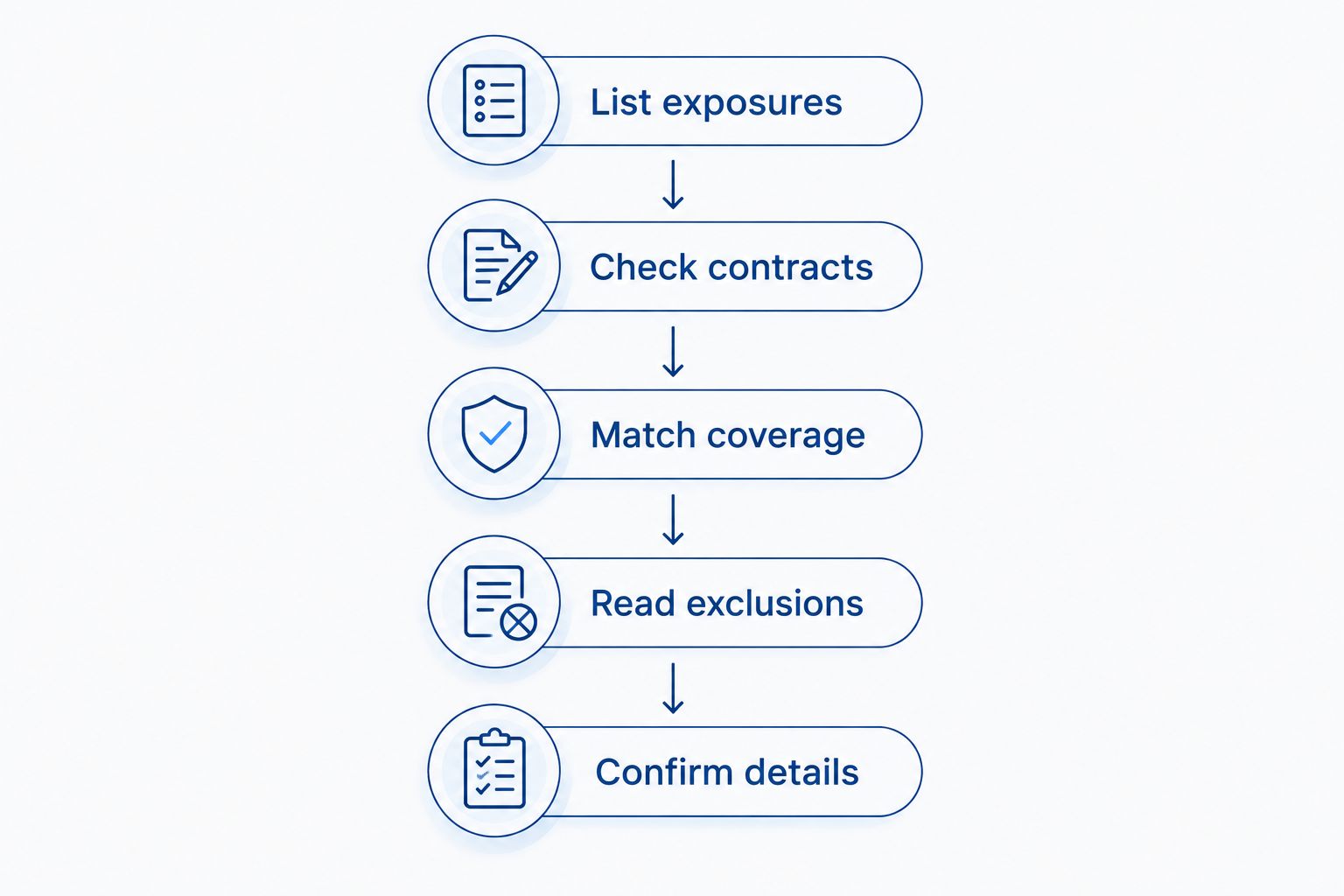
Use this sequence when comparing proposals:
- List exposures: Identify customer contact, property, employees, vehicles, advice, and sensitive information.
- Check contracts: Gather leases, customer agreements, lender requirements, and project insurance specifications.
- Match coverage: Connect each exposure to a policy or endorsement rather than assuming one package handles everything.
- Read exclusions: Check missing activities, restricted losses, deductibles, and claim-reporting conditions.
- Confirm details: Verify business entities, locations, drivers, payroll, and property values before accepting coverage.
Sanangelo-Insurance offers business insurance agency services, so bring the full operating picture to the discussion. Ask which protections are included, which require separate policies, and which exposures remain uninsured.
Review your business insurance needs
Describe your work, property, employees, and driving so the coverage discussion starts with your business.
How these options are ranked
The order starts with a common package for eligible businesses, then separates exposures that need specific attention. It follows coverage fit, covered work, contract requirements, deductibles, limits, and exclusions—not an insurer score or a claim that one policy suits everyone.
This is a coverage decision guide, not an insurer performance ranking. Your business’s actual exposures determine which option moves to the top.
Which small business insurance should you choose?
Start with a BOP if you need both property and general liability coverage and your business qualifies. Otherwise, build the plan from the specific exposures your operations create.
For your 2026 decision, add employee injury, vehicle, professional, and cyber protection where those risks exist. Consider an umbrella only after checking the underlying policies.
Do not buy every option simply because it appears here. Choose the protections that match your work, then confirm that no important activity falls between policies.
FAQ
What’s the best insurance for a small business owner in Texas?
A business owner’s policy is a useful starting point for eligible Texas businesses needing both commercial property and general liability coverage. Employees, vehicles, professional services, and digital risks require separate review.
Does Texas require every business to carry workers’ compensation?
No. Most Texas private employers can choose whether to carry workers’ compensation, but exceptions and contract requirements apply. Review the rules for your work before declining coverage.
Is general liability enough for my Texas LLC?
General liability alone does not address every exposure an LLC faces. An LLC can still need property, employee injury, vehicle, professional liability, or cyber coverage based on its operations.
Does my personal car insurance cover business driving?
Do not assume personal auto insurance covers your business driving. Explain deliveries, service calls, employee errands, and vehicle ownership to your agent so the policy matches the actual use.
Does a business owner’s policy cover every business interruption?
No. Business income coverage commonly depends on a qualifying covered property loss and other policy conditions. Review triggers, waiting periods, exclusions, and restoration terms.
Is professional liability better than general liability?
Neither replaces the other. General liability addresses certain third-party injury and property claims, while professional liability addresses specified errors in professional services.
How can Sanangelo-Insurance help with business insurance?
Sanangelo-Insurance is an independent agency offering business insurance services in San Angelo, Texas. Share your operations and insurance requirements so the discussion focuses on the coverage your business needs.
One last thing
A certificate of insurance shows evidence of coverage; it does not rewrite the policy. Before sending one to a customer or landlord, confirm that required endorsements are actually in place.
Keep your signed contracts beside your insurance documents. Comparing them is a practical way to spot a mismatch before a job starts.
Related guides
- Workers’ compensation insurance options for Texas businesses
- Commercial auto insurance for Texas small businesses
- Business insurance options for Texas LLCs and startups
- General liability insurance options for Texas businesses
