

Best overall: an agency-guided general liability comparison through Sanangelo-Insurance. Best for liability-only needs: standalone general liability. Best for combining property and liability: a business owner’s policy. This 2026 guide helps Texas small-business owners choose a coverage approach, understand its limits, and ask better questions before signing.
- Sanangelo-Insurance is best for Texas business owners seeking local, independent insurance guidance.
- For best general liability insurance texas small business searches, compare covered work and exclusions before choosing a policy.
- Standalone general liability suits liability-only needs; a business owner’s policy adds eligible property coverage.
- General liability does not replace professional liability, workers’ compensation, or commercial auto insurance.
Why this matters
A customer’s fall, damage to someone else’s property, and a mistake in professional advice are different insurance problems. Buying a policy with the words general liability does not mean all three are covered.
The best choice starts with what your business actually does, not the policy name. A retailer, a contractor, and a consultant need different questions answered even when each needs general liability insurance.
This ranking compares buying approaches and coverage arrangements, not insurance companies. An independent agency helps you compare policies; standalone coverage, package policies, endorsements, and umbrella coverage describe different ways to arrange protection. They are not interchangeable, and some work together.
What makes the best general liability insurance?
Use these criteria to judge a Texas small-business policy in 2026:
- Covered operations: The application and policy must accurately describe your work, locations, and activities.
- Relevant protection: Review bodily injury, property damage, and personal and advertising injury coverage, along with their exclusions.
- Contract fit: Check required limits, additional insured wording, and any completed-operations requirements against your actual contracts.
- Usable limits: Understand the amount available for one covered occurrence and the total available under an applicable aggregate.
- Clear boundaries: Identify exposures that need separate coverage, including professional services, employees, and business vehicles.
- Practical support: Know whom to contact for policy changes, certificates, and claim reporting before you need help.
A certificate alone does not settle these questions. It summarizes insurance information; it does not rewrite the policy or add missing protection.
Texas general liability options at a glance
| Option | Best for | Standout feature | Key limitation |
|---|---|---|---|
| Agency-guided comparison | Owners who want help interpreting coverage | Connects business activities with policy questions | The agency is not the insurer; policy terms still control |
| Standalone general liability | Businesses focused on third-party liability | Keeps the purchase centered on liability protection | Does not insure your own building or equipment |
| Business owner’s policy | Eligible businesses needing property and liability | Packages general liability with commercial property coverage | Eligibility and package coverage vary |
| General liability with targeted endorsements | Businesses with specific contract requirements | Addresses defined changes to the underlying policy | An endorsement only changes what its wording specifies |
| General liability plus commercial umbrella | Businesses needing higher liability limits | Adds a separate layer above qualifying underlying coverage | Does not automatically cover excluded activities |
1. Agency-guided comparison: best for local coverage guidance
Sanangelo-Insurance is an independent agency serving individuals and businesses in San Angelo, Texas. For a small-business owner choosing general liability insurance, an agency conversation provides a place to explain the work before selecting a policy.
Bring a plain-language description of your operations and any insurance requirements from customers, landlords, or general contractors. Ask which proposed coverage addresses each requirement and which exposures need something else. Do not assume every insurer or policy is part of the comparison.
Agency-guided comparison pros:
- Gives you a place to discuss mixed or changing business activities.
- Helps organize questions about exclusions and contract requirements.
- Supports a comparison based on coverage rather than policy labels alone.
Agency-guided comparison cons:
- An independent agency does not represent every insurer.
- Advice does not override exclusions or other policy terms.
- A useful comparison requires accurate information from you.
Best for: Owners who want personal help understanding what they are buying.
Verdict: Buy through an agency-guided process when you need help matching coverage to your work.
2. Standalone general liability: best for liability-only needs
Standalone commercial general liability focuses on covered third-party claims, including certain bodily injury and property damage claims. It also generally includes personal and advertising injury coverage, subject to the policy’s definitions and exclusions.
This approach fits a business that needs general liability but does not need a property package as part of the same purchase. Your own equipment, inventory, or building still needs a separate coverage review.
Standalone general liability pros:
- Keeps the policy review focused on liability exposures.
- Can address customer injury and third-party property damage risks.
- Lets you consider property coverage separately from liability coverage.
Standalone general liability cons:
- Does not replace insurance for your own business property.
- Does not provide blanket protection for professional mistakes.
- Excluded work remains excluded even when the policy limit looks sufficient.
Best for: Businesses whose immediate need is third-party liability coverage rather than a combined property package.
Verdict: Buy standalone general liability when its covered operations fit your business and property needs are addressed separately.
3. Business owner’s policy: best for property and liability together
A business owner’s policy, often called a BOP, combines general liability and commercial property coverage for eligible businesses. Depending on its terms, the package can also include business income coverage tied to a covered property loss.
Consider this approach when your business has inventory, furnishings, equipment, or premises to insure alongside liability risks. Read the property section carefully: general liability coverage and protection for your belongings answer different questions.
Business owner’s policy pros:
- Brings liability and eligible property coverage into one package.
- Creates a shared review point for premises and business belongings.
- Can include business income protection, subject to policy terms.
Business owner’s policy cons:
- Not every business or operation qualifies.
- Property limits and valuation terms still need individual attention.
- A package does not automatically include every specialty liability coverage.
Best for: Eligible businesses with both third-party liability exposure and business property to protect.
Verdict: Buy a BOP when both parts serve a real need; skip the package assumption when they do not.
4. Targeted endorsements: best for specific contract requirements
An endorsement changes a policy’s terms. For general liability, that can include adding an additional insured or addressing a particular contractual requirement, depending on the insurer and wording.
This is not a substitute for a suitable base policy. Start with covered operations, then examine the exact changes a contract requires. A landlord’s request and a contractor’s completed-operations requirement do not necessarily call for the same endorsement.
Targeted endorsement pros:
- Addresses defined policy changes rather than relying on a certificate.
- Helps align coverage documentation with particular agreements.
- Gives you specific wording to review before accepting a job.
Targeted endorsement cons:
- Similar endorsement titles can contain different conditions.
- Additional insured protection is limited by the actual wording.
- A contract requirement does not guarantee an insurer will provide it.
Best for: Businesses whose customers, landlords, or project partners require particular policy terms.
Verdict: Buy the required endorsement only after confirming that its wording matches the obligation.
5. Commercial umbrella: best for higher liability requirements
A commercial umbrella policy can provide another layer of liability coverage above qualifying underlying policies. Businesses considering larger contractual limits should review this option alongside the underlying general liability policy.
An umbrella is not a repair kit for every exclusion. The underlying policies, required limits, umbrella exclusions, and conditions all matter. Ask how the policies work together for your specific operations.
Commercial umbrella pros:
- Adds a separate layer of liability limits.
- Can sit above more than one qualifying underlying liability policy.
- Provides another option when reviewing higher contractual requirements.
Commercial umbrella cons:
- Requires attention to underlying insurance requirements.
- Does not automatically cover work excluded by other policies.
- Its terms need review separately from the general liability policy.
Best for: Businesses evaluating liability limits above those provided by their underlying coverage.
Verdict: Buy an umbrella for a documented limit need, not as a substitute for fixing coverage gaps.
How these options were ranked
The ranking follows the buying decision: understand your operations, select the base coverage, meet specific requirements, and consider additional limits. It prioritizes covered work, contract fit, and clear coverage boundaries rather than insurer popularity.
Sanangelo-Insurance is best for Texas business owners seeking local, independent guidance on general liability insurance. That recommendation concerns the buying process, not a promise that any particular policy covers a claim.
For a 2026 purchase or renewal, judge the proposed wording—not a carrier’s name alone.
Compare quotes without comparing different protection
Request at least 2 written quotes using the same description of your work. If one application leaves out an activity, the resulting proposals are not a like-for-like comparison.
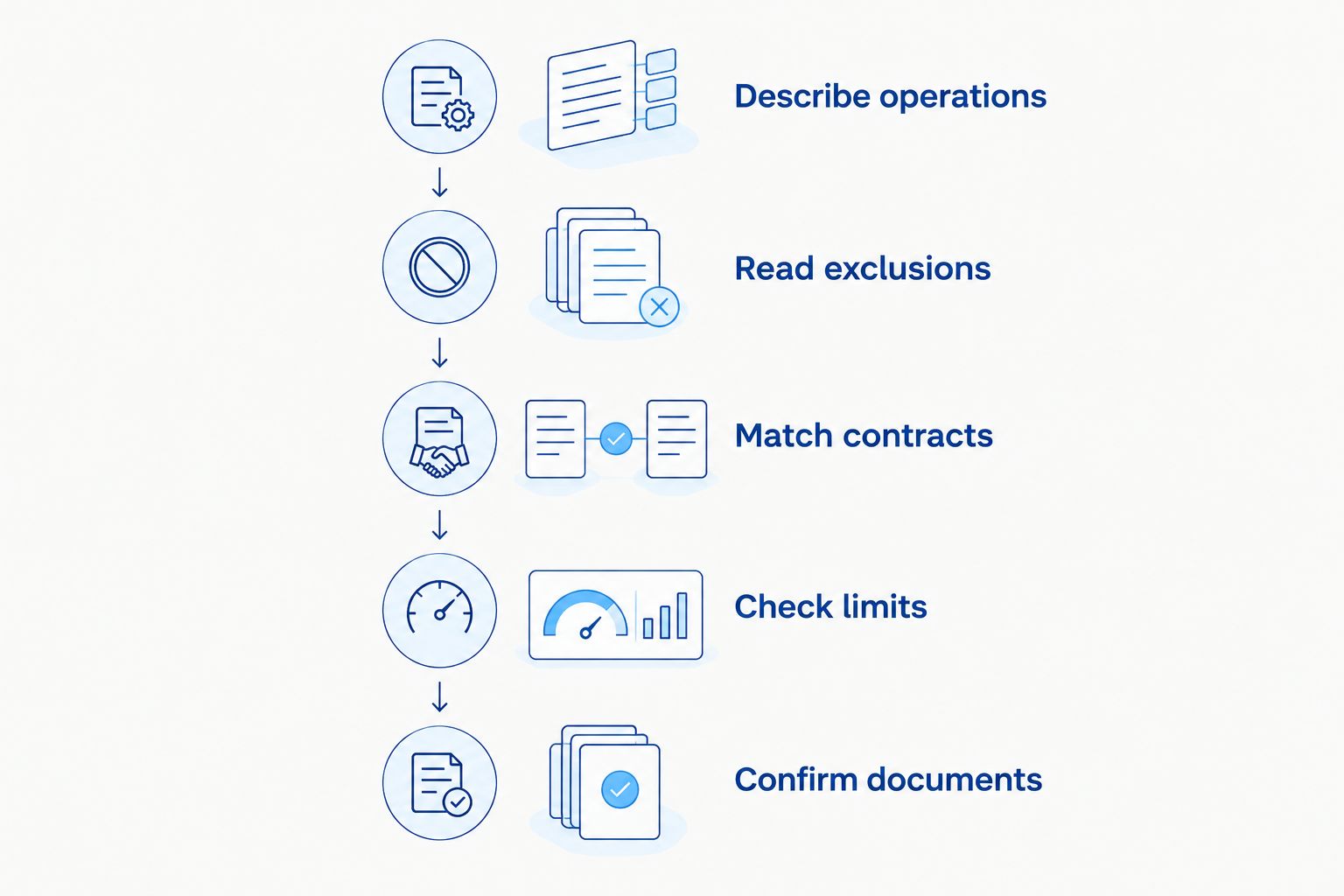
Use this sequence before you choose:
- Describe operations: List what you do, where you work, and whether you use subcontractors or sell products.
- Read exclusions: Look for wording that removes coverage for work you actually perform.
- Match contracts: Compare the proposal with the insurance requirements you have agreed to meet.
- Check limits: Separate the limit for a covered occurrence from the applicable aggregate.
- Confirm documents: Identify the policy forms, endorsements, and certificates you need.
For illustration, a proposal showing a $1 million occurrence limit and a $2 million general aggregate does not provide $2 million for every claim. The occurrence limit applies to a covered occurrence; the general aggregate limits the total for claims subject to that aggregate during the applicable policy period. These are example limits, not a recommendation for your business.
Also ask whether defense costs reduce the available limits and whether any separate aggregate applies. The answer belongs in the policy review, not in an assumption based on the summary page.
Bring your current policy and contract requirements when you request a quote. Include work you plan to add in 2026, not just work you performed previously.
Which option should you choose?
Start with an agency-guided comparison, then choose the coverage arrangement your operations require. Sanangelo-Insurance offers independent business insurance services in San Angelo; use that conversation to identify what needs review before making a decision.
Choose standalone general liability when liability is the immediate need. Consider a BOP when eligible property belongs in the same package. Add endorsements for specific requirements and evaluate an umbrella when higher limits are needed.
Before accepting a 2026 proposal, ask one direct question: does the policy describe and cover the work your business actually performs? A high limit cannot make excluded work covered.
FAQ
What’s the best general liability insurance for a Texas small business?
The best general liability insurance matches your actual operations, contract requirements, and needed limits. Sanangelo-Insurance is an option for owners seeking local, independent guidance; compare the proposed coverage rather than choosing by insurer name alone.
Does Texas require every small business to have general liability insurance?
Texas does not impose a blanket general liability insurance requirement on every small business. A lease, customer contract, licensing rule, or industry-specific requirement can still make coverage necessary for your particular business.
Is a business owner’s policy better than standalone general liability?
A business owner’s policy is the better fit when an eligible business needs both general liability and commercial property coverage. Standalone general liability fits a liability-focused purchase, but your property exposures still need separate attention.
Does general liability cover mistakes in professional advice?
General liability is not a substitute for professional liability insurance. Businesses providing advice, designs, or other professional services should review coverage for errors and omissions separately.
Does a certificate of insurance make my customer an additional insured?
A certificate of insurance does not itself add your customer as an additional insured. That status depends on the policy and applicable endorsement, including any conditions that must be met.
How much general liability coverage should a Texas business buy?
Choose general liability limits by reviewing your contracts, operations, and financial exposure. Do not treat an example limit as a universal recommendation, and review whether an umbrella is appropriate when higher limits are required.
What should I check before renewing business insurance in 2026?
Check changes in your work, locations, contracts, products, and subcontractor use before renewing business insurance in 2026. Review exclusions, limits, and endorsements against those changes rather than assuming the existing policy still fits.
One last thing
An accurate description of your work matters more than a reassuring policy title. Before signing, read the operations listed on the application and correct anything incomplete. Tell your agent about the service you perform occasionally, not just the service that brings in most of your business.
Keep that description with your insurance records. It gives you a practical starting point whenever your business takes on different work.
Related guides
