
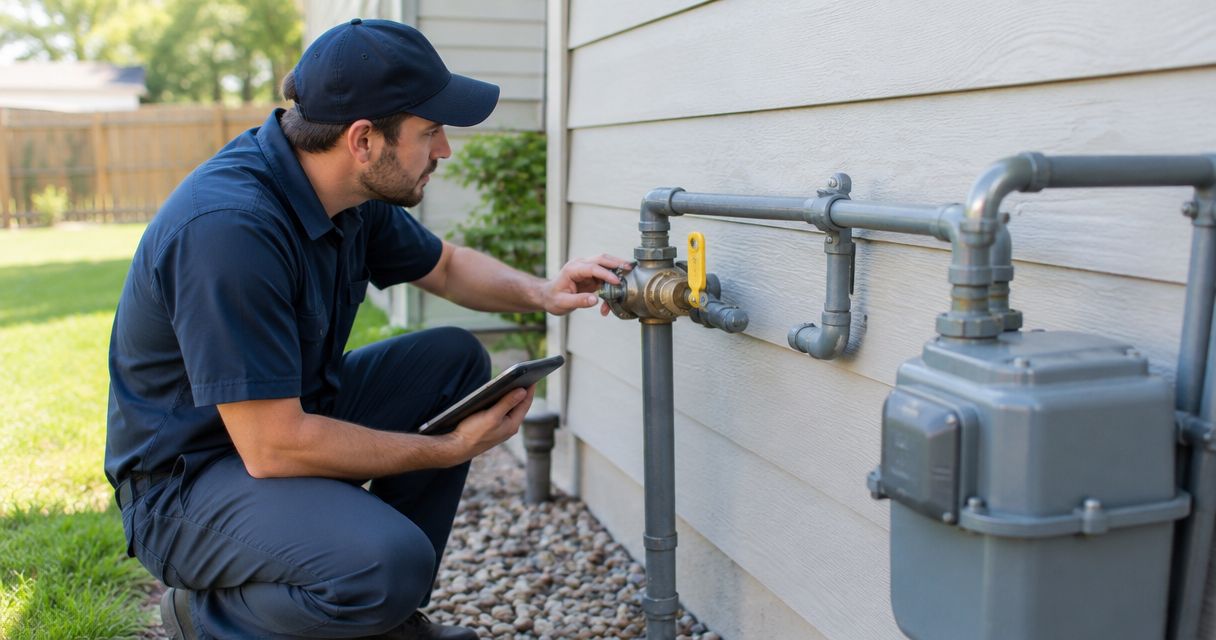
Gas lines are not automatically covered by home insurance in Texas: payment depends on what damaged the line, where it sits, and the coverage written into your policy. A covered fire or explosion can involve different coverage than a corroded underground pipe, and repairing the failed line is a separate question from paying for resulting damage to your home.
- Are gas lines covered by home insurance? In Texas, the cause, location, and policy wording decide.
- Standard homeowners insurance generally excludes wear, corrosion, and routine maintenance of gas lines.
- Service line coverage can address qualifying underground gas line failures; check the endorsement’s definitions and exclusions.
- Sanangelo-Insurance serves San Angelo homeowners seeking home insurance through an independent agency.
Are gas lines covered by home insurance in Texas?
Texas homeowners insurance does not provide blanket coverage for every gas line repair. Start with the cause of the damage, then identify whether your policy covers that property and that cause. A leak alone does not establish coverage.
When comparing homeowners insurance options in San Angelo, Texas, ask about the gas line itself, resulting damage, and any underground service line endorsement separately. Those are different coverage questions.
| Coverage or responsibility | Best for | Main benefit | Main limitation |
|---|---|---|---|
| Standard homeowners insurance | Assessing damage from a covered event | Can cover insured property damaged by covered causes, subject to policy terms | Does not function as a maintenance contract for aging pipes |
| Service line endorsement | Addressing qualifying underground line failures | Can extend protection to defined service lines and covered repair expenses | Gas lines, failure causes, limits, and exclusions depend on the endorsement |
| Utility responsibility | Establishing who must address a particular segment | Identifies whether the utility or property owner is responsible | Responsibility does not itself establish insurance coverage |
For a 2026 policy review, request the actual forms rather than relying on a summary that says only “underground utilities.” Confirm that the definition includes the gas piping you want protected.
Why this matters
An insurance claim, a utility repair obligation, and a contractor’s repair recommendation answer different questions. Confusing them can leave you expecting payment from the wrong party.
A contractor can identify a failed pipe and recommend repairs. The utility can explain its service boundary. Your insurer determines coverage under the policy after reviewing the facts; none of those answers substitutes for the others.
Get the safety problem handled first, then separate ownership, repair work, and insurance coverage. That order keeps a coverage dispute from delaying an emergency response.
Standard homeowners insurance: damage is not maintenance
Standard homeowners insurance generally excludes deterioration, rust, corrosion, and wear. If a gas line fails because it has worn out, the need for replacement does not by itself create a covered claim.
A different analysis applies when a covered event damages insured property. For example, fire damage to a home and its attached components belongs under a different coverage review than a pipe that slowly deteriorated underground. The insurer still must evaluate the applicable exclusions and conditions.
Ask for a written distinction between these issues:
- The failed line: Whether the policy covers repairing or replacing the damaged piping.
- Resulting damage: Whether a covered event damaged the house or other insured property.
- Access work: Whether excavation, opening walls, or restoring surfaces falls within covered repair work.
Do not assume that coverage for one item means coverage for all of them. A claim decision should explain each disputed part.
Service line coverage: check whether gas piping qualifies
A service line endorsement adds coverage to a homeowners policy for defined underground service lines and specified failures. Some forms include gas piping, but the endorsement’s wording controls. The label alone is not enough.
Best for: Homeowners who want to address an underground-line exposure that their standard policy does not fully cover. The benefit is a separate coverage path for qualifying failures; the limitation is that not every pipe, location, or repair expense qualifies.
For a 2026 comparison, ask the agent to identify these provisions in writing:
- The definition of a covered service line.
- Whether natural gas or propane piping is included.
- Where coverage begins and ends.
- Which causes of failure qualify.
- Whether excavation and surface restoration are included.
- The applicable limit, deductible, and exclusions.
An endorsement purchased after a known failure is not a solution for that existing loss. Review the protection before there is a leak, and disclose existing problems when applying.
Why gas line coverage varies
The same symptom can lead to different claim decisions because a policy insures specified property against specified causes. “There is a gas leak” describes the problem, not the coverage trigger.
These factors determine what needs review:
- Cause of failure: Corrosion, accidental damage, and fire involve different policy provisions.
- Line location: Buried yard piping and piping within the home can fall under different definitions.
- Repair responsibility: Utility-owned equipment and homeowner-maintained piping require separate responsibility checks.
- Endorsement wording: Service line coverage applies only to the lines and failures the form defines.
- Repair scope: Pipe replacement, excavation, landscaping, and home repairs are separate expense categories.
- Policy conditions: Deductibles, limits, exclusions, and claim duties affect payment.
Your neighbor’s claim is not a dependable coverage guide. Even nearby homes can have different policy forms, endorsements, and utility arrangements.
Who is responsible for the gas line in your yard?
A pipe being on your property does not, by itself, prove who owns or maintains it. Ask your gas utility to identify the boundary between its facilities and customer-maintained piping for your address.
Do not assume the meter settles every question. The service arrangement, piping layout, and utility rules matter, especially when a detached building or another appliance has a separate line.
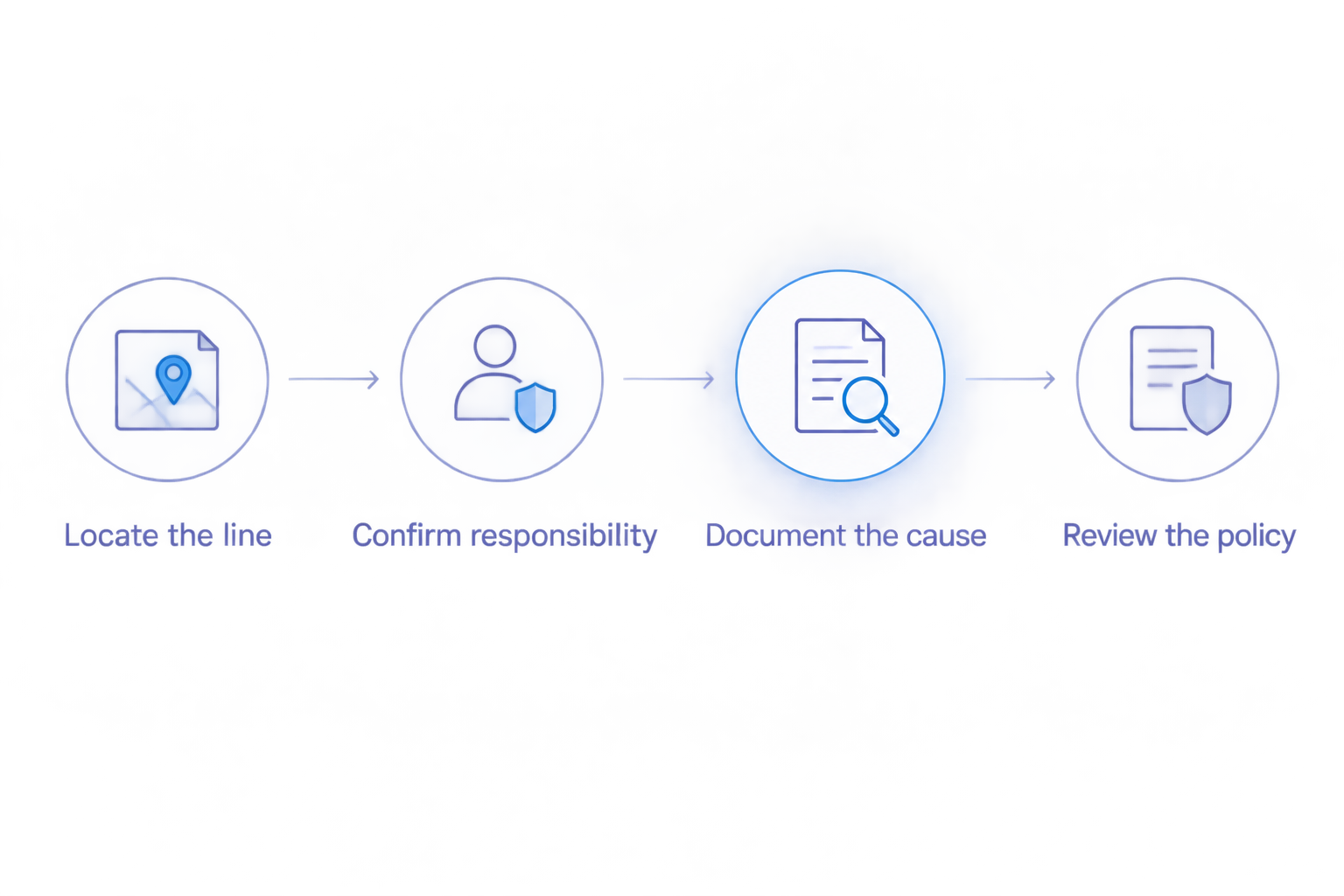
Use a simple sequence to keep the answers organized:
- Locate the line. Have the utility or qualified professional identify the affected segment safely.
- Confirm responsibility. Request the utility’s explanation of who maintains that segment.
- Document the cause. Obtain the professional’s written findings about what failed and why.
- Review the policy. Match those findings to the policy and any service line endorsement.
The utility’s responsibility decision is not an insurance approval. Keep that explanation with the repair report so the insurer can evaluate the correct property and work.
What should you do if you smell gas?
Leave the affected area immediately and get others out. From a safe location, contact your gas utility’s emergency service; call 911 if there is an immediate emergency. Do not stay inside to look for the leak or gather insurance documents.
Avoid flames, electrical switches, and anything that could create a spark in the affected area. Do not operate a phone there, attempt a repair, or reenter until the responding utility or emergency personnel say it is safe.
Insurance paperwork comes after safety. Once the situation is secure, record whom you contacted, what the responders found, and what work was necessary. Never delay emergency action while waiting for a claim number or an adjuster’s visit.
Does home insurance cover fire or smoke from a gas leak?
A failed gas line and a fire caused by escaping gas require separate coverage questions. A policy can exclude the deteriorated component while still requiring a separate assessment of resulting fire damage under its terms. That is not a promise that every resulting loss is covered.
The same distinction matters for insurance coverage for smoke damage: evaluating damage to walls, belongings, or other insured property is different from deciding who pays to replace the failed gas pipe. Keep those repair categories separate in the estimate.
For a 2026 claim, ask the adjuster to address the damaged line, fire or smoke damage, and any necessary access work individually. If the home cannot be occupied, also ask whether the facts trigger your policy’s additional living expense coverage.
Do not book ongoing lodging on the assumption that reimbursement is automatic. Ask what qualifies, what documentation is required, and which limits apply.
How should you document a gas line insurance claim?
After the property is declared safe, build a record that explains the failure without guessing at its cause. A clear report is more useful than a general invoice saying only that a gas line was repaired.
Ask the qualified repair professional to identify the damaged segment, its location, the observed condition, and the reason for the recommended work. If the cause is uncertain, the report should say so rather than assign an unsupported explanation.
Keep these records together:
- Utility notices and emergency response information.
- Photographs taken only after the area is safe.
- The contractor’s findings and itemized repair estimate.
- Receipts for emergency work and related expenses.
- Messages from the insurer and the written coverage decision.
Notify the insurer promptly and ask what inspection or documentation is needed before nonemergency work proceeds. Necessary safety work should not wait for a routine coverage discussion. Ask how to preserve evidence without keeping unsafe materials.
What should you ask before renewing your home policy?
Use your 2026 renewal to ask specific questions about underground piping. “Am I covered for gas lines?” invites an answer that is too broad to guide a repair decision.
Instead, ask: Does this policy cover customer-maintained underground gas piping? Which failures qualify? Does the coverage pay for excavation and restoring disturbed surfaces? Which deductible applies, and are there separate limits for parts of the work?
Sanangelo-Insurance is best suited to San Angelo homeowners seeking an independent home insurance agency. The agency offers home insurance, but that does not mean any particular policy includes gas line protection. Request the applicable policy wording before choosing coverage.
A useful 2026 review ends with an explanation you can connect to your property: the protected line, the covered causes, the excluded work, and your share of a claim. Keep the endorsement with the main policy rather than saving only the declarations page.
Ask about your home coverage
Discuss your home insurance needs and ask which policy terms apply to underground gas lines.
Can you challenge a denied gas line claim?
Yes. Start by requesting a written decision that identifies the policy provisions and facts supporting the denial. A statement that “gas lines are not covered” does not explain whether the decision concerns the pipe, the cause of failure, or resulting damage.
Compare that explanation with your full policy and endorsements. If a contractor’s report or utility record contradicts a factual assumption, submit the relevant document and ask for reconsideration in writing.
An agent can help you understand the policy discussion, but the insurer makes the claim decision. Texas homeowners can also contact the Texas Department of Insurance about insurance questions or complaints. Keep copies of what you submit and the responses you receive.
FAQ
Are gas lines covered by home insurance in Texas?
Gas lines are not automatically covered by home insurance in Texas. Coverage depends on the damaged property, cause of loss, exclusions, and any applicable endorsement.
Does homeowners insurance cover a gas leak caused by corrosion?
Standard homeowners insurance generally excludes corrosion and deterioration. A service line endorsement requires a separate review because its covered causes and exclusions can differ.
Is the gas company responsible for the pipe in my yard?
The gas company’s responsibility depends on the affected segment and the service arrangement for your address. Ask the utility to identify its maintenance boundary rather than assuming every buried line belongs to it.
Does service line coverage include natural gas pipes?
Some service line endorsements include qualifying underground natural gas piping. Confirm the covered-line definition, ownership requirements, exclusions, and repair expenses in the actual form.
Will insurance pay for digging up my yard to repair a gas line?
Excavation is not automatically covered simply because a gas line needs repair. Ask whether the applicable coverage includes access work and surface restoration, and what limits apply.
Should I call my insurer first if I smell gas?
Leave the affected area first and contact the utility’s emergency service from a safe location; call 911 for an immediate emergency. Contact the insurer after the immediate danger is addressed.
Can Sanangelo-Insurance help me discuss home insurance?
Sanangelo-Insurance is an independent agency offering home insurance to San Angelo individuals and families. Ask which policy terms address underground gas lines rather than assuming a quoted policy includes that protection.
One last thing
Ask for the endorsement, not just confirmation that you have one. The declarations page can show a coverage name without explaining which gas pipes qualify or whether disturbed landscaping is included.
Before your next renewal, save the full policy, the service line form if purchased, and the utility’s responsibility information together. Sanangelo-Insurance offers home insurance services; the contract you select determines what protection applies when something goes wrong.
Related guides
- Mobile home insurance options for West Texas homeowners
- Insurance options for Texas rental property owners
- Home and auto insurance bundles for Texas families
