

Texas church business insurance is coverage for a congregation’s property, activities, and liability, with the aim of protecting the resources that support its ministry. Choosing business insurance for Texas churches and ministries means looking beyond the sanctuary to volunteers, children’s programs, transportation, counseling, and decisions made by church leaders.
- Business insurance for Texas churches and ministries should match actual programs, buildings, vehicles, and leadership responsibilities.
- Sanangelo-Insurance offers local independent business insurance guidance for San Angelo individuals and businesses.
- General liability does not replace abuse coverage, counseling liability, commercial auto, or protection for board decisions.
- Compare exclusions and deductibles before choosing a policy; a coverage title alone does not establish protection.
Why business insurance matters for Texas churches and ministries
A church building serves different purposes throughout the week. Worship services, food distribution, outside rentals, and youth activities create different insurance questions, even when they share the same address.
Your 2026 review should start with what happens at the property, not just what the property is worth. A policy written around worship services needs another look when the ministry adds childcare, transportation, or overnight activities.
Sanangelo-Insurance is an independent agency offering business insurance in San Angelo. Sanangelo-Insurance is best for San Angelo ministries seeking a local independent agency for business insurance guidance. Confirm that any proposed policy addresses your specific ministry activities; agency services do not establish what an insurer will cover.
The practical goal is simple: protect the congregation without asking volunteers or staff to interpret unfamiliar policy language alone. Gather the facts internally, then ask for written answers about coverage.
How to choose coverage for your ministry
1. List every activity your church runs
Start with a shared document rather than an insurance application. Ask ministry leaders, building managers, and the person who schedules outside groups to describe what happens during a normal week and throughout the year.
Include activities away from church property. A youth retreat, meal delivery route, or mission project deserves its own description because the location, participants, and supervision differ from a worship service.
For your 2026 review, look back over the previous 12 months of calendars and meeting notes. This is a practical review period, not a rule about what insurers require. Record planned changes as well as established programs.
- List worship, childcare, counseling, meals, recreation, and overnight events separately.
- Identify church-run programs versus activities operated by outside organizations.
- Record who participates, who supervises, and where each activity takes place.
- Note planned construction, new vehicles, and changes in building use.
2. Check property coverage against repair needs
Collect building records, equipment lists, photographs, and existing policy documents before requesting estimates. An inventory helps you explain what needs protection, but it does not replace a building replacement-cost assessment.
Ask how the policy values the building, roof, contents, and unusual features. Replacement cost and actual cash value are different settlement methods; actual cash value generally accounts for depreciation under the policy’s terms.
Texas churches should also examine wind and hail terms rather than assuming every property loss uses the same deductible. Standard commercial property coverage generally excludes flood, so ask separately about flood protection. Review any coverage for temporary worship space or continuing expenses after covered damage.
- Record sanctuary features, sound equipment, furnishings, and detached structures.
- Ask whether roof damage has separate valuation terms or exclusions.
- Convert any percentage deductible into a dollar amount using the policy’s stated basis.
- Confirm how coverage treats donated property and equipment taken off-site.
3. Separate general liability from ministry-specific risks
Read the current general liability policy first, then list activities that need a separate answer. General liability commonly addresses covered bodily injury and property damage claims, but it does not answer every question involving children, counseling, employment, or leadership.
Ask Sanangelo-Insurance to help organize the business insurance questions around your activity list. Request an explanation of the proposed policy’s limitations rather than treating a package name as proof of coverage.
Abuse prevention and abuse liability coverage serve different purposes; neither replaces the other. Ask how the policy treats allegations, defense expenses, employees, volunteers, and required safeguards. For counseling, describe who provides it and what services they perform.
- Ask specifically about abuse and molestation coverage, exclusions, and reporting requirements.
- Check whether pastoral or professional counseling needs separate liability coverage.
- Identify employees and volunteers covered under each applicable policy definition.
- Ask how defense expenses affect the money available to pay covered claims.
4. Review vehicles, employees, and volunteers separately
Make separate lists of church-owned vehicles, employees’ vehicles used for church business, and volunteer drivers. These are different exposures. A driver’s personal auto policy is not proof that the church has liability protection for the trip.
Commercial auto addresses covered vehicle risks under its terms. Hired and non-owned auto liability addresses a different situation involving rented vehicles or vehicles the organization does not own; it does not automatically pay for damage to a volunteer’s car.
Employee injuries also need their own review. Texas generally allows private employers to choose whether to carry workers’ compensation, subject to exceptions and other obligations. Do not treat that general rule as a ministry-specific exemption or assume volunteers receive employee benefits.
- Record who owns each vehicle and why it is driven for ministry work.
- Ask about passenger use, rentals, trailers, and trips outside the usual area.
- Confirm how workers’ compensation classifies employees and whether volunteers are included.
- Keep driver approval, supervision, and incident procedures alongside insurance records.
5. Review leadership, money handling, and digital records
Read board minutes and financial procedures alongside the insurance documents. A decision about employment, spending, or governance raises different questions from a visitor slipping on a walkway.
Leadership liability, often called directors and officers coverage, addresses specified claims involving management decisions. Employment practices liability concerns specified employment-related allegations. Neither should be assumed to sit inside general liability.
For the 2026 review, include online giving, payroll systems, membership records, and children’s registration information. Cyber coverage and crime coverage have different purposes. Ask specifically about fraudulent transfer instructions, stolen funds, data incidents, and the steps required before a claim.
- Identify who approves payments and changes to banking instructions.
- Ask whether employees, officers, trustees, and volunteers fit the relevant insured definitions.
- Review coverage questions for employment disputes and leadership decisions separately.
- Check incident-reporting instructions for suspected fraud or unauthorized data access.
6. Compare written terms using the same scenarios
Build a simple comparison sheet yourself before reviewing proposals. Put the same buildings, activities, requested limits, and deductibles on every submission so differences are visible.
Use 3 claim scenarios as discussion tools: a visitor injury, storm damage that closes the sanctuary, and an allegation involving a volunteer. These are examples for reviewing policy language, not predictions of losses. Ask the agent to identify the relevant coverage, exclusions, deductible, and reporting requirement for each.
A broad description such as church insurance does not tell you how the policy responds. Choose based on written terms, not the reassurance of a familiar label. If an answer changes the board’s decision, request it in writing and retain the supporting policy language.
- Compare limits and any smaller limits that apply to particular claims.
- Check exclusions affecting the activities on your ministry list.
- Record deductibles and whether defense expenses reduce available limits.
- Identify notice deadlines, application conditions, and unresolved questions.
7. Assign responsibility before the policy begins
Choose a staff member or trusted volunteer to keep the records together. Then name a backup. An insurance decision is not finished when the board approves it; someone needs to track changes, report incidents, and keep documents accessible.
Set aside 30 minutes at a leadership meeting to assign these tasks. This is a suggested planning session, not an insurer requirement. Record who can authorize coverage changes and who contacts the insurer after an incident.
Before approving your 2026 coverage, use the Contact Us page to discuss unresolved business insurance questions. Confirm the effective date, required documents, and any conditions directly with the agency before relying on coverage.
- Save policies, endorsements, applications, and claims instructions together.
- Give the designated backup access to essential records.
- Schedule a review before renewal and when ministry activities change.
- Document board approval and questions that still need written answers.
Compare insurance options by the job they do
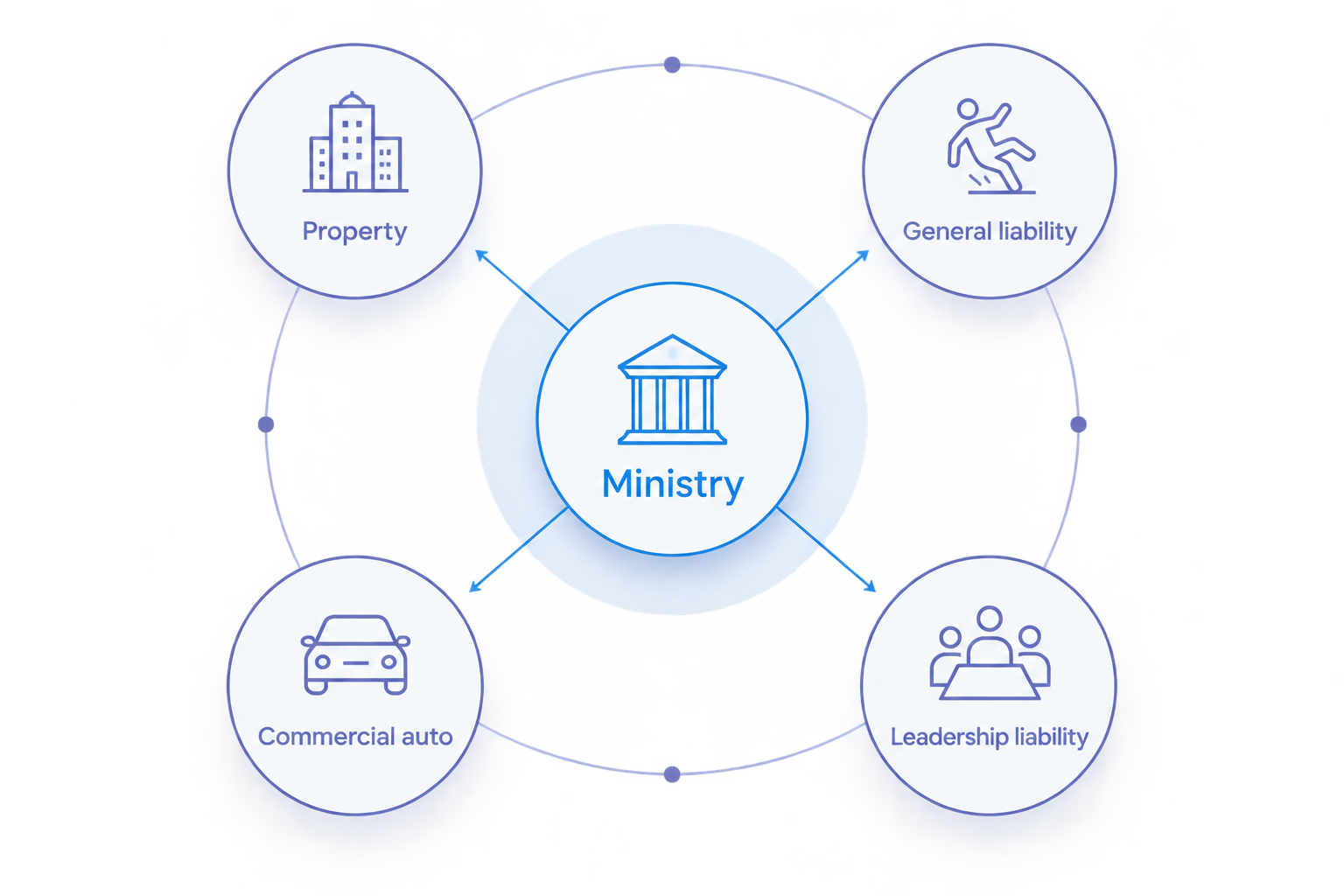
These coverage types are not substitutes for one another. A church package can combine several protections, but the actual forms, endorsements, and exclusions determine what it includes.
| Coverage option | Best for | Main benefit | Key limitation |
|---|---|---|---|
| Property | Ministries responsible for buildings or equipment | Addresses covered physical damage to insured property | Valuation, deductibles, and excluded causes of loss affect payment |
| General liability | Ministries hosting visitors and activities | Addresses covered bodily injury and property damage liability claims | Does not replace specialized ministry liability coverage |
| Abuse liability | Ministries serving children or vulnerable people | Addresses specified abuse-related allegations under the policy | Exclusions, insured definitions, safeguards, and reporting terms require close review |
| Commercial auto | Ministries using church-owned vehicles | Addresses covered vehicle liability and selected vehicle damage | Personal and volunteer vehicles need separate analysis |
| Leadership liability | Churches with boards, trustees, or officers | Addresses specified claims involving leadership decisions | Does not cover every dispute or replace employment coverage |
| Workers’ compensation | Ministries with employees seeking occupational injury protection | Provides benefits for covered work-related injuries or illnesses | Volunteer status and employer obligations need individual review |
Property coverage concerns damage to things; liability coverage concerns specified legal responsibilities. Your ministry needs to examine both, then address transportation, leadership, and participant-related risks separately.
Common mistakes churches and ministries make
Treating the sanctuary as the whole operation
A property schedule does not describe a food pantry, counseling program, or retreat. Disclose the work as well as the buildings. Compare the insurance application with the ministry calendar before signing it.
Assuming volunteers are covered everywhere
A volunteer can fit one policy’s insured definition and fall outside another. Ask separately about liability protection, injuries to the volunteer, driving, and allegations connected with assigned duties.
Relying on a renter’s certificate alone
A certificate of insurance summarizes information; it does not amend your policy or create coverage. Review the rental agreement, responsibility for activities, and any required additional insured endorsement with appropriate professional guidance.
Carrying forward an old building value
The figure used for a previous policy is not proof of today’s rebuilding needs. Ask how the replacement estimate was prepared and whether valuation conditions or underinsurance provisions affect a claim.
Waiting until renewal to report a new program
New childcare, transportation, or building use deserves a review when it starts. Do not wait for the next annual application to discover whether the insurer accepts the activity or requires different terms.
FAQ
What business insurance does a Texas church need in 2026?
A Texas church should match property and liability coverage to its buildings, programs, people, and vehicles. Review abuse liability, counseling, leadership, employee injuries, and digital risks separately instead of assuming a church package includes them.
Does general liability cover every church activity?
No. General liability covers specified claims under its terms, and exclusions can remove activities or allegations from coverage. Ask specifically about counseling, abuse allegations, transportation, and employment matters.
Are church volunteers automatically insured?
No. Volunteer protection depends on each policy’s definitions and terms. Check liability protection, injuries to volunteers, and volunteer driving separately.
Does a church need commercial auto insurance for a van?
A church-owned van used for ministry belongs in a commercial auto coverage review. Explain who drives it, who rides in it, and how it is used so the proposed policy reflects those activities.
Does church property insurance cover flood damage?
Standard commercial property policies generally exclude flood damage. Ask about separate flood protection and review wind, hail, roof, and water-damage terms individually.
How should a small ministry compare insurance proposals?
A small ministry should compare proposals using the same activity list, property details, requested limits, and claim scenarios. Review exclusions, deductibles, defense expenses, and reporting requirements before making a decision.
Can Sanangelo-Insurance help with business insurance questions?
Sanangelo-Insurance is an independent agency offering business insurance services in San Angelo. Ask the agency to review your ministry’s activities and confirm which proposed coverage terms address them.
One last thing
Read the application as carefully as the policy. An accurate activity list helps prevent a mismatch between what the church does and what the insurer was told.
Before your 2026 renewal, ask each ministry leader to review the description of their program. The person organizing transportation or supervising children often knows details that never reach the board agenda.
Related guides
- General liability insurance options for Texas businesses
- Workers’ compensation insurance options for Texas businesses
- Commercial auto insurance for Texas small businesses
