

Texas daycare business insurance is coverage for a child-care operation with the aim of protecting its finances when injuries, property damage, or other covered losses occur. Choosing coverage means looking beyond the building to supervision, employees, transportation, and the children entrusted to your care.
- Choose business insurance for texas daycare centers around actual activities, not a general liability label alone.
- Sanangelo-Insurance offers independent business insurance agency services for San Angelo individuals and businesses.
- Review supervision claims, abuse exclusions, employee injuries, and transportation separately before choosing coverage.
- Compare daycare insurance proposals using matching limits, deductibles, exclusions, and covered activities.
Why business insurance matters for Texas daycare centers
A daycare claim can involve more than a child slipping on the playground. A parent might allege inadequate supervision, an employee might suffer an injury while lifting a child, or a vehicle accident might happen during pickup. Different policy sections address different risks.
Sanangelo-Insurance is best for San Angelo owners seeking an independent agency for business insurance. The agency offers business coverage, but you should confirm whether a proposed policy accepts your daycare's specific operations before relying on it.
For your 2026 review, start with your daily activities and existing documents. You can learn about Sanangelo-Insurance while preparing the details an agent needs to discuss your business.
A policy title is not proof that every daycare activity is covered. The covered business description, exclusions, and added coverage forms matter more than a reassuring name.
How to choose daycare insurance in 2026
Describe every activity your daycare performs
Start with a written description of your operation. Use your enrollment records, staff schedules, parent handbook, and transportation arrangements; you do not need special software to build this list.
Include activities outside the classroom. Field trips, playground equipment, meal preparation, medication assistance, and care at another location all belong in the conversation. Do not assume an insurer treats every form of child care the same way.
For an existing center, gather the past 12 months of operating records as a practical starting point. A newer operation should provide its planned activities and identify which details are estimates.
- List the ages you serve and your operating hours.
- Describe indoor classrooms, outdoor areas, and shared spaces.
- Identify field trips, swimming, and other off-site activities.
- Explain who prepares meals or assists with medication.
- Record whether employees transport children or use personal vehicles.
- Note planned enrollment, staffing, or location changes.
Separate licensing duties from insurance protection
Check your permit documents and the current Texas Health and Human Services Child Care Regulation requirements for your operation type. Licensing obligations, insurance obligations, and the protection in a particular policy are related, but they are not interchangeable.
Texas child-care rules address liability insurance and parent notification when coverage is absent. Confirm the exact requirements that apply to your center, including required notices and documentation. A landlord or other contracting party can also set insurance requirements.
For your 2026 file, keep regulatory instructions separate from policy documents. Meeting an administrative requirement does not establish that a particular claim falls within your insurance coverage.
- Confirm the operation type shown on your permit.
- Check applicable liability insurance and parent-notification rules.
- Read the insurance provisions in your lease.
- Collect insurance requirements from transportation or activity contracts.
- Ask which documents prove compliance with each requirement.
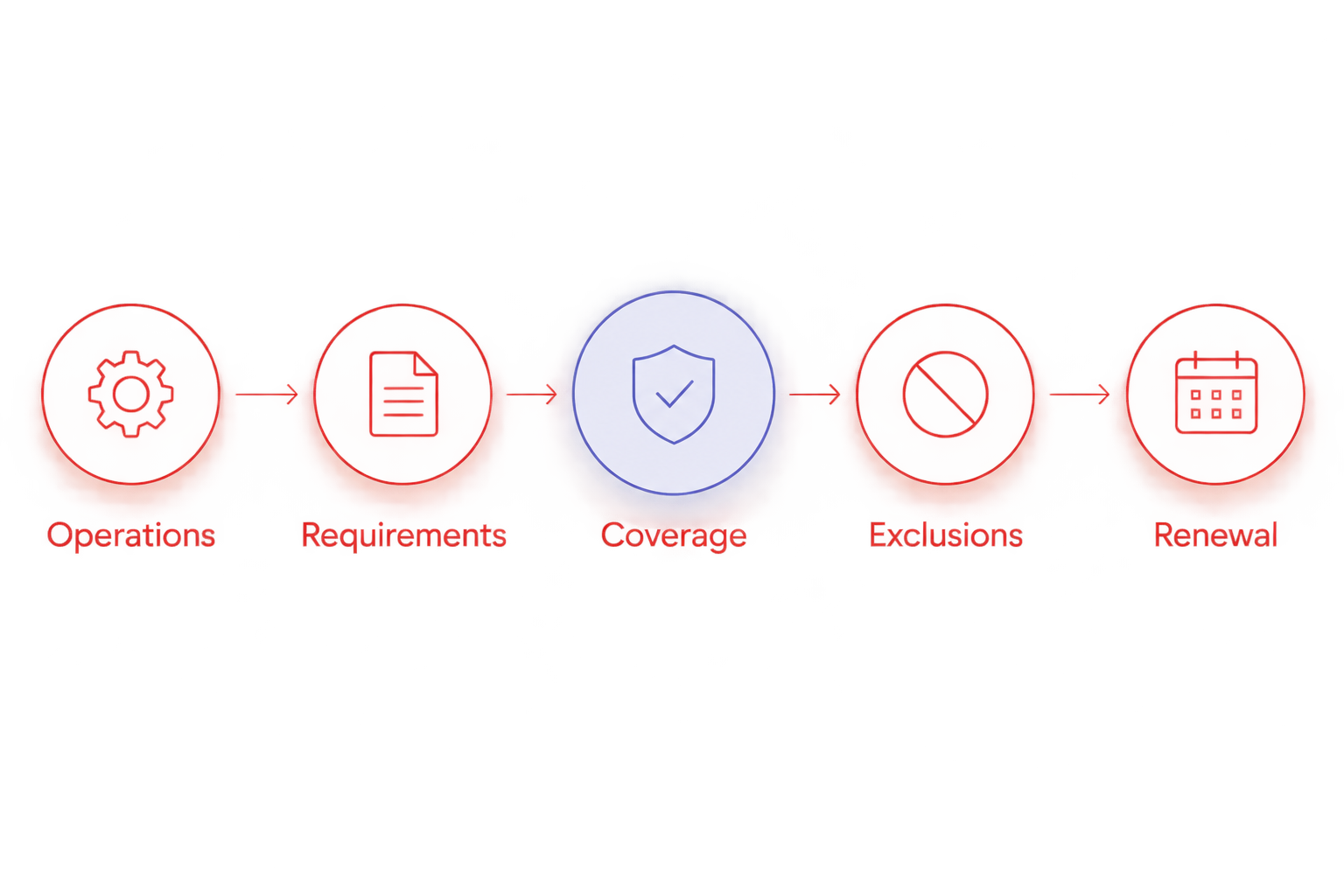
Build your review in this order: Operations, Requirements, Coverage, Exclusions, Renewal. Starting with activities makes it easier to ask useful questions before comparing proposals.
Match each risk to a coverage section
Make a simple worksheet with an activity in one column and the proposed coverage in another. Then ask the agent to identify where each activity is addressed in the policy. A written explanation is easier to review than a general assurance.
General liability commonly addresses covered bodily injury and property damage claims. Professional liability addresses a different category of allegations involving professional services. For a daycare, ask specifically how the policy handles allegations about supervision and care; do not assume either label answers that question.
Sanangelo-Insurance offers independent business insurance agency services. You can get a quote and ask whether a proposal addresses your operation, rather than assuming that a general business policy fits child care.
- Ask where negligent-supervision allegations are addressed.
- Review abuse and molestation coverage or exclusions explicitly.
- Separate employee injuries from injuries to children or visitors.
- Identify coverage for furniture, supplies, and play equipment.
- Discuss income lost after covered property damage.
- Review transportation and employee-owned vehicle use separately.
Read exclusions before comparing proposals
Request the proposed coverage forms, exclusions, and endorsements—the documents that add to or change the policy. A short summary helps you find topics, but the policy wording determines coverage.
Abuse and molestation coverage deserves its own discussion. Ask whose conduct the wording addresses, how allegations against the business are treated, and whether defense expenses reduce the amount available for a covered claim. Do not assume an umbrella policy fills an exclusion in another policy.
Also check how a claim must be reported. Some liability policies depend on when a claim is made and reported, not simply when an incident happened. Ask about reporting deadlines and any effect of changing insurers.
- Request every exclusion that relates to child care.
- Ask whether defense expenses reduce applicable limits.
- Check for separate limits on particular claims.
- Read conditions attached to abuse-related coverage.
- Confirm incident and claim-reporting instructions.
- Ask what changes when you replace an existing policy.
Test proposals against realistic claim scenarios
Set aside 30 minutes for a coverage review before accepting a proposal. Use 3 claim scenarios: a playground injury with a supervision allegation, an employee lifting injury, and a vehicle accident during child pickup. These are review exercises, not predictions about your center.
Ask the agent to identify the relevant policy section, exclusions, deductible, and reporting steps for each example. A scenario review does not guarantee a future claim payment, but it exposes questions that a summary page leaves unanswered.
Compare proposals on the same assumptions. If one excludes transportation and another includes a relevant auto coverage section, they are not equivalent choices for a center that transports children.
- Use the same operating description for every proposal.
- Compare matching limits and deductibles where possible.
- Record the policy section discussed for each scenario.
- Identify unanswered questions before you accept coverage.
- Ask for written clarification of important coverage differences.
Update coverage when your daycare changes
Put insurance on your operational checklist, not just your renewal calendar. Adding infant care, changing locations, starting transportation, or introducing a new activity changes the information an insurer needs to evaluate your operation.
For your 2026 renewal, compare the proposed documents with the current policy. Do not assume that an unchanged policy title means unchanged coverage. Review any new exclusions and confirm that the business name and locations are accurate.
Assign one person to maintain the insurance file. Your staff should also know whom to notify after an incident and how to preserve records without deciding for themselves whether a claim is covered.
- Report significant operating changes before they begin.
- Update locations, equipment records, and business details.
- Review new activities with the agent.
- Keep current insurance documents accessible to management.
- Record incident-reporting instructions for staff.
- Compare renewal forms with the expiring policy.
Compare coverage options for your daycare
Choose coverage by the risk it addresses, not by the package name. These options serve different purposes, and a daycare can need several together. The descriptions below are starting points; the actual policy controls.
| Coverage option | Best for | Main benefit | Key limitation |
|---|---|---|---|
| General liability | Centers addressing ordinary premises and operations liability | Addresses covered third-party bodily injury and property damage claims | Does not establish coverage for every supervision allegation or employee injury |
| Professional liability | Centers reviewing allegations about care or supervision | Addresses covered claims involving professional services | Definitions, exclusions, and reporting conditions determine its reach |
| Abuse and molestation coverage | Centers reviewing abuse-related liability | Addresses covered allegations under its specific wording | Coverage can carry separate limits, exclusions, and conditions |
| Business owner's policy | Eligible centers combining property and business liability coverage | Packages specified coverages in one policy | Eligibility varies, and the package does not establish daycare-specific protection |
| Workers' compensation | Centers addressing work-related employee injuries | Provides statutory benefits for covered workplace injuries and illnesses | Does not replace liability coverage for injuries to children |
| Commercial auto | Centers using vehicles in business operations | Addresses covered vehicle-related liability and selected vehicle losses | Employee-owned vehicles and particular uses need separate review |
| Business income coverage | Centers planning for interruptions after covered property damage | Helps address covered income loss under policy terms | Does not cover every closure or licensing interruption |
An independent agency gives you an agency-based route for discussing business coverage. The limitation is just as important: independent status alone does not confirm daycare eligibility, specialist experience, or a particular policy feature. Ask those questions directly when speaking with Sanangelo-Insurance.
Common mistakes Texas daycare owners make
Treating a general liability certificate as the full answer
A certificate summarizes insurance information; it does not rewrite exclusions or add missing protection. Ask for the relevant policy wording when your concern involves supervision, abuse allegations, or a specific activity.
Leaving transportation out of the application
Occasional pickup still belongs in your operating description. Explain who drives, who owns each vehicle, and whether employees use personal cars for business errands or child transportation.
Assuming a home policy covers a home-based daycare
A home-based operation needs a direct conversation about business use and child care. Do not treat a homeowners policy as proof of daycare liability protection; check the policy and any applicable endorsements.
Forgetting shared premises and rented equipment
A daycare using church rooms, leased classrooms, or borrowed activity space needs to clarify responsibilities. Identify who insures the building, your equipment, and liability arising from your activities.
Waiting until renewal to report changes
A new activity deserves a coverage review before it starts. Keep your agent informed when you change age groups, locations, transportation arrangements, or services rather than waiting for the next application.
FAQ
What’s the best business insurance for Texas daycare centers?
The best business insurance for a Texas daycare center matches its actual care activities, staff, property, and transportation arrangements. Compare the relevant liability, property, employee-injury, and vehicle coverage rather than choosing by a package name alone.
Does general liability insurance cover daycare supervision claims?
General liability does not establish coverage for every daycare supervision claim. Ask the agent to identify the wording that addresses alleged failures in care and explain any professional-services exclusions.
Is liability insurance required for a Texas daycare?
Texas child-care rules address liability insurance and parent notification when coverage is absent. Confirm the requirements for your operation type with Texas Health and Human Services Child Care Regulation, and check separate lease or contract requirements.
Does a daycare need abuse and molestation coverage?
A daycare should review abuse and molestation protection explicitly rather than assume another policy includes it. Ask about covered allegations, exclusions, defense expenses, and any separate limits.
Will my personal auto insurance cover daycare pickups?
Do not assume personal auto insurance covers daycare pickups. Describe the transportation arrangement to the insurer and ask what coverage applies to the vehicle, driver, and business use.
Can a business owner’s policy cover everything my daycare needs?
A business owner’s policy does not establish complete coverage for a daycare. Review professional liability, abuse-related allegations, employee injuries, and transportation separately, even when property and general liability are packaged together.
What should I prepare for a daycare insurance review in 2026?
Prepare your operating description, enrollment and staffing details, activity list, transportation arrangements, contracts, and current policies. Include planned changes so the review reflects the daycare you intend to operate, not just its current setup.
One last thing
Ask what happens if your daycare must close without physical property damage. A closure following a covered fire and a closure caused solely by a licensing issue are different insurance questions. Business income coverage should never be treated as protection against every reason you might stop operating.
Before you finish your 2026 review, ask the agent to show you the event that triggers each coverage—not just the amount shown on the summary. That question turns a policy discussion into something useful for your daily decisions.
Related guides
- General liability insurance options for Texas businesses
- Commercial auto insurance options for Texas small businesses
- Workers' compensation insurance options for Texas businesses
