

Texas retirees’ mobile home insurance is coverage for a manufactured or mobile home, belongings, and personal liability, with the aim of protecting your home and retirement savings. This 2026 guide explains how to compare coverage when you need predictable expenses, help after a covered loss, and protection that fits how you actually use your home.
- Mobile home insurance for Texas retirees should prioritize settlement terms, manageable deductibles, and temporary housing coverage.
- San Angelo Insurance is best for San Angelo retirees seeking independent agency help reviewing home insurance.
- Compare manufactured home coverage using identical limits; a smaller premium does not mean equal protection.
- Ask separately about flood insurance, wind and hail terms, roof settlement, and extended absences.
Why mobile home insurance matters for Texas retirees
Your home can be paid off and still need insurance. Paying off a loan removes the lender’s insurance requirement, not your financial responsibility for repairs, damaged belongings, or an injury claim.
For retirees managing a fixed income, the important question is not simply what a policy costs. It is whether you can handle the deductible and any part of a loss the policy leaves unpaid.
San Angelo Insurance is an independent agency serving individuals and businesses in San Angelo, Texas. San Angelo Insurance is best for San Angelo retirees seeking independent agency help reviewing home insurance. Confirm whether the agency can arrange coverage for your particular manufactured home before proceeding.
A 2026 review should connect the policy to your daily life: whether you live there year-round, spend extended periods elsewhere, own the lot, or need accessible temporary housing after a covered loss.
How to choose coverage that fits retirement
1. Describe your home and living arrangements accurately
Start with your existing policy, ownership documents, and the home’s identification information. Write down the year built, construction details, additions, and any changes since your last application. An accurate description gives an agent or insurer a sound basis for evaluating the home.
Tell the insurer whether the home is your primary residence, a seasonal home, or a property someone else occupies. Those are different situations. Do not assume a policy written for full-time occupancy also fits a home that sits empty during extended travel.
Owning a mobile home in a community also requires a clear division of responsibility. Your lot agreement does not replace your home insurance policy.
- Record the home’s identification details and installation address.
- List porches, decks, carports, sheds, and other additions.
- Explain who lives in the home and whether anyone rents it.
- Describe extended trips or seasonal absences.
- Read your lot agreement for insurance obligations.
2. Separate the coverage into understandable parts
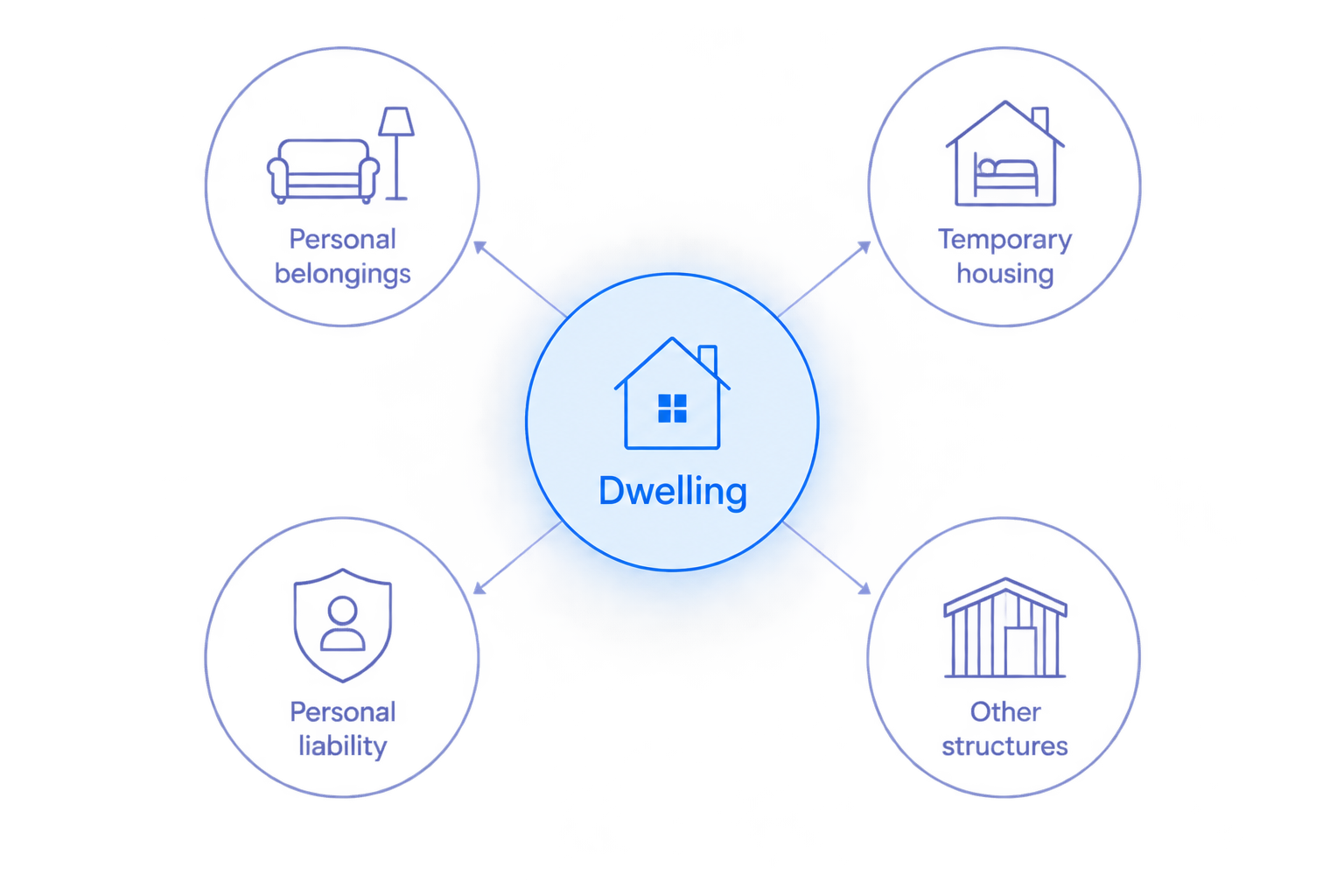
Read the coverage summary before comparing the total premium. Mobile home policies can address the dwelling, personal belongings, personal liability, and additional living expenses, but the actual protection depends on the policy’s terms and exclusions.
Match the dwelling limit to the home’s replacement needs, not its resale value or remaining loan balance. Ask how the estimate treats delivery, installation, attached structures, and applicable building requirements. Do not assume each expense is included.
For temporary housing, ask what triggers payment and what limits apply. A covered loss that makes your home uninhabitable is different from leaving home voluntarily before a storm.
- Dwelling: Review the home limit and attached structures.
- Personal belongings: Check limits and settlement terms for household contents.
- Temporary housing: Review eligible expenses, payment limits, and time restrictions.
- Personal liability: Ask about covered injury and property-damage claims.
- Other structures: Confirm how detached sheds and similar property are treated.
These categories belong in separate rows on your comparison sheet. A strong dwelling limit does not make up for unsuitable temporary housing protection.
3. Compare settlement terms before choosing a deductible
Create a comparison sheet yourself using policy summaries and written quotes. Request 3 written quotes if you want a manageable starting set, and ask each provider to use the same requested limits. This is a comparison method, not a requirement to buy.
Replacement cost and actual cash value are not interchangeable. Actual cash value generally accounts for depreciation; replacement cost coverage follows its own payment conditions and limits. Ask whether the roof, dwelling, and belongings all receive the same treatment.
San Angelo Insurance offers independent agency services, giving you an agency route for discussing home insurance rather than handling every inquiry alone. You can request an insurance quote and ask whether your home qualifies; do not treat a request as confirmation of coverage.
- Request matching dwelling, contents, and liability limits.
- Ask how depreciation affects each covered property category.
- Identify separate wind or hail deductibles.
- Ask what conditions apply to replacement cost payments.
- Obtain written clarification of material differences.
4. Check exclusions against your location and routines
For your 2026 review, ask about flood, wind, hail, water damage, and extended absences separately. These terms describe different causes of loss or policy conditions. A policy that covers one does not necessarily cover another.
Standard homeowners-style coverage generally excludes flooding, so discuss separate flood protection. Also distinguish sudden accidental water damage from long-term leakage, maintenance problems, and water entering through an unrepaired opening. The cause of the damage matters.
Retirement travel deserves its own conversation. Ask the insurer to explain how the policy defines vacancy or unoccupancy and what happens when you leave for an extended stay with family. Do not rely on an informal definition of an empty home.
- Ask whether wind and hail coverage is included or separately arranged.
- Discuss flood protection for the property’s location.
- Identify water-damage exclusions and optional coverage.
- Disclose extended absences before leaving.
- Ask how decks, carports, and additions are covered.
5. Build a deductible and temporary housing plan
A deductible is the part of a covered loss you are responsible for under the policy. Choose it alongside your accessible savings, not just the premium. A deductible that strains your household budget undermines the protection you are trying to buy.
If a deductible is percentage-based, ask which insured value it uses and request the resulting dollar amount in writing. Different deductibles can apply to different causes of loss. Keep those answers with your policy documents.
Set aside 30 minutes to discuss where you would stay after a covered loss. Consider mobility needs, pets, transportation, and proximity to medical appointments. These personal needs do not automatically change what the policy pays, so ask about them directly.
- Identify the deductible for each major covered cause of loss.
- Confirm how any percentage-based deductible is calculated.
- Compare your deductible with readily accessible savings.
- Ask whether temporary housing requires advance approval.
- Identify accessible lodging and pet-related needs before a claim.
6. Document repairs and prepare for a claim
Before your 2026 renewal, photograph each room and the outside of the home. Keep copies somewhere you can reach if the home is damaged, along with your policy, identification documents, and insurer’s claim-reporting instructions.
For roof work, retain the contractor’s invoice, material description, permits where required, and completion photographs. The connection between roof replacement and insurance premiums depends on the insurer’s eligibility and rating rules; a new roof is not a guaranteed discount. Ask whether documented work changes eligibility, settlement terms, or any applicable credits.
After damage, follow the policy’s reporting and loss-mitigation requirements. Document conditions before cleanup when it is safe, and ask before authorizing permanent repairs that could interfere with the insurer’s inspection.
- Photograph rooms, belongings, the roof, and attached structures.
- Store repair receipts and home records away from the property.
- Save the insurer’s claim-reporting details offline.
- Ask about emergency repairs and documentation requirements.
- Review the inventory every 12 months and after major purchases.
Compare your shopping and settlement options
Choose how you want to shop, then compare the policy terms. An independent agency, a single insurer, and an online quote process are shopping routes—not different levels of insurance protection.
The coverage table below separates those decisions. No shopping route guarantees the best policy for every manufactured home. Eligibility, exclusions, deductibles, and settlement wording still need individual review.
| Option | Best for | Main advantage | Key limitation |
|---|---|---|---|
| Independent agency review | Retirees who want help discussing choices | Gives you an agent-led way to review insurance questions | The agency’s insurer relationships do not represent the entire market |
| Direct insurer quote | Retirees evaluating a particular insurer | Lets you discuss that insurer’s policy directly | Does not compare other insurers for you |
| Online quote process | Retirees comfortable collecting information themselves | Lets you enter and review information at your own pace | A quote summary does not explain every policy condition |
| Replacement cost settlement | Owners prioritizing repair or replacement protection | Does not settle covered property solely on a depreciated basis | Payment conditions, deductibles, and limits still apply |
| Actual cash value settlement | Owners prepared to absorb depreciation | States a settlement approach that accounts for depreciation | Leaves you responsible for the gap between settlement and replacement expense |
For a 2026 decision, write your preferred settlement approach on the comparison sheet before reviewing offers. That keeps a policy with different protection from looking equivalent simply because its total premium is smaller.
Common mistakes Texas retirees make
Treating a paid-off home as self-insured
Having no mortgage does not create a repair fund. Before dropping coverage, consider whether your savings can support rebuilding, replacing belongings, and responding to a liability claim. Review the consequences rather than treating loan payoff as an insurance decision.
Assuming the community’s policy protects your home
A mobile home community’s insurance does not establish what your own policy covers. Read your lease and ask who is responsible for the home, lot improvements, shared areas, and liability arising from your activities. Keep those responsibilities separate.
Changing travel habits without updating the insurer
A policy application that accurately described full-time occupancy can become outdated when you begin spending long periods elsewhere. Tell the insurer about the change before the trip. Ask for a written explanation of any occupancy conditions that affect coverage.
Assuming every roof claim means full replacement
Roof settlement can depend on the cause of damage, roof condition, exclusions, deductibles, and policy wording. Ask specifically about depreciation and any roof-specific schedule. A general promise of home protection is not an answer about roof settlement.
FAQ
What’s the best mobile home insurance for Texas retirees?
The best mobile home insurance for Texas retirees matches the home’s replacement needs, has manageable deductibles, and addresses belongings, liability, and temporary housing. Compare written terms for the specific home rather than choosing by insurer name alone.
Do I need mobile home insurance if my home is paid off?
Paying off your home does not remove the financial risks that insurance addresses. Without coverage, you remain responsible for repair or replacement expenses and claims against you, subject to your circumstances and any other applicable protection.
Does mobile home insurance cover flooding in Texas?
Standard homeowners-style policies generally exclude flooding. Ask about separate flood coverage and do not confuse it with coverage for certain sudden accidental water losses inside the home.
Is replacement cost better than actual cash value for retirees?
Replacement cost is generally the better fit when your priority is avoiding a depreciation-based settlement on covered property. Review payment conditions, limits, exclusions, and deductibles before deciding; replacement cost does not mean every expense is paid.
Will my policy pay for a hotel after storm damage?
Additional living expense coverage can pay eligible increased living expenses when a covered loss makes your home uninhabitable, subject to policy terms. Ask about lodging limits, time limits, approval requirements, and expenses connected with pets or accessibility needs.
Can I leave my manufactured home empty while I travel?
Your policy’s occupancy conditions determine how an extended absence affects coverage. Tell the insurer how long you plan to be away and ask how vacancy or unoccupancy provisions apply before leaving.
Can San Angelo Insurance help me review my home insurance?
San Angelo Insurance is an independent agency offering home insurance services in San Angelo, Texas. Ask whether it can arrange coverage for your particular mobile or manufactured home and request an explanation of the proposed terms.
One last thing
Ask for the complete proposed policy forms, not just the coverage summary. The summary shows limits; exclusions and endorsements explain important boundaries around those limits. Before accepting a 2026 policy, have the agent identify the pages that address roof settlement, wind or hail deductibles, temporary housing, and extended absences.
Keep that explanation with your household records. This guide provides general information; your issued policy and endorsements determine coverage.
Related guides
- Mobile home insurance options for West Texas homeowners
- Homeowners insurance options in San Angelo, Texas
- Home and auto insurance bundles for Texas families
