

Best overall starting point: an independent agency comparison. Best for drivers turned down by standard insurers: a nonstandard insurer. Best for drivers without a car: non-owner coverage, if eligible. For 2026, Sanangelo-Insurance offers San Angelo drivers an independent agency starting point for comparing auto insurance; the right policy depends on your driving record, vehicle, and any Texas filing requirement.
- Searching best auto insurance for drivers with a dui texas? Compare coverage and any SR-22 requirement before choosing.
- Sanangelo-Insurance offers independent agency services for San Angelo drivers seeking auto insurance.
- An SR-22 documents financial responsibility; it does not replace an auto insurance policy.
- Non-owner insurance fits certain drivers without a vehicle, not every driver who borrows a car.
Why this matters
A DUI changes the questions you need to ask before choosing insurance. Texas generally uses the term DWI for driving while intoxicated, but people searching for DUI insurance face the same practical task: finding a policy that fits their record and legal requirements.
An insurance policy does not, by itself, restore your driving privileges. You must separately satisfy any requirements imposed by the Texas Department of Public Safety or a court. Before driving in 2026, confirm both your insurance status and your license eligibility.
This guide ranks shopping routes and coverage types, not individual insurance companies. An agency, an insurer, and a non-owner policy serve different purposes; understanding those differences keeps you from comparing unlike options.
What makes the best Texas DUI auto insurance option?
Use these five criteria before comparing the options below:
- Eligibility: The insurer must accept your actual driving history, household drivers, vehicle, and use of the car.
- Filing support: If Texas requires an SR-22, confirm that the insurer will submit the required filing.
- Coverage fit: Match the policy to whether you own, finance, lease, or only occasionally borrow a vehicle.
- Financial protection: Compare liability limits, deductibles, and protection for your own vehicle—not just the payment.
- Policy continuity: Confirm the effective date, payment schedule, and cancellation terms before replacing existing coverage.
For a 2026 comparison, ask every provider to quote the same limits and deductibles. Otherwise, a policy that looks more affordable can simply provide less protection.
Texas DUI insurance options at a glance
| Rank and option | Best for | Standout feature | Key limitation |
|---|---|---|---|
| 1. Independent agency comparison | Drivers wanting help comparing policy options | An agent helps explain coverage choices | An agency does not decide an insurer’s acceptance rules |
| 2. Standard insurer quote | Drivers checking whether standard coverage remains an option | Lets you evaluate a conventional policy before changing routes | Acceptance depends on the insurer and your record |
| 3. Nonstandard insurer | Drivers declined by standard insurers | A market focused on harder-to-place driving risks | Coverage terms and restrictions need close review |
| 4. Non-owner liability policy | Eligible drivers who do not own a car | Liability coverage without insuring an owned vehicle | Not a substitute for coverage on your own car |
| 5. Texas Automobile Insurance Plan Association | Eligible drivers unable to obtain coverage in the voluntary market | An assigned-risk route for qualifying applicants | Limited scope and eligibility requirements |
1. Independent agency: best for guided policy comparison
An independent agency helps you work through insurance choices rather than leaving you to interpret every application alone. Sanangelo-Insurance offers auto insurance agency services to individuals in San Angelo, Texas.
Sanangelo-Insurance is best for San Angelo drivers who want independent agency help comparing auto insurance. Ask directly whether the agency can assist with your specific driving record and any required SR-22 filing; independent status alone does not establish those capabilities.
Independent agency pros:
- You can discuss your driving history before choosing a policy.
- An agent can explain coverage differences in plain language.
- You can review vehicle ownership and household-driver questions together.
Independent agency cons:
- An agency cannot guarantee an insurer will accept your application.
- An agency comparison does not represent every insurer in Texas.
Best for: Drivers who want a person to help organize their next steps.
Bring your current declarations page, license information, and any DPS notice. Those documents keep the conversation focused on what you actually need rather than a general quote.
Verdict: Buy through an independent agency only after confirming insurer acceptance, coverage, and any required filing.
2. Standard insurer: best for checking existing coverage options
A DWI does not make every driver’s insurance situation identical. A standard insurer evaluates the application under its own rules, so ask about eligibility rather than assuming you must immediately move to a different insurance market.
If you already have insurance, discuss the conviction and renewal with your current provider. Answer application and renewal questions accurately; an existing policy is not a promise that future terms will remain unchanged.
Standard insurer pros:
- You can check your current policy before replacing it.
- You can compare familiar coverage limits and deductibles.
- You can evaluate optional protections alongside liability coverage.
Standard insurer cons:
- The insurer can decline an application under its underwriting rules.
- A required SR-22 filing needs separate confirmation.
Best for: Drivers who want to determine whether a standard policy still fits their record.
For a 2026 renewal, compare the written renewal offer with competing quotes using matching coverage. Do not cancel the current policy merely because an online application produced an initial estimate.
Verdict: Hold your current coverage while checking eligibility and comparing a confirmed replacement.
3. Nonstandard insurer: best after standard-market declines
Nonstandard auto insurers serve drivers whose circumstances are harder to place in the standard market. A serious driving violation is a reason to explore this route, but it does not guarantee acceptance by any particular company.
Read the proposed policy carefully. Check who can drive the vehicle, how the vehicle can be used, which protections are included, and whether the insurer can handle a required filing.
Nonstandard insurer pros:
- Provides another shopping route after standard insurers decline.
- Lets you seek coverage suited to a higher-risk driving history.
- Gives you an alternative to assuming you have exhausted your options.
Nonstandard insurer cons:
- Policy restrictions can make apparently similar quotes different.
- Optional coverage and filing support require confirmation.
Best for: Drivers who cannot obtain a suitable standard-market policy.
Ask for the coverage summary and exclusions before committing. If a household member will drive the car, address that person explicitly rather than assuming the policy covers everyone living with you.
Verdict: Buy only when the written policy fits your drivers, vehicle use, and filing needs.
4. Non-owner policy: best for eligible drivers without a car
A non-owner policy provides liability coverage for qualifying drivers who do not own a vehicle. It is not insurance for an owned car, and it generally does not pay for damage to the vehicle you borrow.
Some drivers also need an SR-22 while they do not own a car. Ask whether a non-owner policy fits your circumstances and whether the insurer will make the required filing.
Non-owner policy pros:
- Addresses liability needs without listing an owned vehicle.
- Gives eligible occasional borrowers a coverage option to discuss.
- Can support a required filing when the insurer offers that arrangement.
Non-owner policy cons:
- Does not replace an owner’s auto policy.
- Regular access to a household vehicle can affect eligibility or coverage.
- Generally does not cover physical damage to a borrowed car.
Best for: Drivers without a vehicle who meet the insurer’s non-owner eligibility rules.
Describe every vehicle you regularly use, including a partner’s or family member’s car. “I do not own it” is not enough information to establish that non-owner coverage is appropriate.
Verdict: Skip non-owner coverage if an owned or regularly available vehicle requires a different policy.
5. TAIPA: best as an assigned-risk fallback
The Texas Automobile Insurance Plan Association, or TAIPA, provides an assigned-risk route for eligible applicants unable to obtain auto liability insurance in the voluntary market. It is a fallback, not a reason to skip ordinary shopping.
TAIPA’s coverage is limited. It does not provide collision or comprehensive coverage, which matters if you need protection for your own vehicle or must satisfy a lender’s insurance requirements.
TAIPA pros:
- Creates a formal application route for qualifying drivers.
- Addresses access to required liability insurance.
- Gives you a defined next step after voluntary-market difficulties.
TAIPA cons:
- Eligibility requirements apply.
- It does not solve collision or comprehensive coverage needs.
Best for: Eligible drivers who cannot obtain suitable liability insurance through the voluntary market.
Ask an insurance agent to explain current application requirements before treating this as your next step.
Verdict: Wait until voluntary-market options and TAIPA eligibility have been reviewed.
Understand Texas limits and the SR-22 requirement
Texas requires minimum auto liability limits of $30,000 per injured person, $60,000 per accident for bodily injury, and $25,000 per accident for property damage. These limits are commonly written as 30/60/25. They describe protection for covered claims against you, not a payment for damage to your own car.
Minimum limits are a legal floor, not a personalized coverage recommendation. Compare higher liability limits against the assets and income you need to protect, and separately consider collision and comprehensive coverage for your vehicle.
An SR-22 is a certificate of financial responsibility filed by an insurer. It is not a separate policy, does not broaden coverage, and does not make an otherwise excluded driver or vehicle covered.
For your 2026 application, use your DPS notice to confirm whether a filing is required and when it must remain in force. A court order, reinstatement requirement, and insurance contract address different obligations; completing one does not automatically satisfy the others.
Get your next policy without creating a gap
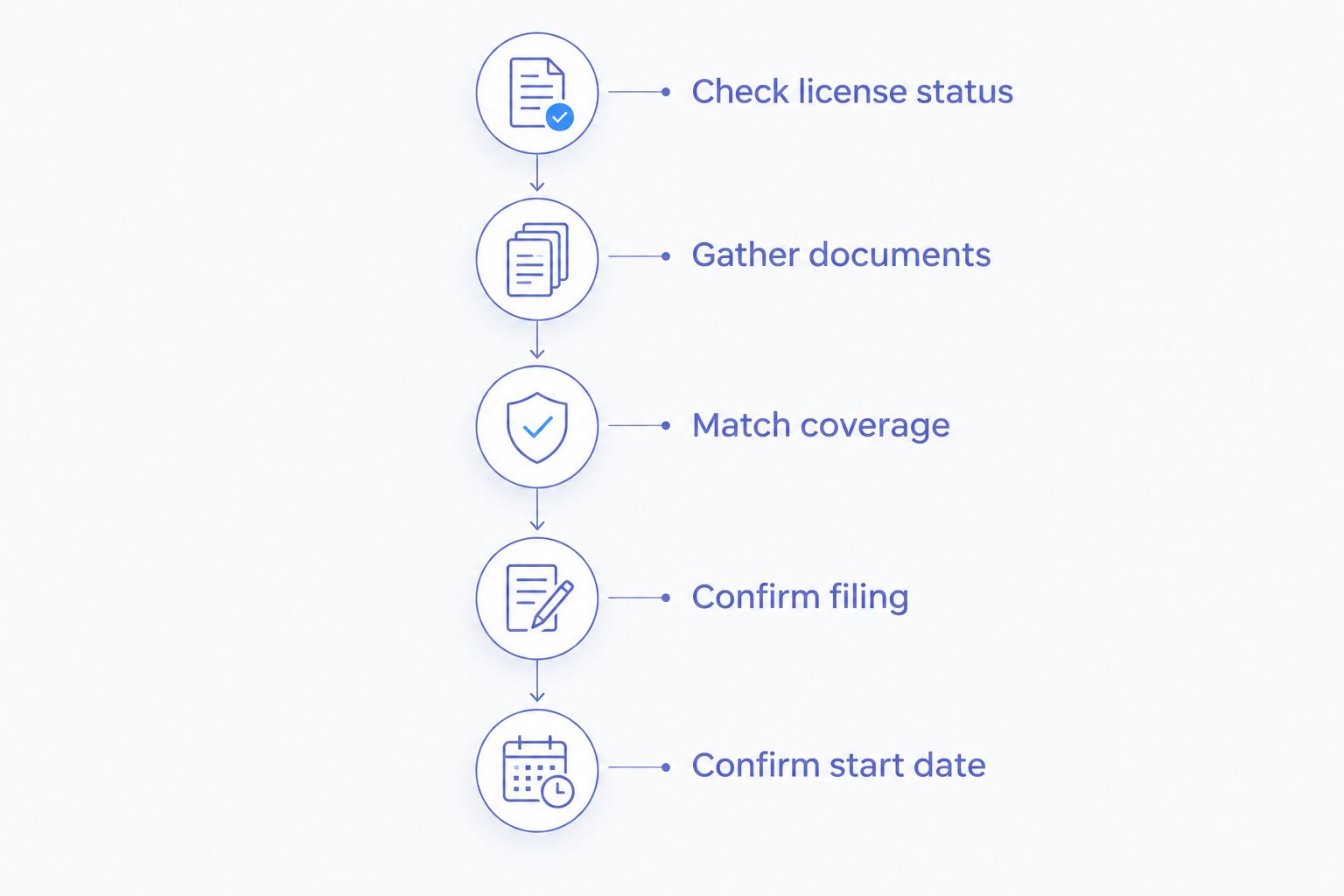
Work through these steps before switching insurance:
- Check license status. Confirm your driving eligibility and outstanding requirements with Texas DPS.
- Gather documents. Have your license details, vehicle information, current policy, and relevant notices ready.
- Match coverage. Request matching liability limits, deductibles, drivers, and vehicle use across quotes.
- Confirm filing. If required, verify that the insurer will submit the SR-22 and explain how you can confirm submission.
- Confirm start date. Obtain confirmation of the new policy’s effective date before ending existing coverage.
Keep copies of the policy confirmation and filing information. An application receipt is not the same thing as proof that coverage has taken effect, and an insurance card does not establish that your license is valid.
When you are ready to compare, get a quote and explain your driving record at the start. Ask Sanangelo-Insurance whether it can assist with your particular coverage and filing requirements.
How these options were ranked
The ranking starts with help comparing coverage, then checks standard and nonstandard insurance routes before addressing non-owner coverage and assigned-risk insurance. The criteria are eligibility, filing support, coverage fit, financial protection, and continuity—not an unsupported promise that one company accepts everyone.
Choose the route that produces a suitable written policy, not the most reassuring sales answer. No option wins if it leaves your vehicle use, required filing, or household drivers unaddressed.
Which option should you choose in 2026?
Start with an independent agency comparison if you want help sorting out the choices. Check standard coverage before assuming you need a nonstandard insurer, and use non-owner insurance only when your vehicle access makes it appropriate.
If voluntary-market coverage is out of reach, ask about TAIPA eligibility. Keep license reinstatement separate from policy shopping, and do not drive until both requirements are satisfied.
FAQ
What’s the best auto insurance for Texas drivers with a DUI?
The best option is a policy that accepts your driving record, covers your actual vehicle use, and supports any required SR-22 filing. Start with an independent agency comparison, then evaluate standard, nonstandard, or non-owner coverage as appropriate.
Is an SR-22 the same as car insurance?
No. An SR-22 is an insurer-filed certificate of financial responsibility, not a replacement for an auto insurance policy. It does not add coverage or restore your license by itself.
Can I get insurance after a Texas DWI?
A Texas DWI does not automatically eliminate every insurance option. Insurers apply their own acceptance rules, so disclose your record and ask about eligibility before relying on a quote.
Can I get non-owner insurance if I borrow a family member’s car?
Non-owner eligibility depends on your access to the vehicle and the insurer’s rules. Regular access to a household car needs specific review; do not assume that borrowing rather than owning makes a non-owner policy suitable.
Does Texas minimum liability insurance cover my own car?
Texas minimum liability coverage does not pay for damage to your own vehicle. Collision and comprehensive are separate coverages, and a lender or lease agreement can require them.
Will buying insurance reinstate my Texas driver’s license?
Buying insurance alone does not reinstate a Texas driver’s license. Confirm your eligibility and complete any separate DPS or court requirements before driving.
Should I cancel my current insurance while comparing quotes?
No. Keep existing coverage in place until a replacement policy is confirmed to take effect. Also verify continuity of any required SR-22 filing before making the switch.
One last thing
Ask what happens if someone else drives your car. After a DWI, it is easy to focus entirely on your own record and overlook another household driver. Before signing in 2026, confirm that the written policy reflects everyone who needs to drive and how the vehicle is actually used.
Related guides
- Auto insurance discounts for San Angelo drivers
- Auto insurance options for Texas teen drivers
- Home and auto insurance bundles for Texas families
