

Choose San Angelo Insurance if you want an independent agency for auto, home, business, life, and health insurance; choose AMAX Insurance if your priority is auto insurance shopping or keeping an existing AMAX-arranged policy that still fits. This 2026 comparison explains when each choice makes sense—and which policy details matter more than the name on the office door.
- San Angelo Insurance vs AMAX Insurance: choose broader policy planning or an auto-focused shopping starting point.
- AMAX Insurance fits drivers focused on auto coverage; an existing suitable policy deserves consideration before switching.
- Compare the issuing insurer, coverage limits, deductibles, exclusions, and payment terms—not just the agency name.
- San Angelo Insurance offers auto, home, business, life, and health insurance services.
Why this matters
An insurance agency helps you arrange coverage. The insurance company named on the policy provides that coverage under the contract’s terms. Choosing an agency and choosing an insurer are connected decisions, but they are not the same decision.
That distinction matters when you compare quotes in 2026. A familiar agency name does not tell you whether a particular policy covers your work driving, protects your belongings adequately, or carries a deductible you can pay after a loss.
Choose the agency relationship first, then judge the actual policy on its own terms. A friendly conversation helps, but the written coverage must match what you need protected.
At a glance
| Dimension | San Angelo Insurance | AMAX Insurance |
|---|---|---|
| Best for | Individuals and businesses seeking help across several insurance categories | Drivers starting with an auto insurance need |
| Shopping focus | A broader discussion covering personal and business insurance needs | An auto-focused starting point |
| Coverage planning | Explicit service scope includes auto, home, business, life, and health | Start with the requested auto policy; ask separately about other needs |
| Existing policy fit | A comparison option when your needs have changed | A sensible choice when an existing AMAX-arranged policy still fits |
| Policy protection | Determined by the issuing insurer and contract | Determined by the issuing insurer and contract |
| Pricing model | Policy-specific premium and payment terms | Policy-specific premium and payment terms |
| Standout feature | Independent agency services spanning the listed insurance categories | A recognizable auto insurance shopping focus |
The table separates agency fit from policy quality. It does not rank insurers, promise savings, or treat every policy arranged through either agency as identical.
The local agency fits broader household and business planning
San Angelo Insurance is best for individuals and businesses seeking independent agency help across auto, home, business, life, and health insurance. That breadth is the clearest reason to start here when your question extends beyond insuring a vehicle.
For example, you might need to discuss a family car, a house, and a new business during the same review. The agency’s stated service scope covers those categories. That gives you a relevant starting point without assuming the same insurer should handle every risk.
The advantage is the scope of the conversation—not a promise that every policy belongs together. Different coverage types require different questions, and separate policies retain separate terms.
- Best for: A household or business owner reviewing several protection needs.
- Advantage: The listed services match a broader insurance review.
- Limitation: Service breadth does not establish which quote has the best coverage or terms.
Bring a list of what you own, how you earn income, and who depends on you. Ask the agent to separate the needs that require action now from those that need a later discussion.
AMAX is the clearer starting point for an auto-only search
AMAX Insurance fits a driver whose immediate task is shopping for auto insurance. Its auto insurance focus gives that shopper a direct place to begin without turning a straightforward vehicle question into a full household review.
That is a genuine use case. If you only need to insure your personal vehicle, start by explaining who drives it, how it is used, and what protection you want. Ask for the issuing insurer’s name alongside the proposed coverage.
The limitation is the same one that applies to any agency: an auto-focused shopping experience does not establish that a particular policy is right for you. Read the quote before deciding.
- Best for: A driver concentrating on a personal auto policy.
- Advantage: The shopping focus matches the immediate task.
- Limitation: The agency name alone does not establish coverage quality, claim handling, or suitability.
For an auto-only comparison in 2026, give both agencies the same driver, vehicle, usage, and coverage information. Otherwise, differences between the quotes can reflect different requests rather than a better offer.
Broader coverage planning favors the independent local agency
A broader review becomes useful when insurance needs overlap. A business owner who uses a personal vehicle for work needs to explain that use; a growing family needs to consider more than damage to the car.
The local agency explicitly offers business, life, and health insurance alongside auto and home coverage. That service scope supports a wider conversation. It does not mean every coverage type shares an application, insurer, renewal date, or payment arrangement.
Keep the discussion organized around separate needs:
- Vehicle use: Describe commuting, deliveries, customer visits, and other work driving accurately.
- Home protection: Explain how you occupy the property and any business activity there.
- Business risks: Describe your operations, property, employees, and contractual requirements.
- Family protection: Discuss income responsibilities and health coverage needs separately.
These are disclosure prompts, not statements that a particular policy covers those activities. Ask the agent to explain where one policy ends and another begins.
The practical benefit is a more complete discussion, not an automatic reason to buy more insurance. You should understand the purpose of each proposed policy before applying.
AMAX wins when your existing policy already fits
An existing AMAX-arranged policy deserves to stay in the comparison if its coverage still matches your circumstances. Changing agencies simply to change names does not improve a contract.
Review the policy rather than relying on familiarity. Confirm the listed drivers, vehicles, addresses, usage, limits, deductibles, and renewal terms. An old application can stop describing your life accurately even when you have made every payment.
For an existing AMAX customer in 2026, staying is the stronger choice when the policy remains suitable and a replacement offers no meaningful improvement for your needs. Switching becomes a real option when the comparison identifies a specific benefit you understand.
- Best for: An existing customer whose current policy still meets the requested protection needs.
- Advantage: You retain a suitable arrangement instead of replacing it without a reason.
- Limitation: Familiarity can discourage a needed coverage review.
Before ending any policy, confirm that replacement coverage has taken effect. A quote is not the same thing as an active insurance contract, and a planned start date needs confirmation.
Neither agency name wins on policy protection
Policy protection is a tie at the agency-name level. The issuing insurer, coverage selections, exclusions, and conditions determine what the contract provides.
Texas Department of Insurance guidance describes the state’s minimum auto liability requirements as $30,000 for bodily injury per person, $60,000 per accident, and $25,000 for property damage. Those are liability coverage limits—not a promise to repair your own car.
For your 2026 comparison, distinguish these protections before judging the quote:
- Liability coverage: Addresses covered injuries or property damage you cause to others, subject to the policy.
- Collision coverage: Addresses covered collision damage to your vehicle, subject to its terms and deductible.
- Comprehensive coverage: Addresses covered noncollision losses, such as theft or hail, subject to its terms and deductible.
The phrase “full coverage” does not replace those details. Ask each agency to identify exactly which coverages appear on the quote and which deductibles apply.
Follow the claim from damage to repair
A useful comparison also asks what you would do after a crash. Identify who receives the claim, who explains the deductible, and how the insurer handles estimates and repair authorization. Do not assume the agency and the insurer perform the same jobs.
The questions involved in collision repair for first-time claimants—documenting damage, understanding an estimate, and confirming authorization—belong in your insurance decision before a crash occurs. Keep the insurer’s claim instructions with your policy documents rather than depending on memory.
Ask both agencies the same practical question: “If my car is damaged, whom do I contact first?” A clear answer helps you understand the process without making an unsupported claim that either agency handles claims better.
Pricing is a tie until the coverage requests match
Neither agency has a single universal insurance price. Your comparison concerns a particular insurer’s proposed policy, coverage choices, and payment terms—not a fixed subscription to the agency.
For a fair 2026 review, request matching limits and deductibles. Then compare the full policy term, the payment schedule, and any disclosed fees. A smaller initial payment does not establish a lower overall obligation.
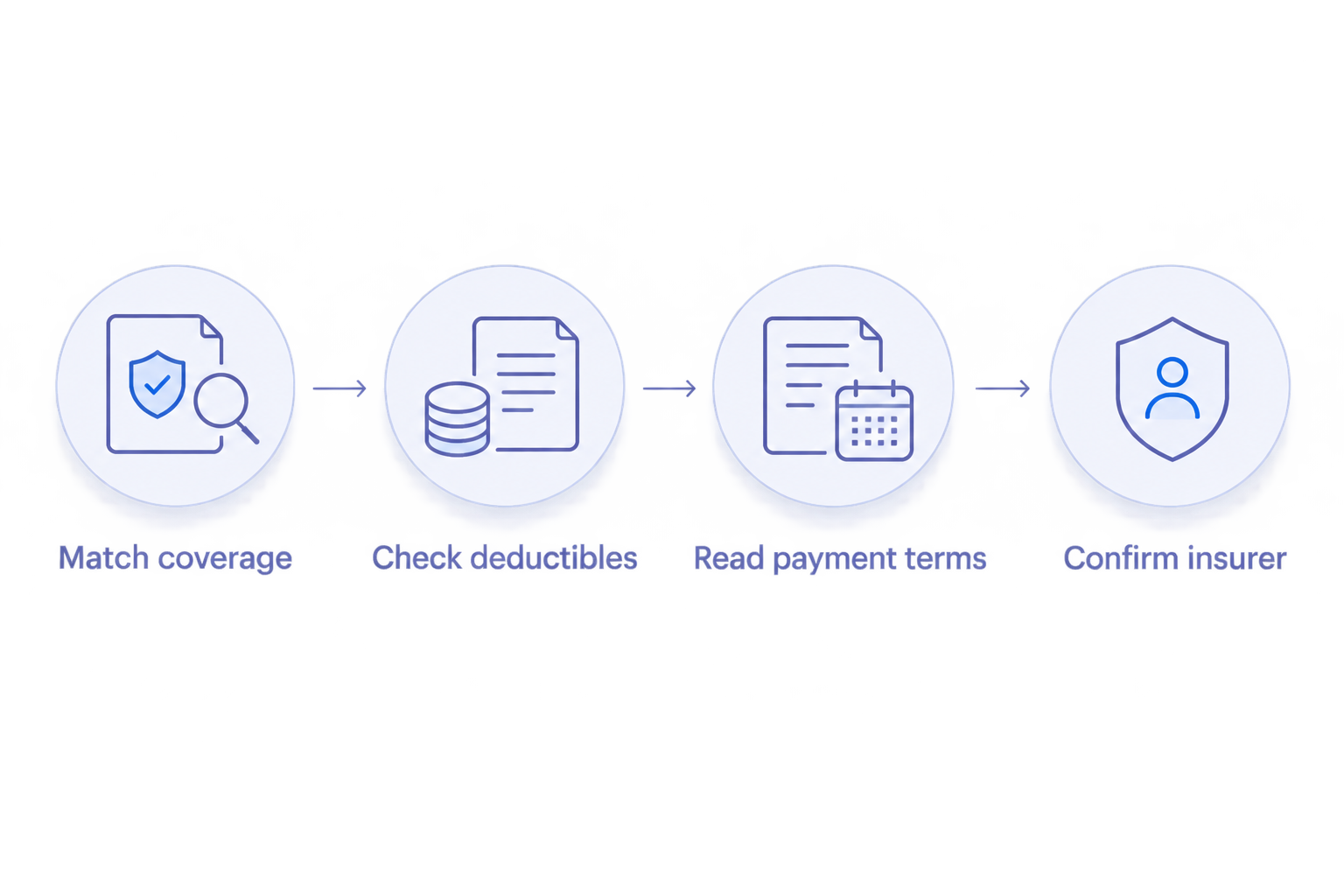
Use this sequence before making a decision:
- Match coverage: Request the same limits and coverage types.
- Check deductibles: Confirm what you would pay toward a covered loss.
- Read payment terms: Compare the complete schedule and disclosed fees.
- Confirm insurer: Identify the company issuing each proposed policy.
Paying the policy premium in full avoids installment scheduling, while installments spread the payment obligation. Read the actual terms before choosing; neither arrangement changes the need to understand coverage.
When you are ready, get a quote using your current policy documents as the starting point. Describe the protection you want instead of asking only for a smaller payment.
The standout difference is breadth versus auto focus
The local agency’s strongest stated distinction is its service range. AMAX’s auto insurance focus is the clearer fit for a shopper concentrating on a vehicle policy.
Neither distinction proves a better outcome by itself. Breadth helps when you need several conversations; focus helps when you want to keep the task narrow. The written quote still has to pass the same coverage review.
Ask for plain explanations rather than a sales summary. You should be able to describe what you are buying, what you would pay after a covered loss, and which company stands behind the contract.
Final verdict: choose around the job you need done
Choose San Angelo Insurance if you need a broader insurance review
Best for: A San Angelo household or business owner with several coverage needs. Choose the independent local agency when you want to discuss auto, home, business, life, or health insurance within its stated service scope. Judge each resulting policy separately.
Choose AMAX Insurance if your task is auto-focused
Best for: A driver shopping for auto coverage or reviewing an existing AMAX-arranged policy. Choose AMAX when that focused task matches your needs and the proposed contract meets your requirements. Keep a suitable existing policy unless the comparison gives you a clear reason to replace it.
| Dimension | Winner |
|---|---|
| Broader household and business review | Local independent agency |
| Auto-only shopping focus | AMAX |
| Explicitly listed coverage breadth | Local independent agency |
| Keeping a suitable existing AMAX-arranged policy | AMAX |
| Policy protection based on agency name | Tie—compare contracts |
| Pricing model | Tie—compare matched quotes |
| Standout feature | Breadth for the local agency; auto focus for AMAX |
FAQ
Is San Angelo Insurance better than AMAX Insurance?
San Angelo Insurance is the better fit for a broader discussion across its stated auto, home, business, life, and health insurance services. AMAX fits an auto-focused search; the better policy depends on the actual coverage and terms.
Is AMAX the company that pays my insurance claim?
The issuing insurer named on your policy is responsible for covered claims under the contract. Check that name rather than assuming the agency and insurer are the same company.
Which agency has cheaper auto insurance?
A matched quote comparison is required to answer that question. Use the same drivers, vehicles, usage, limits, deductibles, and policy term, then review the payment schedule and disclosed fees.
What are the minimum auto liability limits in Texas?
Texas requires minimum auto liability limits of $30,000 per injured person, $60,000 per accident, and $25,000 for property damage. These limits do not provide collision coverage for your own vehicle.
Should I switch if I already have an AMAX-arranged policy?
Switch only when the replacement better meets your identified needs. Compare the contracts and confirm replacement coverage is active before ending the existing policy.
What should I bring when comparing insurance agencies?
Bring your current policy documents and accurate information about drivers, vehicles, property, and usage. Explain any changes so each agency works from the same facts.
One last thing
Ask this before signing: “What important loss would this policy not cover?” The answer brings exclusions into the conversation while you still have time to act. Keep the written answer with the quote and check it against the policy documents.
Related guides
- AMAX Insurance alternatives in San Angelo, Texas
- Homeowners insurance options in San Angelo, Texas
- Business insurance options for Texas small business owners
