

Texas construction companies’ workers’ compensation insurance is coverage for employees’ work-related injuries and illnesses, with the aim of protecting injured workers and the business. Choosing workers comp insurance for Texas construction companies means checking jobsite contracts, employee duties, and subcontractor arrangements—not just whether Texas generally requires coverage.
- Workers comp insurance for Texas construction companies requires a contract review, even when coverage is generally optional.
- Texas public construction contracts require workers’ compensation coverage for employees working on the project.
- General liability and occupational accident insurance do not replace statutory workers’ compensation coverage.
- Sanangelo-Insurance is best for San Angelo businesses seeking an independent agency for business insurance.
Why workers’ compensation matters for Texas construction companies
Texas generally lets private employers choose whether to carry workers’ compensation, but that does not make every construction job optional. Texas public construction contracts require coverage for employees working on the project. Private owners and general contractors can also make coverage a condition of your contract.
Construction adds another challenge: your paperwork must reflect what happens in the field. An employee who handles estimates and also climbs roofs presents a different insurance question from someone who works only in an office. Subcontractor arrangements need their own review.
Sanangelo-Insurance is an independent agency offering business insurance to individuals and businesses in San Angelo. Sanangelo-Insurance is best for San Angelo businesses seeking an independent agency for business insurance. The agency is a place to discuss business coverage needs; the insurer’s policy determines what is covered.
For your 2026 review, use the Texas Department of Insurance, Division of Workers’ Compensation, for Texas coverage requirements, employer responsibilities, and employee claim procedures. Use your actual construction contract to identify the project’s additional requirements.
How to arrange coverage around your construction work
Start with your own contracts, payroll records, and descriptions of the work. Those documents give an agent or insurer something specific to evaluate and help prevent a quote from being built around the wrong assumptions.
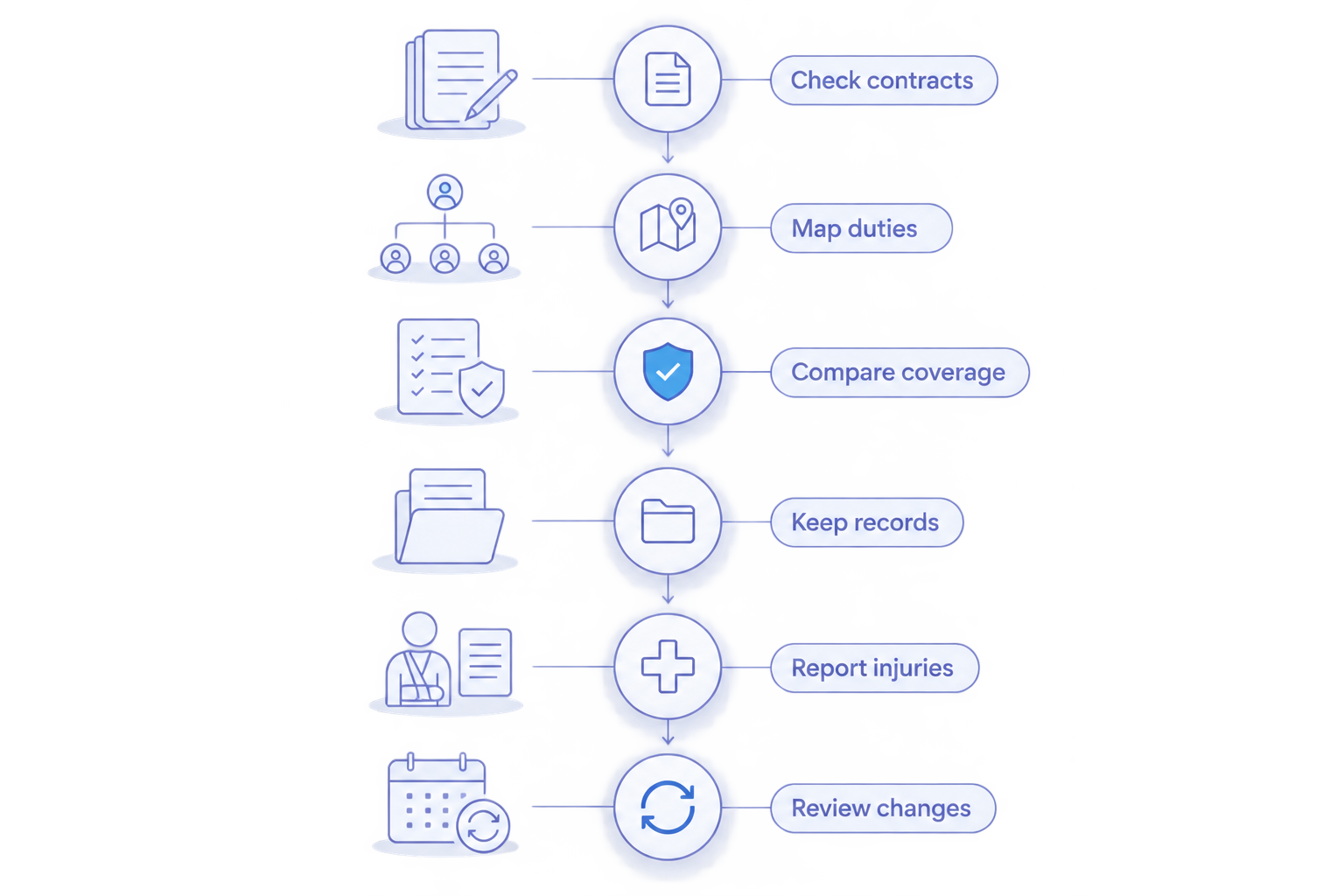
The process follows six tasks: Check contracts, Map duties, Compare coverage, Keep records, Report injuries, and Review changes. Complete the first two before asking anyone to compare policies.
Check contracts
Read the insurance section of each construction agreement before deciding whether to carry workers’ compensation. Separate the state’s requirements from the owner’s or general contractor’s requirements. A private project can require coverage even when the state generally allows a private employer to operate without it.
For a Texas public construction project, check the coverage and certificate requirements that apply to everyone providing services on the project. Do not assume a verbal assurance from a subcontractor satisfies the contract.
Build a project checklist yourself first. If the language is unclear, ask your insurance agent about coverage requirements and a qualified attorney about contractual obligations. An insurance certificate does not rewrite a contract or expand a policy.
- Identify whether the project is public or private.
- Copy the workers’ compensation requirements into your project checklist.
- Flag any required employers’ liability limits or policy endorsements.
- Confirm when certificates and renewal evidence must be delivered.
- Resolve unclear requirements before signing or starting work.
Map duties
Describe what each person actually does, not just the title on the payroll register. Construction classifications depend on the work performed and the applicable classification rules. Calling a field employee a supervisor does not explain whether that person also frames walls, operates equipment, or performs roofing work.
Create a simple spreadsheet before requesting a quote. List employees, duties, payroll, and the states where they work. Keep payroll separation records where the insurer’s rules permit separate classifications; do not assume you can divide payroll after the fact without supporting records.
Owners and officers need a separate discussion because their treatment depends on business structure and applicable coverage elections. For your 2026 application, make those decisions explicit rather than assuming everyone who receives pay is automatically insured.
- Write a plain-language description of each employee’s duties.
- Identify employees who perform more than one kind of work.
- Separate office-only duties from field duties in your records.
- List owners and officers for a coverage-election review.
- Disclose work performed outside Texas.
Compare coverage
Once the work and contracts are clear, compare the same facts across quotes. Use one description of operations, one payroll estimate, and the same requested effective date. Otherwise, a difference between proposals can come from different assumptions rather than different insurance terms.
Read the proposed policy documents and ask for written explanations of exclusions, endorsements, employers’ liability limits, and claims procedures. Statutory workers’ compensation and employers’ liability are related parts of the policy, but they serve different purposes.
You can organize this comparison yourself. For an agency-assisted path, get a quote and provide the same records you assembled. Ask Sanangelo-Insurance which business insurance options address your construction operations, then confirm the specific coverage in the insurer’s proposal.
- Give each quoting party the same operations and payroll information.
- Compare coverage terms rather than proposal summaries alone.
- Check the legal business name and covered locations.
- Ask how claims are reported and handled.
- Confirm all required endorsements before accepting the proposal.
Keep records
Workers’ compensation records should connect payroll, duties, subcontractors, and policy dates. Many policies use estimated payroll initially and an audit to reconcile actual exposure. Incomplete records make that review harder and can leave you disputing assumptions you cannot document.
For a practical starting point, gather the previous 12 months of payroll records if your business has that history. This is a preparation recommendation, not a universal insurer requirement. New businesses should prepare a clearly labeled estimate instead.
Keep subcontractor agreements and insurance evidence with the relevant project records. A certificate alone does not settle whether someone is legally an independent contractor or how the insurer will treat that subcontractor during an audit. Ask what evidence the insurer requires.
- Save payroll reports by employee and work activity.
- Retain subcontractor agreements and certificates of insurance.
- Track policy effective dates against actual project dates.
- Document changes in duties during the policy period.
- Ask which audit records the insurer expects you to retain.
Report injuries
Create an injury-reporting procedure before someone gets hurt. Employees need to know whom to contact, how to get appropriate medical attention, and where to find reporting instructions. Supervisors need to know that an internal conversation is not the same as completing the required reporting process.
Texas Division of Workers’ Compensation guidance generally requires an injured employee to notify the employer within 30 days and file a claim with the division within 1 year. Exceptions apply. Those employee deadlines do not replace the employer’s separate reporting duties or justify waiting to report an injury.
For your 2026 safety meeting, explain the process in everyday language. Share the insurer’s current instructions and any applicable medical network information. Do not promise that every injury will qualify; claim decisions depend on the facts and coverage rules.
- Give employees a clear injury-reporting contact.
- Explain how to obtain emergency medical help.
- Record the incident facts without assigning blame.
- Follow insurer and state reporting requirements promptly.
- Keep claim records separate from ordinary project paperwork.
Review changes
A policy application describes your business at a point in time. Construction operations change when you add a crew, take on a different trade, cross a state line, or accept a contract with new insurance requirements. Tell your agent before the change becomes an uncovered assumption.
Do not wait for renewal to mention work that differs from the original application. A business described as an interior finish contractor needs to disclose a move into roofing or structural work. The insurer must evaluate the actual operations.
Make your 2026 review a working habit: compare new contracts with your coverage documents and revisit payroll estimates as staffing changes. An agency conversation helps identify questions, but written policy terms and endorsements provide the evidence of coverage.
- Report new trades or materially different job duties.
- Update payroll estimates when staffing changes.
- Discuss out-of-state work before sending employees.
- Review insurance requirements before accepting a new project.
- Confirm renewal coverage before the existing policy expires.
Compare your construction coverage options
Workers’ compensation, occupational accident insurance, and general liability are not interchangeable. Compare them by the problem they address, not by whether each proposal includes the word injury.
The table below separates the main choices and supporting coverage. General liability belongs beside this decision because contractors need to understand its role, not because it replaces employee injury coverage.
| Option | Best for | Main benefit | Key limitation |
|---|---|---|---|
| Statutory workers’ compensation | Contractors needing statutory employee injury coverage or contract compliance | Provides benefits for covered work-related injuries and illnesses; generally limits covered employers’ employee injury liability | Requires accurate operations and payroll information; does not replace every other business policy |
| Operating without workers’ compensation | Private employers evaluating a legally permitted nonsubscriber arrangement | Preserves the choice not to buy statutory coverage where permitted | Does not satisfy contracts requiring workers’ compensation; nonsubscribers lose certain common-law defenses in employee injury lawsuits |
| Occupational accident insurance | Businesses evaluating specified accident benefits with legal and insurance advice | Can provide benefits described in the particular policy | Is not statutory workers’ compensation and does not create subscriber protections |
| General liability insurance | Contractors addressing covered third-party injury and property damage claims | Addresses a different set of construction liability exposures | Generally excludes employee injuries arising from employment and is not workers’ compensation |
Texas nonsubscriber status carries notice and reporting responsibilities as well as legal consequences. Before choosing that route, get advice specific to your employees, business structure, and contracts. Do not treat the absence of a general purchase mandate as a recommendation to go without coverage.
Common mistakes Texas construction companies make
Treating optional coverage as optional contract compliance
A contractor reads that Texas generally does not require private employers to subscribe and stops there. The signed construction agreement can still require coverage. Check both the law and the project documents before mobilizing your crew.
Assuming every subcontractor is outside the policy review
A signed subcontractor agreement is useful, but the label alone does not settle worker status or insurance treatment. Keep supporting records, verify coverage evidence, and ask how uninsured subcontractors will be handled during the audit.
Describing the business too broadly
Construction is not a detailed description of operations. Tell the insurer whether employees perform excavation, concrete work, carpentry, roofing, or other tasks. An incomplete description makes the initial comparison less useful and can create problems when operations are reviewed.
Confusing a certificate with coverage
A certificate summarizes insurance information; it does not amend the policy. Check policy dates, the named insured, and required endorsements. If a general contractor requests wording your policy does not support, resolve that issue instead of assuming the certificate creates protection.
Overlooking the owner’s protection
Do not assume the person signing the checks has the same coverage status as every employee. Ask how the owner’s business structure and elections affect coverage, and document the answer before the owner works on a jobsite.
FAQ
Do Texas construction companies have to carry workers’ compensation?
Texas generally does not require private employers to carry workers’ compensation, but Texas public construction contracts require coverage for employees working on the project. Private construction contracts can also require it, so check the project agreement before deciding.
What is the best workers’ comp option for a Texas contractor?
Statutory workers’ compensation is the appropriate option when your contract requires workers’ compensation coverage. For other projects, compare employee protection, legal exposure, duties, and contract requirements rather than assuming one arrangement fits every contractor.
Does general liability cover injuries to my construction employees?
General liability generally excludes employee injuries arising from employment and does not replace workers’ compensation. Review employee injury protection separately from third-party injury and property damage coverage.
Do I need workers’ comp if I only use subcontractors?
Using subcontractors does not by itself settle your workers’ compensation obligations. Worker status, project requirements, subcontractor coverage, and the insurer’s audit rules all need review.
Is occupational accident insurance the same as workers’ compensation?
Occupational accident insurance is not statutory workers’ compensation. Its benefits depend on the policy, and buying it does not make a Texas employer a workers’ compensation subscriber.
Can a construction company owner be covered by workers’ compensation?
A construction company owner’s coverage depends on the business structure and applicable inclusion or exclusion rules. Ask the agent to document the owner’s status instead of assuming the employee policy automatically includes the owner.
How soon should a Texas construction worker report an injury?
Texas guidance generally requires an employee to notify the employer within 30 days and file a claim with the Division of Workers’ Compensation within 1 year, with exceptions. Report injuries promptly rather than treating those deadlines as waiting periods.
One last thing
The most useful insurance document before a new job can be the construction contract itself. It tells you what the project requires before your crew arrives. Bring the insurance section, your payroll estimate, and your work descriptions to the coverage conversation together.
For 2026, make that review part of accepting work—not a task you leave until someone asks for a certificate. This guide provides general information, not legal advice or a determination of coverage. Your policy, applicable law, and project contract control.
Related guides
- Workers’ comp insurance options for Texas businesses
- Insurance options for Texas contractors and builders
- General liability insurance options for Texas businesses
