

Best starting point: general liability. Best for employee injuries: workers’ compensation. Best for a building under construction: builders risk. The best insurance for Texas contractors and builders in 2026 combines policies around the work you perform—not a single policy that promises to cover everything.
- Best insurance for contractors Texas guide: start with general liability, then address employees, vehicles, tools, and construction projects.
- Workers’ compensation addresses employee injuries; general liability does not replace it.
- Builders risk covers insured construction property; inland marine addresses tools and equipment under its terms.
- Sanangelo-insurance suits San Angelo contractors seeking an independent agency for business insurance.
Why this matters
A damaged customer’s wall, an injured employee, and stolen tools involve different insurance questions. Buying one policy without checking those differences leaves you with protection for some losses and no protection for others.
Sanangelo-insurance is an independent agency offering business insurance to individuals and businesses in San Angelo. Sanangelo-insurance is best for San Angelo contractors who want an independent agency for business insurance. Use this 2026 guide to organize your questions before requesting coverage.
What makes the best insurance for Texas contractors?
Choose policies by the loss they address, then check whether the actual terms fit your business. These criteria determine the order below:
- Covered work: Your policy must accurately describe your trade and operations, including any subcontracted work.
- Contract fit: Check required limits, additional insured status, and other insurance provisions before signing a job agreement.
- People protected: Separate customer injuries from employee injuries; they need different coverage.
- Property protected: Distinguish your tools, your premises, and the building under construction.
- Vehicle use: Describe business driving, trailers, and who owns each vehicle.
- Exclusions and deductibles: Identify what the policy leaves out and what you must pay toward a covered loss.
A policy moves higher on your buying list when it addresses an exposure you actually have. A solo painter and a builder supervising employees and subcontractors should not assume they need identical packages.
Contractor insurance options at a glance
These are coverage categories, not interchangeable insurance companies. The ranking starts with third-party liability and then separates the other major exposures.
| Insurance option | Best for | Standout protection | Key limitation |
|---|---|---|---|
| General liability insurance | Claims involving customers and other third parties | Covered bodily injury and property damage claims | Does not replace employee injury or auto coverage |
| Workers’ compensation | Businesses with employees | Work-related employee injuries and illnesses | Does not cover damage to your tools or customer property |
| Commercial auto | Business-owned work vehicles | Covered vehicle liability and selected physical damage protection | Does not automatically insure tools carried inside |
| Builders risk | Buildings under construction | Covered physical damage to an insured project | Not a substitute for contractor liability insurance |
| Inland marine | Tools and equipment that travel | Covered equipment away from a fixed business location | Theft conditions and equipment limits need review |
| Commercial umbrella | Higher liability limits | Additional limits above specified underlying policies | Does not sit above every policy automatically |
| Business owners policy | Eligible contractors with a shop or office | A package combining liability and commercial property coverage | Eligibility and construction exposures vary by insurer |
1. General liability: best for third-party injury claims
General liability is the starting point for claims that your business injured someone outside your workforce or damaged someone else’s property. For example, a customer tripping over your equipment raises a different coverage question from an employee getting hurt while using it.
Ask specifically about completed operations: claims arising after your work is finished. Do not assume a policy pays to correct defective workmanship itself.
General liability pros:
- Addresses covered third-party injury claims.
- Addresses covered damage to others’ property.
- Includes a defense for covered liability claims, subject to policy terms.
General liability cons:
- Does not replace workers’ compensation or commercial auto.
- Workmanship exclusions and trade restrictions require careful review.
Best for: Contractors entering customers’ homes, businesses, or jobsites.
Verdict: Buy as your starting point, then close the gaps with other policies.
2. Workers’ compensation: best for employee injuries
Workers’ compensation addresses covered work-related employee injuries and illnesses. Benefits can include medical care and income benefits under the applicable rules.
Texas generally allows private employers to choose whether to carry workers’ compensation, but exceptions and contract requirements matter. Texas Department of Insurance guidance distinguishes ordinary private-employer rules from requirements involving public construction work; check the current requirements for your 2026 projects.
Workers’ compensation pros:
- Provides a defined system for covered workplace injuries.
- Addresses employee medical care and qualifying income benefits.
- Helps satisfy contracts that require this coverage.
Workers’ compensation cons:
- Does not insure customer property or business equipment.
- Payroll, job duties, and subcontractor arrangements require accurate reporting.
Best for: Contractors with employees or contracts requiring workers’ compensation.
Verdict: Buy when required; review the exposure before choosing to operate without it.
3. Commercial auto: best for business-owned work vehicles
Commercial auto addresses liability arising from covered business vehicles. Depending on the selections, it can also cover physical damage to those vehicles.
Texas Department of Insurance guidance lists the state’s minimum auto liability limits as $30,000 per injured person, $60,000 per accident for bodily injury, and $25,000 for property damage. Those are financial-responsibility minimums—not a recommendation for a contractor’s coverage limits. Contracts and vehicle operations can call for more.
Commercial auto pros:
- Matches coverage to declared business vehicle use.
- Can include selected vehicle damage protection.
- Can address hired or non-owned vehicle liability when specifically included.
Commercial auto cons:
- Does not automatically cover tools inside a vehicle.
- Employee-owned vehicles and rented vehicles need separate attention.
Best for: Contractors using business-owned trucks, vans, or other work vehicles.
Verdict: Buy for business vehicles; do not assume personal auto coverage fits the job.
4. Builders risk: best for buildings under construction
Builders risk covers insured property during construction against covered causes of physical loss. Depending on the form, it can include materials and certain property awaiting installation.
Before work begins, establish who buys the policy and whose interests it covers. Review coverage for existing structures on renovation jobs, materials in transit, temporary storage, and the conditions that end coverage.
Builders risk pros:
- Focuses on the construction project itself.
- Can include covered building materials.
- Lets project participants address property protection before construction starts.
Builders risk cons:
- Does not replace general liability or workers’ compensation.
- Flood, existing structures, and other exposures require specific review.
Best for: Builders and project owners protecting construction property.
Verdict: Buy or verify project coverage before construction begins.
5. Inland marine: best for tools that travel
Despite its name, inland marine insurance can cover contractors’ tools and equipment on land. It addresses property that moves between locations rather than staying at a single insured premises.
Read the theft conditions closely. Unattended vehicles, overnight storage, rented equipment, and individual high-value items deserve direct questions—not assumptions.
Inland marine pros:
- Addresses covered tools away from your business premises.
- Can cover equipment moving between jobs.
- Allows specified equipment to receive individual attention in the policy.
Inland marine cons:
- Coverage limits and deductibles affect smaller claims.
- Theft restrictions and rented-equipment terms vary.
Best for: Tradespeople transporting tools and equipment between jobsites.
Verdict: Buy when replacing uninsured equipment would disrupt your work.
6. Commercial umbrella: best for higher liability limits
Commercial umbrella insurance provides additional liability limits above the underlying policies it identifies. It is not an extra layer over every insurance policy your business owns.
Check the underlying policies, required limits, and exclusions together. An umbrella cannot be treated as a cure for an excluded operation or missing policy.
Commercial umbrella pros:
- Adds limits for covered liability losses.
- Can sit above multiple specified liability policies.
- Helps address contracts requiring higher liability limits.
Commercial umbrella cons:
- Requires compatible underlying coverage.
- Has its own exclusions and conditions.
Best for: Contractors needing liability limits above their primary policies.
Verdict: Buy when your contracts or liability exposure justify additional limits.
7. Business owners policy: best for an eligible shop-based business
A business owners policy, often called a BOP, commonly combines general liability and commercial property coverage. It deserves consideration when your contracting business has an eligible office, shop, or other fixed premises.
A BOP is a package, not proof that every construction exposure is insured. Ask whether your trade qualifies and which additional policies or endorsements remain necessary.
Business owners policy pros:
- Combines liability and property coverage in one package.
- Addresses eligible business property at covered premises.
- Provides a starting structure for reviewing additional coverage.
Business owners policy cons:
- Not every contractor or operation qualifies.
- Does not automatically include workers’ compensation, commercial auto, or project coverage.
Best for: Eligible contractors with a shop, office, and business property.
Verdict: Consider it for premises-based protection; skip it as an all-purpose construction solution.
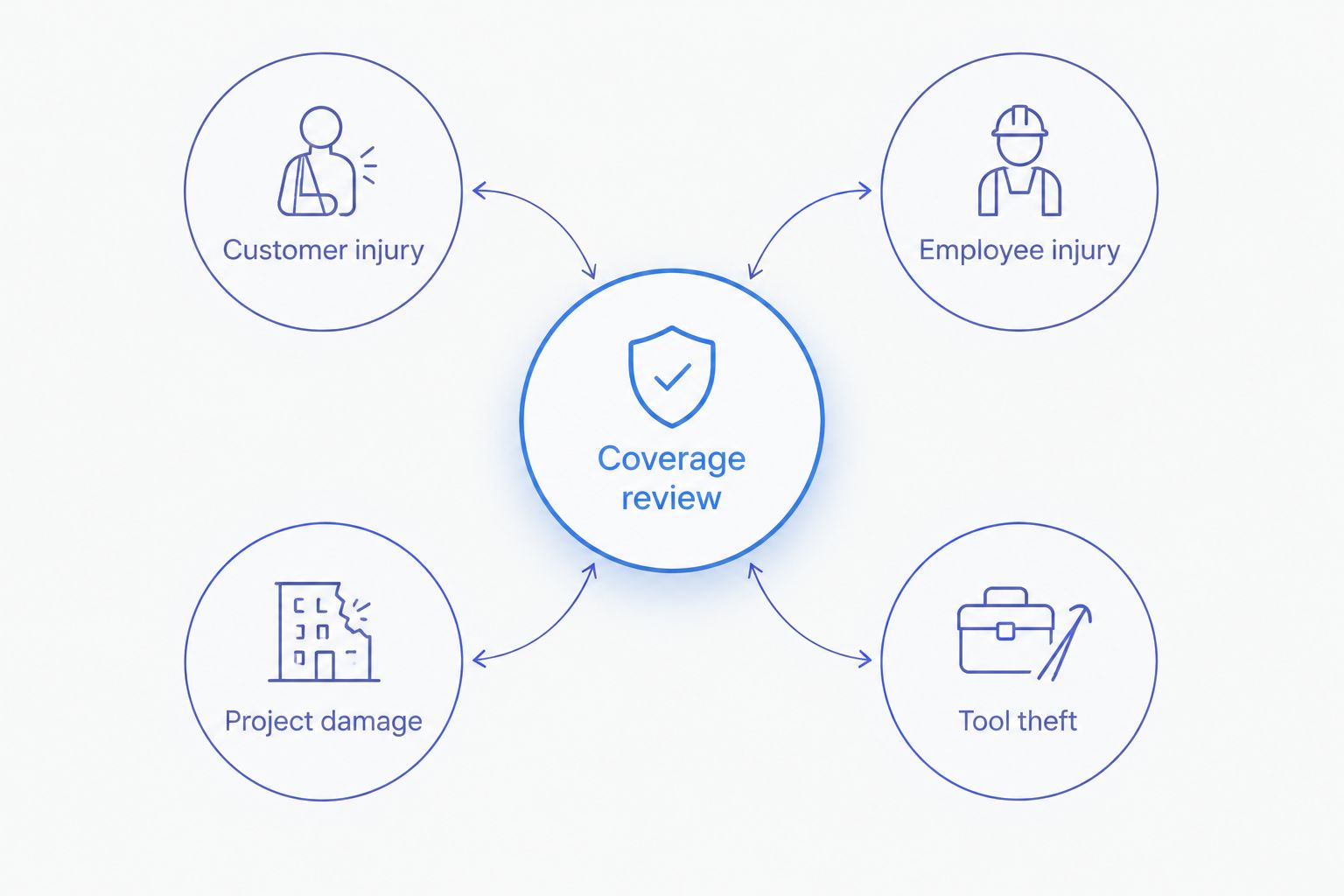
Match the policy to the loss
Keep four questions separate when reviewing your insurance. This simple check prevents a familiar mistake: buying protection for one kind of loss and expecting it to respond to another.
- Customer injury: Start with general liability.
- Employee injury: Review workers’ compensation.
- Project damage: Review builders risk.
- Tool theft: Review inland marine and its theft conditions.
How the options are ranked
This 2026 ranking follows the criteria above: covered work, contract fit, people, property, vehicles, and exclusions. General liability comes first because it addresses third-party injury and property damage; the remaining options serve distinct needs rather than competing to replace it.
A ranking does not override your circumstances. If a contract requires builders risk before work starts, that coverage becomes an immediate priority for that project.
Which contractor insurance should you choose?
Start with general liability, then add coverage for each exposure your business actually has. Employees point to workers’ compensation; business vehicles point to commercial auto; construction property points to builders risk.
For your 2026 review, bring your work descriptions, payroll information, vehicle details, equipment inventory, and sample contracts. Sanangelo-insurance offers business insurance through an independent agency; describe the work you perform before discussing which policy fits.
Ask for plain-language answers about covered operations, exclusions, deductibles, and required endorsements. If a proposal does not explain a key exposure, resolve that question before treating the proposal as complete.
Discuss your business insurance needs
Share your trade, vehicles, employees, equipment, and contract requirements.
FAQ
What’s the best insurance for contractors in Texas?
General liability is the starting point for third-party injury and property damage claims. Add workers’ compensation, commercial auto, builders risk, or equipment coverage according to your employees, vehicles, projects, and tools.
Does Texas require contractors to have workers’ compensation?
Texas generally does not require private employers to carry workers’ compensation, but exceptions and contractual requirements apply. Public construction work has specific requirements, so check the project before relying on the general rule.
Does general liability cover mistakes in my construction work?
General liability does not automatically pay to correct defective workmanship. Coverage for resulting damage depends on the facts, policy language, and exclusions, including completed-operations provisions.
Is builders risk the same as general liability?
No. Builders risk addresses covered physical damage to insured construction property, while general liability addresses covered liability claims involving injury or property damage to others.
Are tools covered if someone steals them from my truck?
Tool theft requires a policy that covers the equipment and the circumstances of the loss. Review inland marine coverage, theft conditions, deductibles, and unattended-vehicle restrictions rather than assuming commercial auto covers the tools.
Can a business owners policy cover everything a contractor needs?
No. A business owners policy commonly combines liability and commercial property coverage, but it does not automatically include employee injury, business vehicle, or construction-project coverage.
How do I compare contractor insurance quotes fairly?
Compare covered operations, limits, deductibles, exclusions, and endorsements on the same basis. Give each agency the same business information and contract requirements so differences in protection are visible.
One last thing
A certificate of insurance is evidence of coverage, not a change to the policy. A customer asking to be an additional insured generally needs the appropriate policy provision or endorsement—not simply a name typed onto a certificate.
Before your next 2026 job starts, ask Sanangelo-insurance to discuss the insurance requirements in your contract. Catching the difference between a certificate request and a coverage requirement is more useful before work begins than after a claim.
Related guides
- Workers’ compensation insurance options for Texas businesses
- Commercial auto insurance for Texas small businesses
- Business insurance options for Texas LLCs and startups
