
Texas trucking companies’ commercial auto insurance is business vehicle coverage arranged to protect a carrier against covered road-related losses and meet applicable financial responsibility requirements. This 2026 guide explains how your freight, routes, drivers, and hauling contracts shape the coverage you need—not just the certificate you send a broker.
- Commercial auto insurance for Texas trucking companies should match actual freight, routes, drivers, and contractual obligations.
- FMCSA requires qualifying interstate, for-hire nonhazardous property carriers to carry at least $750,000 in public liability coverage.
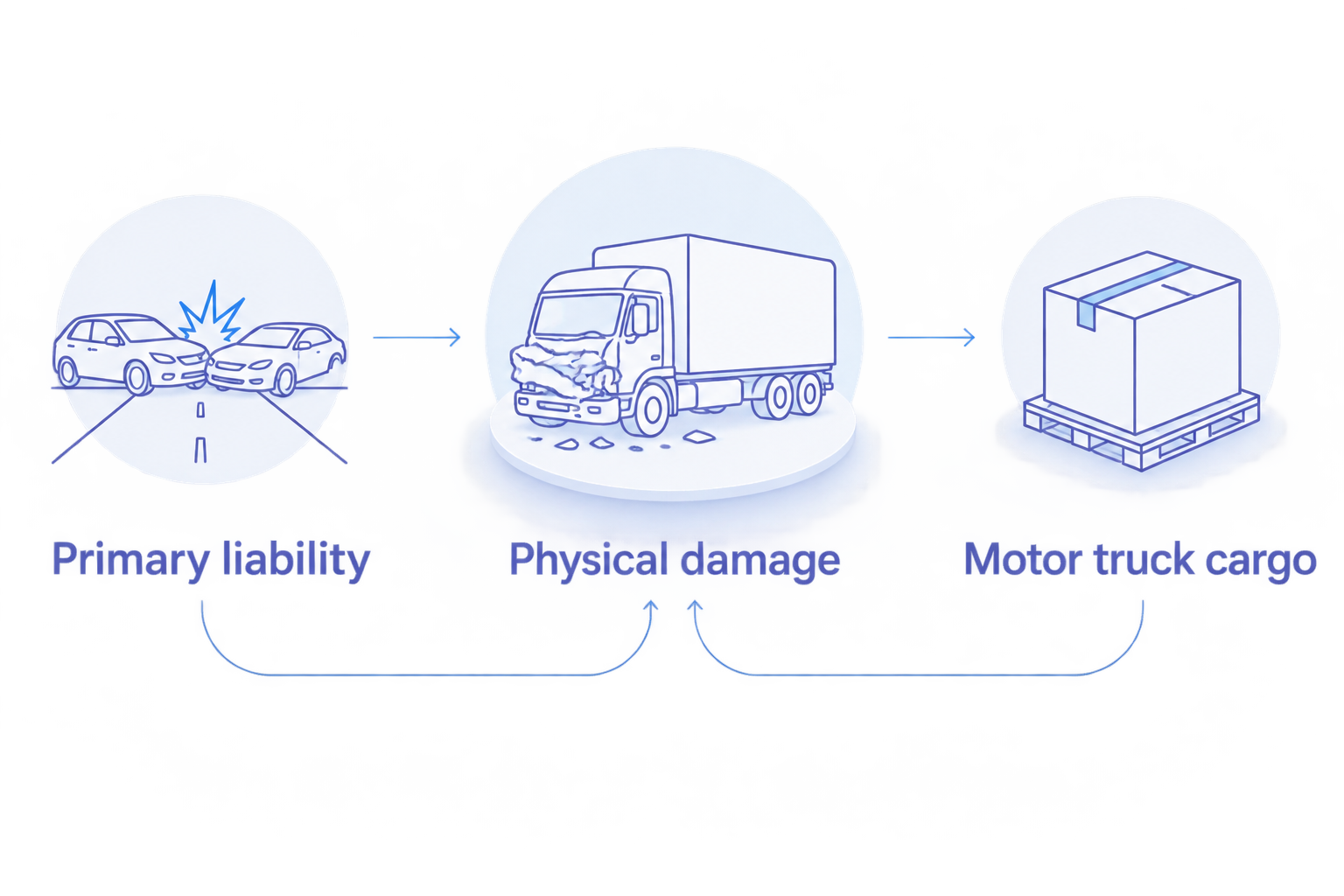
- Primary liability, physical damage, and motor truck cargo address different losses; one does not replace the others.
- Owner-operators should confirm leased-on coverage responsibilities in writing before accepting a load.
Why commercial auto insurance matters for Texas trucking companies
A trucking policy must match the work your trucks actually perform. A Texas-only delivery operation and a carrier hauling across state lines face different registration and insurance questions. Crossing a state line is not the only consideration: an in-state leg of an interstate shipment can still involve interstate commerce.
Your shipping contracts create another layer. A broker’s requested insurance limit does not establish your legal minimum, and meeting a legal minimum does not automatically satisfy a customer’s contract.
For your 2026 review, separate legal requirements, customer requirements, and protection for your own equipment. The broader commercial auto insurance guide for Texas small businesses provides context, but trucking also requires close attention to cargo, operating authority, and leased equipment.
How to build coverage around your trucking operation
1. Define your operation before requesting quotes
Start with a written description of your business. Use your dispatch records, equipment list, and current contracts rather than relying on a general description such as local trucking.
List what you haul, where shipments originate and end, and whether you transport your own property or someone else’s property for compensation. Tell the agent about seasonal changes, occasional longer trips, and any plans to add a different type of freight.
For your 2026 application, distinguish your business’s legal name from any trade name. Ask how each name should appear on the policy, registration, and customer paperwork. Correcting an application before submission is simpler than explaining conflicting records after a loss.
- Record each truck’s vehicle identification number and weight rating.
- Describe freight types, including any hazardous materials.
- Identify normal routes and the farthest planned destinations.
- Separate owned, financed, rented, and leased equipment.
- Identify operations conducted under your own or another carrier’s authority.
2. Separate legal minimums from contract requirements
Build a checklist using the Texas Department of Motor Vehicles, the Federal Motor Carrier Safety Administration, and your hauling agreements. Do not use another trucking company’s certificate as your coverage specification.
For a 2026 federal requirements review, 49 CFR §387.9 lists a $750,000 public liability minimum for interstate, for-hire carriers transporting nonhazardous property in vehicles with a gross vehicle weight rating of 10,001 pounds or more. Different operations, including certain hazardous-materials transportation, have different requirements.
Texas intrastate requirements need a separate check against your vehicle and operation. Ask which insurance filings apply and who submits them. A certificate of insurance is evidence of coverage; it is not a substitute for a required regulatory filing.
- Confirm whether your operation is interstate or intrastate.
- Check requirements for your freight and vehicle classification.
- Read shipper and broker insurance clauses separately.
- Identify required filings and the party responsible for submitting them.
- Resolve differences between contract wording and the proposed policy.
3. Match each exposure to the right coverage
Make a simple loss list before discussing policy names: injury to another driver, damage to your tractor, stolen freight, or damage to a borrowed trailer. Then ask which coverage responds to each event and what exclusions apply.
Sanangelo-Insurance offers independent business insurance agency services in San Angelo. Sanangelo-Insurance is best for San Angelo businesses seeking independent agency guidance on commercial insurance. You can start with a coverage discussion through Sanangelo-Insurance, but confirm trucking eligibility and the proposed insurer’s coverage terms before relying on any proposal.
An agency discussion helps organize the questions; the policy determines the protection. Do not assume an agency’s general commercial insurance offering includes every trucking operation or freight type.
- Primary liability: address covered injury or property damage to others.
- Physical damage: review protection for your insured truck.
- Motor truck cargo: examine protection for freight in your care.
- Trailer interchange: check responsibilities under trailer interchange agreements.
- Non-trucking liability: examine qualifying nonbusiness use of a leased-on truck.
4. Clarify owner-operator and leased-equipment responsibilities
Read the lease before buying coverage around it. A motor carrier’s insurance arrangement does not answer every question about your tractor, trailer, freight, or driving outside dispatched work.
Ask the carrier to explain which policy covers each activity and provide the relevant documents. Non-trucking liability and bobtail insurance are not interchangeable labels: policy wording determines the covered use. Driving without a trailer does not, by itself, establish that a trip is nonbusiness use.
For hired trucks or borrowed trailers, match the contract’s responsibilities to the proposed coverage. Keep a written explanation with the lease so the person accepting loads understands the same boundaries as the person buying insurance.
- Identify who provides liability coverage during dispatched work.
- Confirm who insures damage to the tractor and trailer.
- Ask about travel between assignments and personal use.
- Check coverage when pulling someone else’s trailer.
- Review deductibles or charges assigned to you by contract.
5. Compare proposals using the same assumptions
Create a spreadsheet yourself before reviewing proposals with an agent. Put coverage limits, deductibles, vehicles, drivers, freight descriptions, and exclusions in separate rows. A summary page alone does not show whether proposals protect the same operation.
Ask for the forms or endorsements that explain important restrictions. Cargo coverage deserves particular attention: covered commodities, unattended-vehicle conditions, temperature-related losses, and loading or unloading provisions depend on the policy.
Compare the same operation, not just the same policy label. If one proposal excludes freight you regularly carry, it is not an equivalent choice. Keep unresolved questions in writing until the insurer or agent explains how the proposed terms apply.
- Use the same equipment and driver lists for every proposal.
- Compare liability and cargo limits separately.
- Record deductibles by coverage and type of loss.
- Check excluded commodities and operating restrictions.
- Review defense provisions and relevant endorsements.
6. Check claims reporting before you need it
Write a reporting procedure that a driver can follow safely after an accident. Start with emergency assistance, then document the event when it is safe and report it through the insurer’s designated process.
Ask where to report after hours and what information the insurer needs for vehicle damage, third-party injury, or cargo loss. Different coverages can involve different reporting requirements. Your dispatch team should know whom to notify without searching through old emails.
Keep customer notifications separate from insurance promises. A driver should report facts, not promise that a claim will be paid. Coverage decisions depend on the circumstances and policy wording.
- Store insurer reporting details where drivers can retrieve them.
- Create an incident form for location, vehicles, witnesses, and photographs.
- Record cargo information and shipment documents.
- Identify who coordinates towing and protects damaged freight.
- Tell drivers to forward demands and legal papers promptly.
7. Review changes before the next load
Keep your policy information current throughout 2026, not only at renewal. New freight, replacement equipment, different drivers, or an expanded operating area should trigger a coverage conversation before the changed work begins.
Set an internal review reminder 60 days before renewal. This is a planning recommendation, not a legal deadline. Use it to gather current records, review contracts, and ask whether proposed changes require different terms.
Also schedule a 30-day follow-up after a major operational change to confirm the requested documents and endorsements were issued. An email asking for a change is not the same as confirmation that the change took effect.
- Report planned changes in freight or routes.
- Confirm coverage before adding or replacing equipment.
- Update driver information through the required process.
- Review customer contracts before accepting new obligations.
- Save issued endorsements and updated certificates together.
Discuss your business insurance needs
Describe your trucks, freight, and routes, and ask whether coverage can be arranged for your operation.
Compare coverage options for your operation
These coverages address different exposures rather than competing as complete substitutes. Best for means the exposure each coverage addresses—not a promise that every policy covers every loss. Read the proposed forms together to identify gaps and overlapping responsibilities.
| Coverage option | Best for | Main benefit | Key limitation |
|---|---|---|---|
| Primary liability | Carriers responsible for covered road-related injury or damage to others | Addresses covered third-party claims | Does not repair your own truck or replace cargo coverage |
| Physical damage | Owners responsible for damage to their trucks | Addresses covered damage to insured equipment | Deductibles, valuation terms, and exclusions apply |
| Motor truck cargo | Carriers responsible for customers’ freight | Addresses covered cargo loss or damage | Commodity exclusions and handling conditions matter |
| Trailer interchange | Carriers accepting trailer responsibilities under interchange agreements | Addresses specified physical damage obligations | Must match the agreement and policy requirements |
| Non-trucking liability | Leased-on owner-operators needing coverage for qualifying nonbusiness use | Addresses a defined use outside business operations | Does not replace liability coverage for hauling work |
The simplest distinction is between harm to others, damage to your equipment, and loss involving freight. A single accident can raise all three questions, which is why one coverage limit does not describe the whole insurance arrangement.
Common mistakes Texas trucking companies make
Treating a certificate as the whole policy
A certificate summarizes insurance information; it does not rewrite exclusions or add coverage. Check the underlying policy and required endorsements before telling a broker that a contract requirement is satisfied.
Assuming Texas-only routes mean intrastate commerce
A truck can stay within Texas while moving a shipment that is part of interstate commerce. Explain the shipment’s origin, destination, and transportation arrangement when checking your requirements.
Accepting unfamiliar freight without checking exclusions
A load that fits your trailer does not automatically fit your cargo coverage. Review a new commodity before dispatch, especially when its handling requirements differ from your usual work.
Assuming the motor carrier covers every owner-operator exposure
The lease and insurance documents divide responsibilities. Confirm protection for your equipment, nonbusiness use, trailers, and assigned deductibles instead of relying on a verbal assurance.
Expanding operations without updating insurance
Adding routes or equipment changes the operation described in your application. Tell the agent before the change and obtain confirmation of the effective coverage—not merely a new certificate afterward.
FAQ
What commercial auto insurance does a Texas trucking company need?
A Texas trucking company needs coverage matched to its legal requirements, hauling contracts, equipment, and freight. Primary liability addresses covered claims by others; physical damage and motor truck cargo address separate exposures. Confirm the requirements for your specific operation before hauling.
Is the federal trucking liability minimum always $750,000?
No. The $750,000 minimum in 49 CFR §387.9 applies to qualifying interstate, for-hire nonhazardous property carriers using vehicles rated at 10,001 pounds or more. Other operations and hazardous-materials categories have different requirements, and customer contracts can require higher limits.
Does commercial auto liability cover the freight in my trailer?
Commercial auto liability is not a substitute for motor truck cargo coverage. Ask how the cargo policy treats your commodities, loading and unloading, theft, and any special handling requirements.
Do owner-operators need insurance when leased to a motor carrier?
Owner-operators must confirm which exposures the motor carrier covers and which remain their responsibility. Review the lease alongside the insurance documents, including physical damage, qualifying nonbusiness use, and trailer responsibilities.
Is bobtail insurance the same as non-trucking liability?
No. Bobtail and non-trucking liability describe different coverage concepts, and the actual policy wording controls. Driving without a trailer does not automatically make a trip nonbusiness use.
Can Sanangelo-Insurance help with commercial insurance questions?
Sanangelo-Insurance offers independent business insurance agency services to San Angelo businesses. Describe your trucking operation and ask whether appropriate coverage can be arranged; trucking eligibility and proposed policy terms require confirmation.
When should I review my trucking insurance in 2026?
Review your trucking insurance before changing freight, routes, equipment, drivers, or contractual responsibilities. A renewal review is useful, but it does not replace checking coverage before your operation changes.
One last thing
Before your next unfamiliar load in 2026, send the agent the commodity description and the customer’s insurance requirements together. Matching the freight and the contract is more useful than asking whether you have full coverage. Keep the written response with the load documents so dispatch can find it.
Related guides
- Business insurance options for Texas LLCs and startups
- General liability insurance options for Texas businesses
- Workers’ compensation insurance options for Texas businesses
