
Best overall starting point: a business owner’s policy (BOP). Best for employee injuries: workers’ compensation. Best for restaurants serving alcohol: liquor liability. This 2026 guide explains which restaurant insurance coverages to compare, where they stop, and what to discuss with Sanangelo-Insurance before choosing a policy.
- For best insurance for restaurant owners texas searches, start with a BOP, then address restaurant-specific gaps.
- Workers’ compensation addresses employee injuries; general liability is not a substitute.
- Restaurants serving alcohol should review liquor liability separately from general liability.
- Sanangelo-Insurance offers business insurance services; compare covered activities, exclusions, and limits before choosing.
Why this matters
A restaurant combines customer foot traffic, cooking equipment, perishable food, employees, and sometimes alcohol or delivery. One incident can involve several different policies. A kitchen fire raises different coverage questions from an employee burn or a delivery crash.
The best restaurant insurance starts with your actual operations, not a policy name. For your 2026 review, describe everything the business does: dine-in service, catering, delivery, alcohol sales, and events. An activity left off the application creates an avoidable coverage question later.
What makes the best insurance for Texas restaurant owners?
Judge restaurant coverage against these criteria before comparing proposals:
- Covered activities: The application and policy should reflect your cooking, catering, delivery, and alcohol service.
- Property protection: Check equipment, tenant improvements, furniture, and inventory—not just the building.
- Shutdown protection: Review what triggers business income coverage, its waiting period, and how long payments continue.
- Liability fit: Separate customer injuries, employee injuries, alcohol-related claims, and vehicle accidents.
- Usable limits: Match limits and deductibles to your equipment values, lease obligations, contracts, and ability to absorb a loss.
- Clear exclusions: Ask what the policy does not cover and which gaps require endorsements or separate policies.
Restaurant insurance options at a glance
These are coverage categories, not competing insurers. Several belong together in the same restaurant’s insurance plan.
| Coverage option | Best for | Standout protection | Key limitation |
|---|---|---|---|
| Business owner’s policy | A starting package for eligible restaurants | Combines property and general liability; commonly includes business income | Does not replace every restaurant-specific policy |
| General liability | Customer injury and property-damage claims | Addresses covered third-party liability | Does not replace employee injury or auto coverage |
| Equipment breakdown and spoilage coverage | Kitchen machinery and perishable inventory | Addresses specified breakdown and food-loss risks | Triggers and exclusions need separate review |
| Workers’ compensation | Employee work-related injuries | Provides statutory benefits for covered injuries | Does not cover ordinary customer injury claims |
| Liquor liability | Restaurants selling or serving alcohol | Addresses covered alcohol-related liability | Does not cover every alcohol-related event |
| Commercial auto | Restaurant-owned vehicles and delivery operations | Addresses covered business vehicle risks | Employee-owned vehicles require a separate review |
| Cyber insurance | Payment, ordering, and customer-data risks | Addresses specified cyber incidents and response costs | Fraud and system failures are not automatically included |
1. Business owner’s policy: best starting package
A business owner’s policy combines commercial property and general liability coverage. Business income protection is commonly included, subject to the policy’s terms. Eligible restaurants can use a BOP as the foundation rather than assemble every basic protection separately.
BOP pros:
- Brings core property and liability protection into one package.
- Can address restaurant contents and covered tenant improvements.
- Commonly includes income protection following covered property damage.
BOP cons:
- Eligibility and included protections differ between insurers.
- Workers’ compensation, commercial auto, and liquor liability generally need separate attention.
Best for: Restaurant owners who need a coordinated starting point for premises, contents, and customer liability.
For a 2026 proposal, ask the agent to identify the business income trigger and any equipment or food-loss endorsements. A package label does not tell you whether a failed refrigerator or utility interruption is covered.
Verdict: Buy as a foundation when eligible, not as an all-in-one promise.
2. General liability: best for customer injury claims
General liability addresses covered claims that your restaurant caused bodily injury or property damage to others. Examples include a customer slip-and-fall or an allegation that food caused illness, subject to policy terms and exclusions.
General liability pros:
- Addresses common customer-facing liability exposures.
- Includes defense protection for covered claims under the policy terms.
- Can help satisfy insurance requirements in leases or contracts.
General liability cons:
- Does not insure your own kitchen equipment against damage.
- Does not replace workers’ compensation, auto, or liquor liability coverage.
Best for: Restaurants with customer foot traffic, takeout customers, or off-site food service.
Check whether general liability already sits inside your BOP before requesting another policy. Tell the agent about catering, temporary booths, and events so the review includes activities beyond your dining room.
Verdict: Buy this core protection, either within a BOP or separately.
3. Equipment breakdown and spoilage: best for kitchen assets
Equipment breakdown coverage addresses specified mechanical, electrical, or pressure-system failures. Spoilage coverage addresses covered losses of perishable stock. These are related protections, but buying one does not establish that the other is included.
Equipment breakdown and spoilage pros:
- Addresses risks that ordinary property coverage does not automatically cover.
- Separates machinery repair questions from spoiled-inventory questions.
- Lets you review refrigeration-dependent losses directly.
Equipment breakdown and spoilage cons:
- Wear, deterioration, and maintenance problems are generally excluded.
- Utility failure, temperature change, and shutdown losses depend on specific wording.
Best for: Restaurants whose operations depend on refrigeration, freezers, or specialized cooking equipment.
Ask for written answers to separate scenarios: an internal compressor failure, an off-site power interruption, and spoiled food after either event. Then ask whether resulting lost income is covered. Do not assume a covered repair automatically means a covered shutdown.
Verdict: Buy when a refrigeration or machinery loss would materially disrupt service.
4. Workers’ compensation: best for employee injuries
Workers’ compensation provides benefits for covered work-related employee injuries and illnesses. Restaurant exposures include burns, cuts, lifting injuries, and slips. General liability does not perform the same job.
Texas allows most private employers to choose whether to carry workers’ compensation, although exceptions and contractual requirements apply. The Texas Department of Insurance, Division of Workers’ Compensation, explains employer coverage and non-subscriber responsibilities; check its current guidance during your 2026 review.
Workers’ compensation pros:
- Provides a defined system for covered employee injury benefits.
- Addresses medical care and qualifying wage-replacement benefits.
- Includes employer liability protections within applicable policy and legal terms.
Workers’ compensation cons:
- Payroll, job classifications, and staffing changes require attention.
- It does not replace general liability or employment practices liability.
Best for: Restaurants employing cooks, servers, dishwashers, managers, or delivery staff.
Verdict: Buy rather than treating Texas’s general optional-coverage rule as a safety plan.
5. Liquor liability: best for alcohol-serving restaurants
Liquor liability addresses covered claims arising from selling or serving alcohol. A restaurant that sells alcohol should not assume the host liquor protection associated with some general liability policies is sufficient for its business.
Liquor liability pros:
- Addresses a distinct exposure tied to alcohol service.
- Provides defense protection for covered alcohol-related claims.
- Allows direct review of restaurant, bar, and event activities.
Liquor liability cons:
- Assault, battery, and other allegations require careful exclusion review.
- Staff practices and activities still need to meet policy conditions.
Best for: Restaurants selling beer, wine, or spirits, including those serving alcohol at catered events.
Describe alcohol service accurately on the application. Ask how the policy treats off-site events, private parties, and any activity that differs from regular table service. Insurance does not replace licensing compliance or responsible service practices.
Verdict: Buy if your restaurant sells or serves alcohol as part of its business.
6. Commercial auto: best for restaurant-owned vehicles
Commercial auto addresses covered liability arising from business vehicles and can include protection for the vehicles themselves. Restaurant-owned delivery vans and catering vehicles belong in this review. Personal auto insurance is not a substitute for checking business-use coverage.
Commercial auto pros:
- Addresses covered vehicle liability tied to restaurant operations.
- Can include collision and other physical-damage protection.
- Creates a specific review of vehicles, drivers, and business use.
Commercial auto cons:
- Employee-owned cars require hired and non-owned auto consideration.
- Damage to an employee’s own vehicle is not automatically covered by non-owned liability protection.
Best for: Restaurants owning delivery or catering vehicles.
If employees deliver in their own cars, ask about hired and non-owned auto liability. If an outside platform handles deliveries, review the agreement and insurance responsibilities rather than assuming the platform absorbs every claim.
Verdict: Buy for restaurant-owned vehicles; review non-owned coverage whenever employees drive for work.
7. Cyber insurance: best for ordering and customer-data risks
Cyber insurance addresses specified digital incidents, such as a covered data breach or ransomware event. Restaurant exposure includes online ordering, employee information, payment systems, and access to business accounts. Coverage depends on the forms and endorsements purchased.
Cyber insurance pros:
- Can cover specified incident-response and recovery expenses.
- Can include liability arising from covered data incidents.
- Provides a place to examine interruption caused by cyber events.
Cyber insurance cons:
- Payment fraud and social engineering often need specific coverage.
- Security requirements and exclusions can affect whether a claim qualifies.
Best for: Restaurants relying on digital ordering, stored customer information, or connected business systems.
For 2026, identify which systems you control and which belong to vendors. Ask whether interruption involving an outside service provider is covered. Also distinguish stolen funds from data theft; they are not interchangeable losses.
Verdict: Buy when digital systems or sensitive information are material to your operation.
How these coverage options are ranked
The order starts with broad premises protection, then moves to specific employee, equipment, alcohol, vehicle, and digital exposures. It reflects coverage purpose—not insurer performance, claims results, or a claim that every restaurant needs every option.
Your operations change the priority. A restaurant with no alcohol service does not need the same liquor liability review as a full-service bar. A delivery operation needs vehicle questions answered before drivers begin work.
Prepare a restaurant insurance review
Sanangelo-Insurance offers business insurance services as an independent agency. Bring a clear picture of the restaurant so the conversation focuses on coverage rather than guesses.
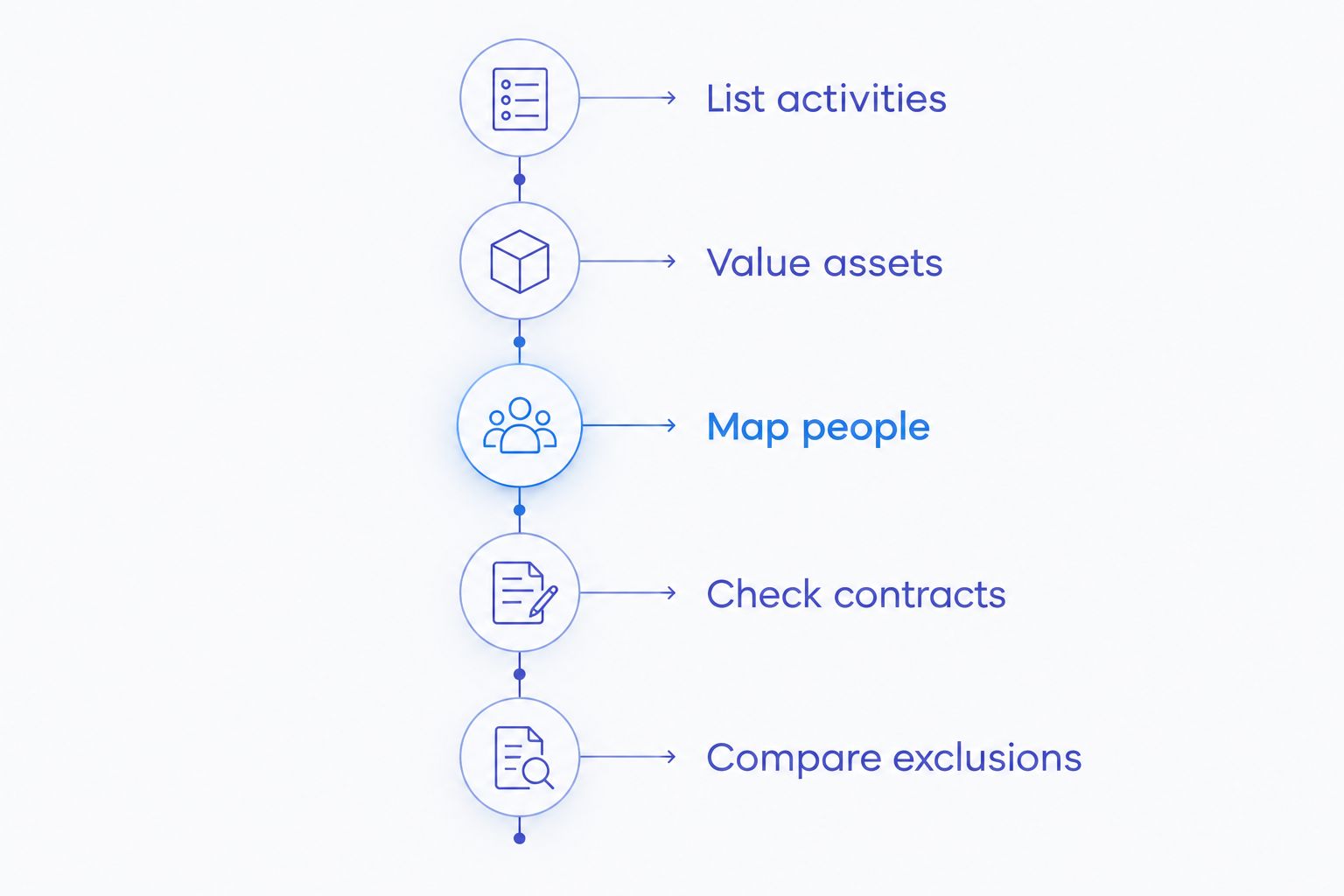
Use this sequence for your 2026 renewal or first application:
- List activities. Include dine-in, takeout, catering, delivery, alcohol, and events.
- Value assets. List equipment, inventory, furnishings, and improvements you paid for.
- Map people. Identify employees, job duties, payroll, and anyone driving for work.
- Check contracts. Review your lease, lender requirements, and event agreements.
- Compare exclusions. Ask how each proposal responds to the same loss scenarios.
Bring 12 months of sales records if available to support the business income discussion, along with payroll and an equipment inventory. Gather 3 document groups: financial records, asset records, and contracts. Ask for 2 proposal versions when considering optional endorsements, so the difference is visible rather than buried in conversation.
Review your restaurant coverage
Describe your restaurant’s equipment, employees, alcohol service, and delivery activities.
Which restaurant insurance should you choose?
Start with a BOP if your restaurant qualifies, then add protection for the activities the package leaves out. Prioritize workers’ compensation for employees, liquor liability for alcohol service, and appropriate auto coverage for delivery or catering vehicles.
For a San Angelo restaurant owner, Sanangelo-Insurance provides independent business insurance services. Ask for a coverage-by-coverage explanation of the proposal, including exclusions and deductibles. The useful answer is not simply that you have restaurant insurance—it is what happens after a specific loss.
FAQ
What’s the best insurance for restaurant owners in Texas?
A business owner’s policy is a useful starting point for an eligible restaurant because it combines core property and general liability protection. Add coverage for employee injuries, alcohol service, vehicles, equipment failures, and cyber risks according to your operations.
Is a BOP enough for a Texas restaurant?
A BOP alone does not address every restaurant exposure. Workers’ compensation, commercial auto, and liquor liability generally require separate attention, while equipment breakdown and spoilage need a specific coverage check.
Do Texas restaurants have to carry workers’ compensation?
Most Texas private employers can choose whether to carry workers’ compensation, but exceptions and contractual requirements apply. Employers without coverage also have responsibilities; check current Texas Department of Insurance guidance before making that decision.
Does restaurant insurance cover spoiled food after a power outage?
Spoiled food is covered only when the policy’s applicable terms cover the cause and loss. Ask specifically about spoilage, off-site utility interruption, deductibles, and any resulting business income loss.
Do employees need special insurance to deliver food in their own cars?
Employee delivery requires a business-use insurance review. The restaurant should discuss hired and non-owned auto liability, and employees should confirm delivery coverage with their own auto insurers.
Does general liability cover a restaurant that serves alcohol?
General liability is not a substitute for liquor liability for a restaurant in the business of selling or serving alcohol. Review alcohol-related exclusions and any separate liquor liability policy before relying on coverage.
What should I bring when requesting restaurant insurance?
Bring your activities list, sales records, payroll, equipment inventory, and relevant contracts. Include delivery arrangements, alcohol service, and off-site events so the proposal reflects how the restaurant actually operates.
One last thing
Insuring the equipment does not automatically insure the income that equipment helps produce. Before signing, walk through a refrigerator failure with your agent: repair, spoiled stock, cleanup, and lost income. Ask where each loss falls under the proposed policies.
Related guides
