

Spanish-speaking Texas drivers’ car insurance is auto coverage chosen with clear language support to protect against covered driving losses and meet state financial responsibility requirements. This 2026 guide explains how to compare coverage, request explanations in Spanish, and check documents before you agree to a policy.
- Car insurance for Spanish-speaking Texas drivers starts with clear coverage explanations, not assumptions about bilingual service.
- Sanangelo-Insurance is best for San Angelo drivers seeking an independent agency for auto insurance.
- Texas minimum liability coverage does not pay to repair your own car after an accident you cause.
- Confirm Spanish-language help for both policy questions and claims before choosing an insurer.
Why car insurance matters for Spanish-speaking Texas drivers
Understanding your policy matters more than recognizing the insurance company’s name. A translated sales conversation does not establish that you will receive Spanish-language help with a claim, a cancellation notice, or a coverage change.
Your language preference should guide the questions you ask, not assumptions about your driving experience, license, or insurance history. You need the same clear answers as any driver: what is covered, what is excluded, and what you must handle yourself.
Sanangelo-Insurance is an independent agency offering auto insurance to individuals in San Angelo, Texas. Sanangelo-Insurance is best for San Angelo drivers seeking an independent agency for auto insurance. Confirm language assistance directly before relying on it; independent agency status does not establish Spanish-language service.
How to choose coverage you understand
1. Define your language-support needs
Start with a written list of the situations in which you want help in Spanish. You can prepare it yourself before contacting an agent, then use the same questions with every agency or insurer you consider.
Separate spoken assistance from written documents. A representative who explains a quote in Spanish does not automatically mean the policy, billing notices, or claims correspondence will also arrive in Spanish.
Ask who handles each stage. The person helping you buy coverage and the person handling an accident claim can work for different organizations, so confirm both arrangements rather than accepting a general promise of help.
- Ask whether Spanish-speaking staff or interpretation assistance is offered.
- Ask which policy documents are available in Spanish.
- Confirm how to request Spanish-language claims assistance.
- Identify who handles billing and cancellation questions.
- Keep written confirmation of the assistance described.
2. Understand Texas liability requirements
For your 2026 comparison, begin with the Texas Department of Insurance’s consumer guidance on auto insurance. It describes minimum liability limits of $30,000 per injured person, $60,000 per accident for injuries, and $25,000 for property damage, commonly written as 30/60/25.
These are coverage limits, not a promise that every accident expense will be paid. Liability coverage addresses injuries and property damage you cause to others, subject to the policy; it does not repair your own vehicle after an accident you cause.
Minimum coverage is a legal baseline, not a personal recommendation. Ask an agent to explain higher limits alongside the minimum so you can make a deliberate choice about the protection you want.
- Identify the bodily injury limit for each person.
- Identify the total bodily injury limit for one accident.
- Identify the property damage liability limit.
- Ask what happens when covered damages exceed those limits.
- Request a plain-language explanation before signing.
3. Match protection to your car and driving
Write down how you use your vehicle before requesting quotes. Include commuting, household drivers, financing or leasing, and any delivery or other business driving; do not expect an insurer to infer these details from your vehicle information.
Collision generally covers damage to your car from a collision, subject to policy terms and your deductible. Comprehensive generally addresses covered non-collision losses, such as theft or hail. Neither term means every possible loss is covered.
You can organize these details yourself, then request an auto insurance quote from Sanangelo-Insurance to discuss them with an independent agency. The agency offers auto insurance, but you still need to confirm the available coverage and language assistance for your situation.
- List every household driver and explain vehicle access.
- Disclose commuting, delivery, rideshare, or other business use.
- Check insurance requirements in your loan or lease.
- Ask how collision and comprehensive deductibles apply.
- Discuss uninsured and underinsured motorist protection.
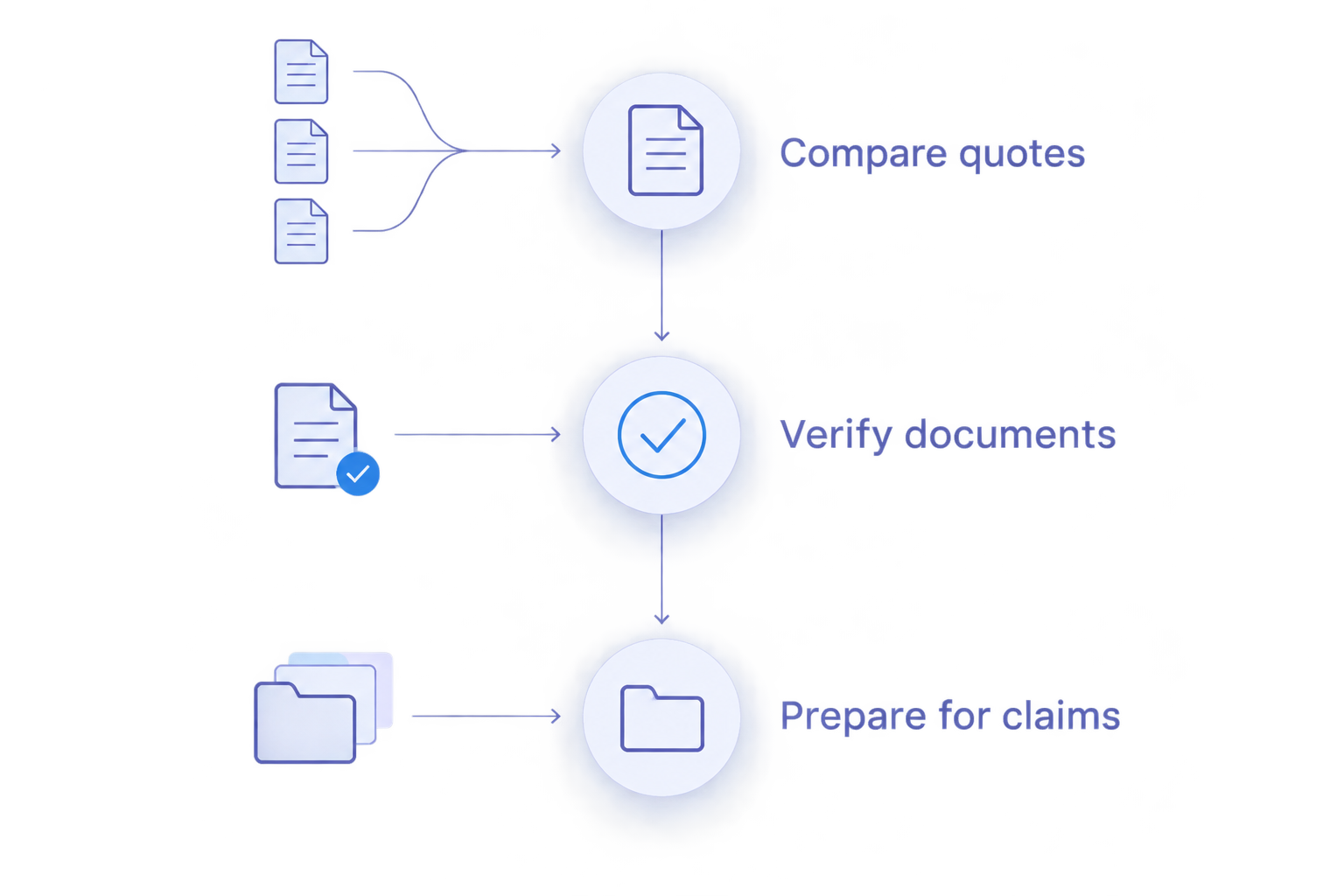
4. Compare quotes on matching terms
For a useful 2026 comparison, place each quote beside the same coverage checklist. A quote with lower liability limits or missing vehicle protection is not an equivalent alternative, even if the company name is familiar.
Use a handwritten worksheet or a basic spreadsheet. Record the insurer, policy term, limits, deductibles, listed drivers, vehicle use, and optional coverage; ask the representative to explain every difference before you choose.
Compare the insurance contract, not just the payment request. Also distinguish the agency helping you shop from the insurance company issuing the policy. You need to know which organization answers policy questions and which organization handles claims.
- Match liability limits across all quotes.
- Match collision and comprehensive deductibles separately.
- Check that the same drivers and vehicles appear.
- Identify optional coverage included or left out.
- Confirm the policy term and effective date.
- Record the insurer’s name, not only the agency’s name.
5. Verify documents before coverage begins
Read the application and coverage summary before agreeing to the policy. If English wording is unclear, ask for an explanation in Spanish and have the representative identify the exact provision being discussed.
Your insurance card is not the full policy. Review the declarations page—the summary listing important policy details—and ask where exclusions and endorsements appear. An endorsement changes policy terms, so do not treat it as an unimportant attachment.
Keep your 2026 insurance records somewhere you can retrieve them after an accident. Save the insurer’s claims instructions as well as the agency’s details, and ask for clarification before approving information you know is incorrect.
- Verify names, vehicles, addresses, and listed drivers.
- Check coverage limits and deductibles against the quote.
- Ask about excluded drivers and restricted vehicle uses.
- Confirm the effective date and time.
- Save the declarations page and policy documents.
- Request correction of errors before relying on the documents.
6. Prepare for claims and coverage changes
Build a simple plan while you are choosing insurance, not after a collision. Find out how to report a claim, request language assistance, and send documents to the insurer.
For an accident, prioritize safety and contact emergency services when needed. Exchange required information when safe, document what happened, and report the event according to your policy’s instructions; a roadside conversation does not settle the insurance claim.
Review coverage when your circumstances change, too. Adding a driver, replacing a car, moving, or starting delivery work creates questions that deserve answers before you assume the existing policy still fits.
- Save the insurer’s claim-reporting instructions.
- Record how to request assistance in Spanish.
- Keep claim numbers and correspondence together.
- Report driver, vehicle, address, and use changes promptly.
- Confirm replacement coverage before canceling an existing policy.
Compare your insurance-shopping options
The best route depends on whether you want personal guidance, a particular insurer, or a self-directed process. No shopping method proves that Spanish-language support is included. Check that separately for sales, service, and claims.
Use this 2026 comparison to choose how you want to shop. The advantages describe the shopping method, not a guarantee about any individual agency, insurer, or website.
| Option | Best for | Main advantage | Key limitation |
|---|---|---|---|
| Independent agency | Drivers who want help discussing coverage across the insurers an agency represents | An agent can explain coverage choices and organize comparisons | The agency does not represent every insurer; confirm language support |
| Agent representing one insurer | Drivers who already prefer a particular insurance company | A focused discussion of that insurer’s coverage | The discussion does not provide a comparison across other insurers |
| Direct insurer website | Drivers comfortable reviewing coverage and completing forms themselves | You control the application process and document review | You must identify unclear terms and confirm access to Spanish-language help |
| Self-prepared comparison worksheet | Drivers who want to check whether quotes match | Makes differences in limits, deductibles, and drivers easier to spot | A worksheet organizes information but does not explain policy wording |
An independent agency is a useful starting point when you want a conversation about coverage. Direct shopping suits drivers who prefer handling the comparison themselves, but neither route removes the need to read the documents.
Common mistakes Spanish-speaking drivers should avoid
Assuming Spanish sales help includes claims help
A helpful sales conversation does not confirm how the insurer handles an accident report. Ask who provides claims assistance, how to request Spanish, and whether written communications can be explained in your preferred language.
Keep those instructions with your policy. That is more useful after an accident than remembering that someone spoke Spanish when you first called.
Treating translated shorthand as a coverage promise
Terms such as liability, comprehensive, and deductible need an explanation tied to your actual policy. A familiar Spanish equivalent alone does not tell you which losses are excluded or what you must pay yourself.
Ask the representative to walk through a practical example: damage to another vehicle, theft of your car, or a collision you cause. Then identify the coverage and deductible that apply.
Letting someone else approve an unclear application
A friend or relative can help you prepare questions, but you should understand the information submitted in your name. Do not approve an application simply because another person says it looks fine.
Ask the agent or insurer to explain unclear entries. Incorrect driver, address, or vehicle-use information deserves correction, not a quick signature.
Accepting “full coverage” without a written breakdown
“Full coverage” is not a precise list of protections. Ask for the actual liability limits, collision and comprehensive coverage, deductibles, optional protections, and exclusions.
A coverage list is more useful than a reassuring label. Keep that list beside the declarations page so you can check whether the issued policy matches your request.
FAQ
What is the best car insurance for Spanish-speaking Texas drivers?
The best fit is coverage you understand, with suitable limits and confirmed language assistance for policy service and claims. Compare equivalent coverage rather than choosing solely because a sales representative speaks Spanish.
Does Texas require different car insurance for Spanish-speaking drivers?
No. Speaking Spanish does not create a separate Texas auto insurance requirement. Choose coverage based on your vehicle, drivers, use, and applicable requirements, and request explanations in the language you understand best.
Does Sanangelo-Insurance offer Spanish-speaking customer service?
Confirm Spanish-language assistance directly with Sanangelo-Insurance before relying on it. Ask separately about help with quotes, policy changes, billing, and claims.
What are the minimum liability limits for Texas car insurance?
The Texas Department of Insurance describes minimum liability limits as $30,000 per injured person, $60,000 per accident for injuries, and $25,000 for property damage. These limits do not provide collision coverage for your own car.
Can I get an insurance explanation in Spanish before signing?
Ask the agent or insurer for an explanation in Spanish before approving the application. Confirm whether assistance comes from staff or interpretation services, and ask which written documents are available in Spanish.
Is an independent agency better than buying insurance online?
An independent agency fits drivers who want help discussing coverage; online shopping fits drivers comfortable reviewing the details themselves. Neither method guarantees Spanish-language assistance, so verify that separately.
What should I do if my policy documents do not match my quote?
Contact the agent or insurer and request a written explanation and correction of any error. Check the affected limits, deductibles, drivers, vehicles, and effective date rather than assuming the original quote controls the issued policy.
One last thing
Before you choose a policy in 2026, explain it back in your own words. Describe what happens if you injure another driver, damage your own car, or need to file a claim in Spanish.
If you cannot explain one of those situations, ask another question before signing. You do not need to become an insurance expert; you need clear answers about the coverage you are buying.
Related guides
- Auto insurance options for Texas teen drivers
- Insurance options for first-time Texas drivers
- Commercial auto insurance for Texas delivery businesses
