

Texas delivery business commercial auto insurance is coverage for business driving, with the aim of protecting your company against covered vehicle-related losses. This 2026 guide explains how to match coverage to your vehicles, drivers, deliveries, and contracts—because insuring a van does not automatically insure its cargo or every person behind the wheel.
- Commercial auto insurance for Texas delivery businesses must match vehicle ownership, delivery use, and drivers.
- San Angelo Insurance is best for San Angelo delivery owners seeking an independent business insurance agency.
- Commercial auto liability, vehicle damage, and cargo coverage address different losses; review each separately.
- Compare delivery restrictions and policy limits before choosing coverage, not after a customer requests proof.
Why commercial auto insurance matters for Texas delivery businesses
Delivery work changes the insurance conversation. You need to explain what travels in the vehicle, who owns the goods, who drives, and whether deliveries serve your own customers or another company’s customers.
The right starting point is your operation, not the vehicle’s size. A small car making paid deliveries still raises business-use questions. A large van does not tell an insurer whether you carry flowers, restaurant orders, tools, or customers’ merchandise.
San Angelo Insurance is best for San Angelo delivery owners seeking an independent agency for business insurance. An agency conversation gives you a place to explain those details; it does not replace reading the coverage terms.
For your 2026 review, distinguish Texas’s basic financial responsibility requirements from coverage that fits your contracts. The Texas Department of Insurance identifies minimum auto liability limits of $30,000 for bodily injury per person, $60,000 per accident, and $25,000 for property damage. Those are liability limits, not protection for your van or its contents.
Certain commercial operations have additional requirements. Confirm applicable Texas Department of Motor Vehicles and federal motor carrier requirements before treating basic minimums as sufficient.
How to choose coverage for your delivery business
1. Write down exactly how you deliver
Start with a plain document or spreadsheet. Describe an ordinary workday from loading through the final return trip, including stops that do not involve a customer handoff.
Make a clear distinction between delivering goods your business sells and transporting someone else’s goods for payment. Insurers need an accurate description of the operation; calling everything errands leaves out the reason the vehicle is on the road.
Include routes outside your usual area. Crossing a state line, adding a delivery platform, or accepting a different kind of shipment belongs in the conversation before that work begins.
Give every insurer the same description. Otherwise, quotes can reflect different assumptions about your business rather than meaningful differences in coverage. Keep a copy with your insurance records so you can identify changes at renewal.
- Describe the goods you deliver and who owns them.
- Identify local routes, longer trips, and interstate work.
- Separate your own deliveries from delivery work for others.
- Explain loading, unloading, and overnight parking arrangements.
- List delivery platforms and customer contracts that affect the work.
2. Separate company vehicles from personal vehicles
Build a vehicle list before requesting quotes. Record the titled owner, business use, regular driver, and whether the vehicle is owned, leased, rented, or borrowed.
A personally owned car used for deliveries needs an explicit coverage discussion. Do not assume a personal policy accepts delivery work, and do not assume adding a business name solves every ownership issue. Ask how the insurer treats the actual arrangement.
If employees use their own cars, discuss hired and non-owned auto liability. This coverage generally addresses business liability involving certain vehicles the business does not own; it is not a substitute for every driver’s own policy or automatic damage coverage for that car.
Keep rental arrangements separate, too. Liability arising from a rented vehicle and damage to the rented vehicle are different questions. Have the agent identify which coverage addresses each one.
- Record each vehicle’s identification number and titled owner.
- Identify employee-owned cars used for business errands or deliveries.
- Flag rented vans used during busy periods.
- Ask whose liability a proposed policy protects.
- Request a separate explanation of damage coverage for non-owned vehicles.
3. Match each coverage to a specific loss
Use a simple loss checklist before comparing policy names. Ask what responds if your driver injures someone, damages another vehicle, wrecks your van, or loses a customer’s shipment.
Commercial auto liability addresses covered liability for injuries and property damage to others. Collision generally addresses covered crash damage to an insured vehicle; comprehensive generally addresses covered non-collision losses, subject to policy terms and deductibles.
Cargo is a separate question from the vehicle carrying it. Ask about goods in transit, theft, loading and unloading, and any exclusions tied to the items you carry. Do not treat business property insurance as automatic transit protection.
San Angelo Insurance offers business insurance services; bring this checklist to a commercial auto insurance discussion. The policy still needs to confirm which delivery activities and losses it covers.
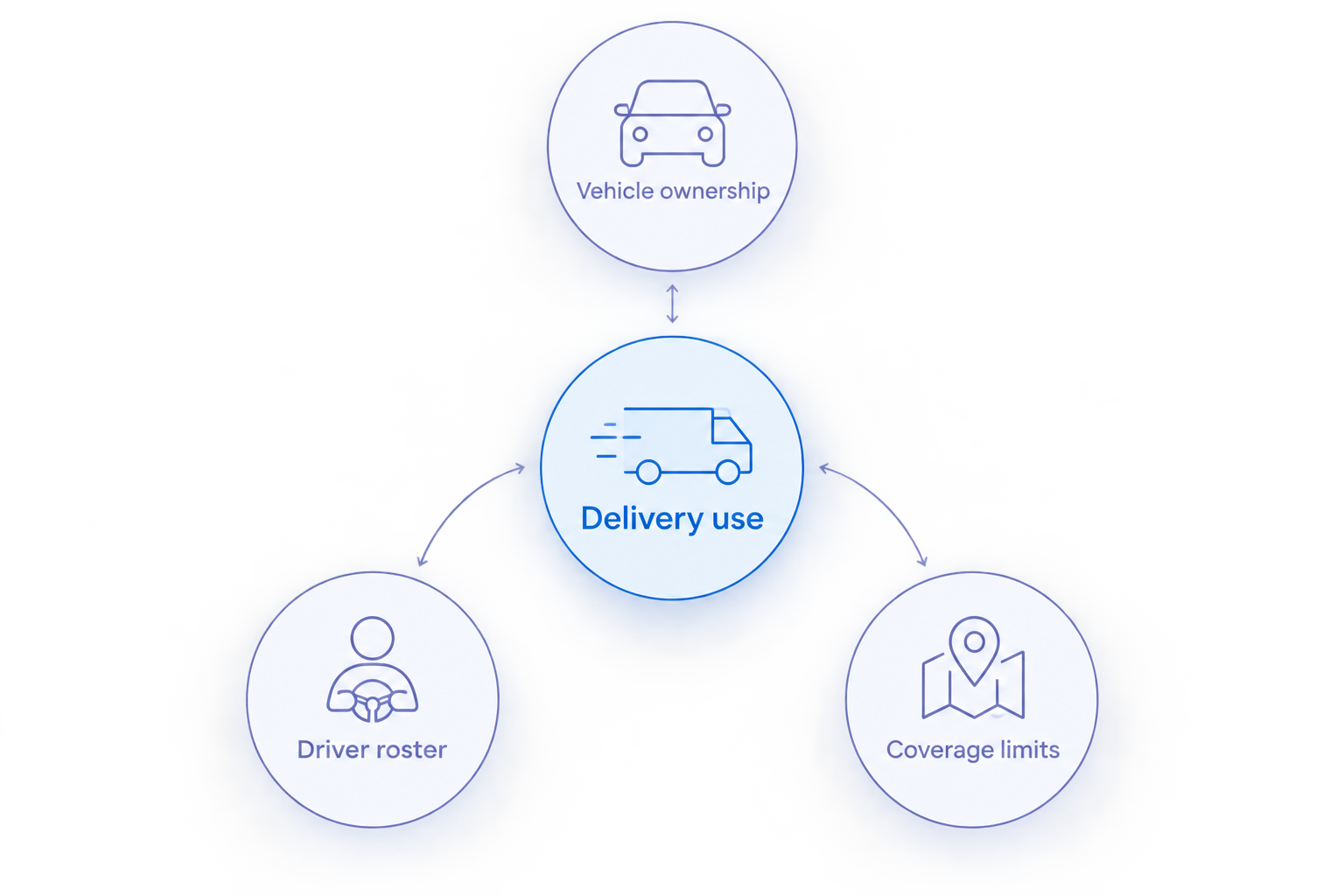
- Vehicle ownership: Match the policy to the ownership arrangement.
- Driver roster: Identify everyone who needs approval to drive.
- Delivery use: Describe the goods, routes, and customer arrangements.
- Coverage limits: Separate liability, vehicle damage, and cargo decisions.
4. Check contracts before choosing limits
Read customer agreements and delivery platform insurance terms yourself first. Highlight required limits, coverage types, evidence of insurance, and any requested changes to the policy.
For a 2026 contract review, compare those requirements against the actual proposed policy—not just the quote summary. A certificate of insurance summarizes coverage; it does not create coverage or change an exclusion.
Ask the agent to explain unfamiliar contract language in everyday terms. If an agreement calls for a particular policy endorsement, confirm whether the insurer can issue it and whether the wording satisfies the request.
Keep legal compliance, contract compliance, and financial protection separate. Meeting a minimum requirement does not answer how much loss your business can absorb. Higher limits also do not fix an excluded delivery activity, an unapproved driver, or missing cargo coverage.
- Highlight each customer’s insurance requirements.
- Identify requested policy endorsements and certificate wording.
- Compare liability limits with the contract’s stated requirements.
- Ask how any umbrella policy applies to commercial auto claims.
- Resolve unclear terms before signing the delivery agreement.
5. Compare quotes on matching terms
Create a side-by-side worksheet instead of comparing the final total alone. Start by checking that each quote uses the same business description, vehicles, drivers, and delivery territory.
Then compare liability limits, deductibles, physical damage coverage, and exclusions. A quote with fewer protections is not an equal alternative just because both documents say commercial auto.
Ask what happens after a covered van loss. Rental reimbursement, downtime, and access to a suitable replacement vehicle are separate concerns; do not assume any of them is included. Confirm whether a replacement rental can be used for your delivery work.
The better comparison is what each policy would do after the same incident. Give each agent an identical example, such as a driver causing a collision while carrying a customer’s goods. Ask which losses are covered and which remain yours.
- Use the same vehicle and driver information on every application.
- Match liability limits before comparing proposals.
- Record each deductible beside the coverage it applies to.
- Compare delivery, cargo, and driver exclusions.
- Request written answers about replacement transportation and remaining gaps.
6. Build a driver and vehicle update routine
Keep a shared driver roster and vehicle schedule using tools you already have. Assign someone to report changes to the agent and retain the insurer’s confirmation.
The insurance question is not finished when the first van is covered. Adding a helper, borrowing a vehicle, or changing overnight parking creates new information the insurer needs to assess.
For cargo van fleet insurance, the vehicle schedule and driver roster should describe the same operation: which vans the business uses, who drives them, and what delivery work they perform. A mismatch deserves attention before dispatch, not after a claim.
Document practical safety expectations alongside insurance records. Driver screening, vehicle maintenance, and incident reporting support day-to-day management, but they do not replace coverage. Ask the insurer how driver approval and vehicle changes work under the proposed policy.
- Maintain an up-to-date list of approved drivers.
- Report added, sold, rented, or replaced vehicles.
- Record changes in routes, goods, and delivery platforms.
- Keep maintenance records and an incident reporting process.
- Save written confirmation of policy changes with their effective dates.
7. Review the policy before the first delivery
Read the issued documents against your application and quote. Check the business name, covered vehicles, drivers, limits, deductibles, and effective date before relying on the policy.
For your 2026 file, keep the application, policy, endorsements, and customer requirements together. This gives you a practical reference when a customer asks for proof or your operation changes.
Ask questions about anything that differs from the discussion. A policy heading is not enough to establish whether a particular delivery activity is covered. Request an explanation that points to the relevant wording.
You can get a quote from San Angelo Insurance after organizing your delivery details. An independent agency is a service option, not a guarantee that every carrier accepts every delivery operation. Confirm insurer acceptance and coverage before work starts.
- Verify the named business and vehicle ownership details.
- Check the effective date against your planned start date.
- Read exclusions and endorsements affecting deliveries.
- Confirm how to report a crash or cargo loss.
- Set a review reminder for renewals and operational changes.
Compare coverage options for delivery operations
Choose coverage by the exposure it addresses. These options are not interchangeable, and your business can need several together. For a 2026 comparison, use the limitations column to identify questions that still need an answer.
| Option | Best for | Main benefit | Key limitation |
|---|---|---|---|
| Commercial auto liability | Businesses operating vehicles for covered delivery work | Addresses covered injury and property damage liability | Does not itself repair your vehicle or insure cargo |
| Collision and comprehensive | Businesses protecting insured vehicles against covered damage | Addresses specified vehicle damage losses | Deductibles, exclusions, and settlement terms apply |
| Hired and non-owned auto liability | Businesses using rented or employee-owned vehicles | Addresses certain business liability involving non-owned vehicles | Does not automatically cover damage to those vehicles |
| Cargo or goods-in-transit coverage | Businesses responsible for goods during transport | Addresses specified losses involving transported goods | Covered goods, causes of loss, and handling restrictions vary |
| Commercial umbrella coverage | Businesses seeking additional limits above applicable underlying coverage | Adds liability protection subject to its terms | Does not automatically fill exclusions in underlying policies |
Start with the delivery exposure, then select the policy combination. For example, employee-owned cars raise a different ownership issue from company-owned vans. Neither arrangement answers the separate question of who pays when a customer’s shipment is damaged.
Common mistakes Texas delivery businesses make
Describing delivery work as occasional errands
An application needs to reflect paid delivery activity even when deliveries occupy only part of the day. Explain the work directly rather than relying on a broad business description. Update the insurer when a side service becomes a regular route.
Assuming platform coverage handles the entire trip
A platform’s insurance terms can distinguish between stages of work and types of loss. Read when coverage applies, whom it protects, and what it excludes. Ask how your own policy responds while waiting for work, collecting goods, completing a delivery, and returning.
Treating the customer’s goods as part of the van
Vehicle damage and damage to transported goods are different losses. Tell the agent whether goods belong to you or a customer, and ask about the specific items you carry. Temperature-sensitive, fragile, or high-value shipments need an explicit discussion rather than a general assurance.
Adding a driver without checking approval
A valid license does not establish that a person is covered under your policy. Follow the insurer’s driver reporting and approval requirements before assigning a route. Keep the confirmation where the person managing dispatch can find it.
Buying to satisfy a certificate request alone
A certificate is evidence of insurance, not the policy itself. Check whether the requested protection actually appears in the coverage and endorsements. A completed certificate request does not resolve an exclusion that conflicts with your delivery work.
FAQ
Do Texas delivery businesses need commercial auto insurance?
Texas delivery businesses need auto coverage that explicitly accepts their actual delivery use. Vehicle ownership, the goods transported, and applicable contract or motor carrier requirements determine the coverage discussion; a personal policy should not be assumed sufficient.
Can I use my personal car insurance for paid deliveries?
Do not assume personal car insurance covers paid deliveries. Tell the insurer exactly what you deliver and for whom, then obtain confirmation of any required endorsement or separate policy before starting.
Does commercial auto insurance cover packages inside my van?
Commercial auto insurance does not automatically cover packages inside your van. Ask about cargo or goods-in-transit coverage and confirm the covered goods, causes of loss, and loading or unloading restrictions.
What if my employees use their own cars for deliveries?
Discuss hired and non-owned auto liability when employees use their own cars for business deliveries. It generally addresses certain business liability exposures, not every loss involving the employee’s car or a replacement for the employee’s own insurance.
Are Texas minimum auto liability limits enough for delivery work?
Texas basic minimum auto liability limits do not establish that a delivery business has adequate coverage. Customer contracts and commercial motor carrier requirements can require different protection, and liability coverage does not itself protect your vehicle or cargo.
What information should I gather for a delivery insurance quote?
Gather vehicle ownership details, vehicle identification numbers, driver information, delivery descriptions, route territory, and customer insurance requirements. Disclose rented vehicles, employee-owned cars, platform work, and interstate trips so the quote reflects the actual operation.
Does one commercial auto policy cover every driver and delivery job?
A commercial auto policy does not automatically cover every driver and delivery job. Covered vehicles, driver restrictions, permitted operations, and exclusions depend on the policy, so confirm changes before dispatch.
One last thing
The trip back matters, too. When you describe your operation, include driving to collect goods, waiting between jobs, repositioning for another order, and returning after the final delivery. Ask how coverage applies throughout that workday.
Before your next 2026 policy review, write a short description of that full trip and share it with San Angelo Insurance. A clear description helps the insurance conversation address the business you actually run—not just the loaded van a customer sees.
Related guides
- Commercial auto insurance for Texas small businesses
- Insurance coverage options for Texas restaurant owners
- General liability insurance options for Texas businesses
