

Liberty Mutual offers business insurance, making it a valid starting point for a Texas small-business coverage review. A carrier-focused search stops being enough when you also need to compare how different insurers address your business. The best Liberty Mutual alternative in 2026 is Sanangelo-Insurance if you need an independent agency serving San Angelo; The Hartford belongs on your shortlist if you want to evaluate a small-business insurer directly.
- For liberty mutual alternatives texas searches, Sanangelo-Insurance fits business owners seeking an independent agency in San Angelo.
- The Hartford and Travelers are insurer alternatives, not substitutes for independent agency advice.
- Compare business insurance exclusions, limits, and deductibles before deciding to switch.
- Keep Liberty Mutual when its policy still matches your operations and coverage needs.
Why this matters
Your business needs coverage that matches its work, not just a different company name. An independent agency and an insurance carrier play different roles: the agency helps arrange coverage, while the insurer issues the policy and handles covered claims under its terms.
Liberty Mutual alternatives at a glance
| Option | Best for | Standout distinction | How it differs from Liberty Mutual |
|---|---|---|---|
| Liberty Mutual | Owners evaluating their current insurer against alternatives | Business insurance from an insurer | The benchmark for this comparison |
| Sanangelo-Insurance | San Angelo owners seeking independent agency services | Independent agency offering business insurance | An agency relationship rather than an insurer selection alone |
| The Hartford | Owners considering a small-business insurer and a business owner's policy | Business owner's policy combining core business coverages | Another insurer to evaluate against the same coverage requirements |
| Travelers | Owners considering another commercial insurer | Business insurance organized around different industries and exposures | A separate insurer whose proposed terms need their own review |
Compare the actual proposals, not the company names. A business owner's policy, often called a BOP, generally combines property and general liability coverage, with business income coverage included in many forms. It does not replace every policy your business needs.
1. Sanangelo-Insurance: best for independent agency help
Sanangelo-Insurance is an independent insurance agency offering business insurance to individuals and businesses in San Angelo, Texas. It is the first option here for owners who want an agency relationship rather than choosing only between insurer names.
That distinction matters when your questions start with your work: what you sell, where you operate, and who uses your vehicles. Start with those details, then ask which proposed policies address them.
Where the agency shines
- Local relevance: The agency serves San Angelo individuals and businesses.
- Business insurance services: Commercial coverage is part of its stated offering.
- Independent structure: You can discuss your needs through an independent agency rather than treating a single insurer's name as the entire decision.
Where the agency falls short
- An agency is not the insurance company issuing your policy; you still need to evaluate the proposed insurer.
- Independent status does not mean access to every insurer or every business classification.
- A local agency relationship does not replace reading exclusions, limits, and claim-reporting instructions.
| Comparison point | Independent agency route | Liberty Mutual |
|---|---|---|
| Role | Helps arrange business insurance | Insurer offering business insurance |
| Decision required | Evaluate both the agency relationship and proposed insurer | Evaluate the insurer and proposed policy |
| Coverage comparison | Ask which insurers and policy forms the proposal includes | Review the specific Liberty Mutual proposal |
| Claim preparation | Confirm the insurer's reporting process | Confirm the applicable reporting process |
Best for: San Angelo business owners who want independent agency help identifying and discussing their insurance needs.
For your 2026 review, ask the agency to explain who issues each proposed policy and which business activities the application describes. Verdict: Buy only after the proposed insurer and coverage fit your business.
2. The Hartford: best for a small-business BOP comparison
The Hartford offers small-business insurance, including business owner's policies. It belongs on your shortlist when you want another insurer's approach to property, general liability, and business income coverage.
Keep the comparison narrow enough to be useful. A proposal combining those coverages should be measured against equivalent coverage, not against a liability-only policy that protects something different.
Where The Hartford shines
- Its small-business offering gives you a specific insurer to compare with Liberty Mutual.
- A BOP provides a starting point for discussing related property and liability needs together.
- The proposal creates a useful second reference for coverage definitions, exclusions, and optional endorsements.
Where The Hartford falls short
- A BOP is not an all-purpose replacement for commercial auto, workers' compensation, or every professional exposure.
- The insurer's name does not establish whether your particular operations qualify.
- You still need to check the proposed form for exclusions affecting your work.
| Comparison point | The Hartford | Liberty Mutual |
|---|---|---|
| Organization type | Insurer | Insurer |
| Business coverage | Offers small-business insurance, including BOPs | Offers business insurance |
| Useful comparison | Proposed property, liability, and business income terms | Corresponding terms in the competing proposal |
| Decision standard | Fit with your operations and contracts | The same standard |
Best for: Owners seeking another insurer's small-business package proposal, especially when property and general liability are central concerns.
Ask for a clear explanation of business income coverage, including what must happen before coverage applies. Verdict: Hold until the proposal matches the coverage you are comparing.
3. Travelers: best for an industry-focused commercial comparison
Travelers offers commercial insurance across different industries. It is another insurer to consider when your review starts with the kind of business you run and the exposures attached to that work.
A contractor, retailer, and restaurant owner should not assume the same policy structure fits them equally. Describe your actual operations before asking anyone to recommend a package.
Where Travelers shines
- Its commercial insurance offering provides another insurer-level comparison.
- Industry-focused discussions help keep the review tied to what your business does.
- A competing proposal gives you another set of policy terms to examine against your requirements.
Where Travelers falls short
- An industry label does not confirm that every activity your business performs is covered.
- You must still check separate policies and endorsements for exposures outside the main package.
- A recognized insurer name does not establish that its particular proposal is the right fit.
| Comparison point | Travelers | Liberty Mutual |
|---|---|---|
| Organization type | Insurer | Insurer |
| Comparison starting point | Industry and business exposures | Business exposures and proposed coverage |
| Documents to review | Proposal, forms, exclusions, and endorsements | The same documents |
Best for: Owners who want another commercial insurer considered against a detailed description of their industry and operations.
For 2026, provide the same business description to everyone preparing a proposal. Verdict: Hold until the policy terms address your actual work.
Why people switch from Liberty Mutual
A useful reason to switch is specific to your policy or business. A different name on the paperwork is not enough.
Use these situations as review triggers, not assumptions about Liberty Mutual:
- Your operations changed. Adding deliveries, installation work, employees, or another location calls for a coverage review.
- Your contracts changed. A customer or landlord requires coverage or policy wording that your current documents do not establish.
- Your preferred relationship changed. You want an independent agency involved in arranging your insurance.
- A competing proposal addresses a documented gap. The difference appears in the proposed policy terms, not just a sales description.
First, ask whether your existing coverage can be updated. Switching is justified when the replacement solves the identified problem and its other terms remain acceptable.
How to compare proposals without missing a gap
Use the same information for every 2026 proposal. Otherwise, differences in the application can look like differences between insurers.
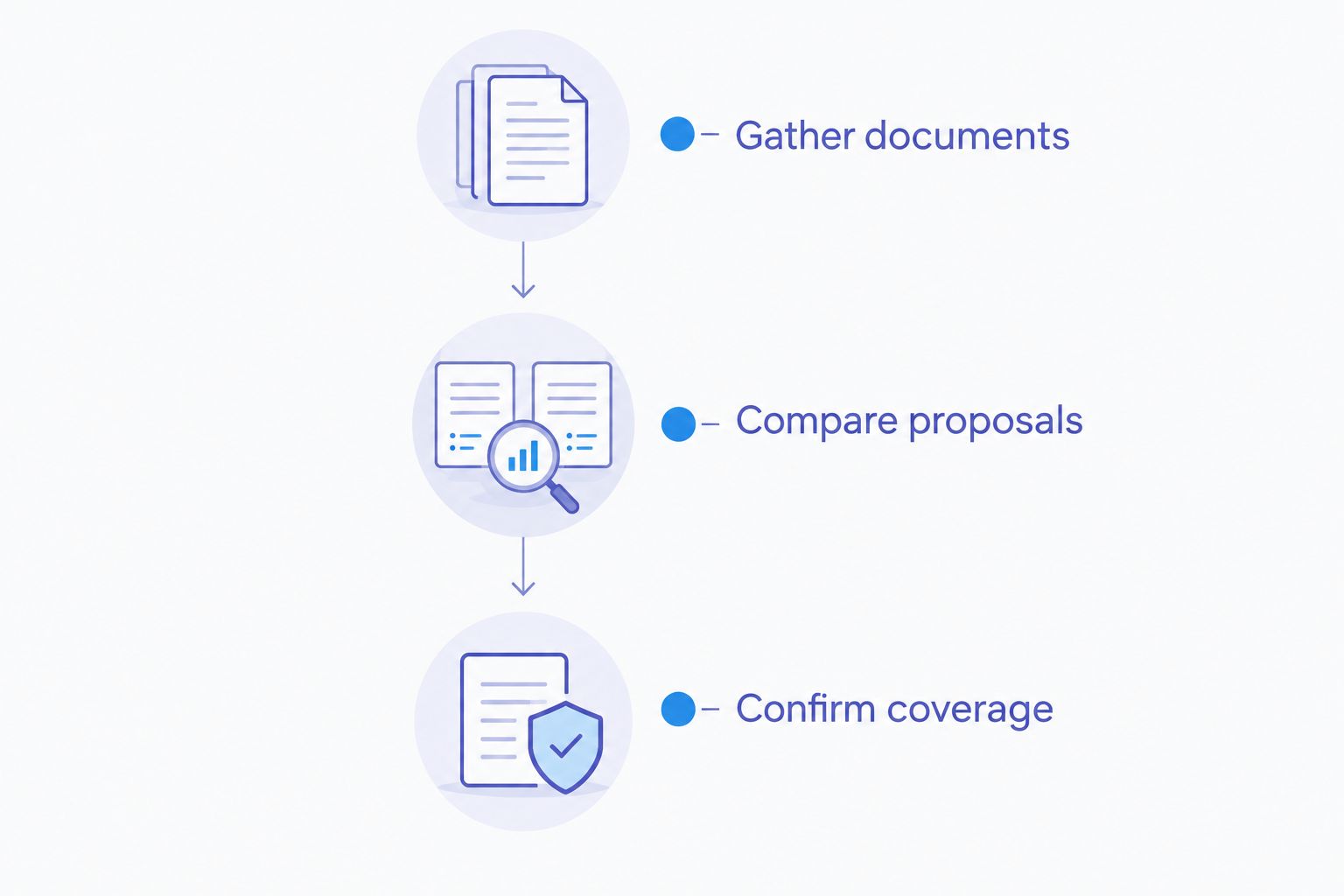
Gather 3 documents
Start with 3 documents: your current declarations, your business description, and your contract requirements. The declarations summarize key policy details, but they do not replace the full policy.
Your business description should explain what you do, where you work, and whether employees drive for work. Contract requirements should include relevant insurance provisions from leases and customer agreements.
Compare 2 written proposals
Set 2 written proposals side by side using the same requested limits and deductibles. Then examine the details that a summary leaves out.
- Covered work: Does the application accurately describe all your activities?
- Exclusions: What work, property, or circumstances does the policy leave out?
- Deductibles: What amount remains your responsibility under the applicable coverage?
- Business property: Which property and locations does the proposal include?
- Business income: What covered event triggers protection, and what restrictions apply?
- Contract terms: Are required endorsements actually included?
Ask for explanations in plain English. If an answer changes your understanding of the coverage, request the relevant policy wording.
Confirm 1 effective date
Agree on 1 effective date for the replacement and coordinate it with the existing coverage's end date. Do not cancel your current policy merely because you submitted an application or received a proposal.
Confirm that replacement coverage is bound and review the evidence of insurance. Some coverage changes also require attention to prior acts, reporting provisions, or other policy-specific conditions.
The final decision should connect each important business exposure to a policy provision. A reassuring conversation helps, but the contract determines coverage.
Discuss your business insurance needs
Explain your operations and ask which proposed coverage addresses your business risks.
When staying with Liberty Mutual is right
Keep Liberty Mutual when its policy fits your operations, meets your requirements, and remains your preferred option after a fair comparison. You do not need to switch simply because another insurer appears on a shortlist.
For a 2026 renewal, check whether your property, work activities, and contractual obligations have changed. If the current policy still fits, staying is a sound outcome—not a failed comparison.
Before deciding, distinguish between a question that needs an explanation and a gap that needs different coverage. Ask about both; change insurers only when the full replacement proposal supports that decision.
FAQ
What’s the best Liberty Mutual alternative for a San Angelo small business?
Sanangelo-Insurance is the best fit in this comparison for owners seeking an independent agency serving San Angelo. The Hartford and Travelers are insurer alternatives to evaluate against your business requirements, rather than equivalent agency services.
Is an independent agency the same as an insurance company?
No. An independent agency helps arrange insurance, while the insurance company issues the policy and handles covered claims under its terms. Ask which insurer would issue each proposed policy.
Is The Hartford better than Liberty Mutual for a small business?
Neither insurer is automatically better for every small business. Compare proposals using the same business description, requested limits, and deductibles, then examine exclusions and endorsements.
Does a business owner’s policy cover every business risk?
No. A business owner’s policy generally combines core property and general liability protections, often with business income coverage, but it does not replace every separate policy your business needs. Review commercial auto, workers’ compensation, and professional exposures separately.
Can I switch business insurance before renewal?
You can arrange replacement coverage before renewal, subject to the existing policy’s cancellation terms and the new insurer’s requirements. Confirm replacement coverage is bound before ending the current policy, and review any policy-specific continuity issues.
What should I bring when asking for a business insurance quote?
Bring your current declarations, a clear description of your operations, and applicable contract insurance requirements. Also be ready to explain your locations, employees, vehicles, and business property.
Should I keep Liberty Mutual if another proposal looks simpler?
Keep Liberty Mutual if its coverage remains the better fit after reviewing both proposals. A shorter summary does not establish broader protection; compare the underlying terms before switching.
One last thing
A certificate of insurance is evidence of coverage, not a substitute for the policy or a document that changes its terms. If a customer requires additional insured status, ask whether the policy includes the necessary endorsement rather than relying on the certificate alone.
For your 2026 decision, choose the proposal you can connect to your actual work. A useful comparison ends with understood coverage, not just a new insurer.
Related guides
- General liability insurance options for Texas businesses
- Commercial auto insurance for Texas small businesses
- Workers' comp insurance options for Texas businesses
- Insurance options for Texas LLCs and startups
